
 CleanLink Interactive Spring/Summer 2026 Issue
 Recognizing the 2026 Reader Choice Award Winners
 2026 Emerging Leader Award
 How Surfactant Use is Expanding in Commercial Cleaning
By Dr. James Kim, SVP, Science and Regulatory Affairs, American Cleaning Institute
Throughout the year, you'll often hear about some type of 'safety reminder' commemoration, such as Poison Prevention Week or National Safety Month. But the spotlight on safety, especially preventing accidental poisonings and chemical exposures, deserves attention far beyond a single week or month.
While most of the attention focuses on storing products safely in the home, for commercial cleaning operations, it is also a practical, year-round reminder to protect the people closest to the work: the frontline cleaning professional.
As the American Cleaning Institute has worked with various stakeholder groups to promote safe product use and storage, one message comes through clearly: protecting building occupants and protecting cleaning professionals go hand in hand. The men and women on the frontline–janitors, housekeepers, and environmental services teams–handle cleaning and disinfecting products every shift, often while students, patients, guests and employees move through the same hallways and rooms.
Occupied Spaces, Higher Risk
A simple habit can prevent a surprising number of incidents: putting products away immediately after use–every time. Many accidental exposures don’t happen during application; they happen in the ‘in-between moments’, when a bottle is left out during a task change, a cart is parked in a corridor, or work is interrupted by a call light, a guest request, or an urgent cleanup.
In hospitals, schools, hospitality, offices, airports, restaurants and other high-traffic settings, cleaning teams are expected to move quickly and work efficiently–often in full view of the public. This increases the importance of controlling access to products and tools, and of using procedures that are consistent across shifts, buildings, and contractors.
When storage and handling practices slip, the consequences are real and immediate: splashes to skin or eyes, respiratory irritation from vapors, accidental contact by a passerby, or a product mix-up that results in misuse. These are preventable events, and prevention starts with everyday behaviors supported by training, labeling, and supervision.
Unattended Carts: Lock It Up
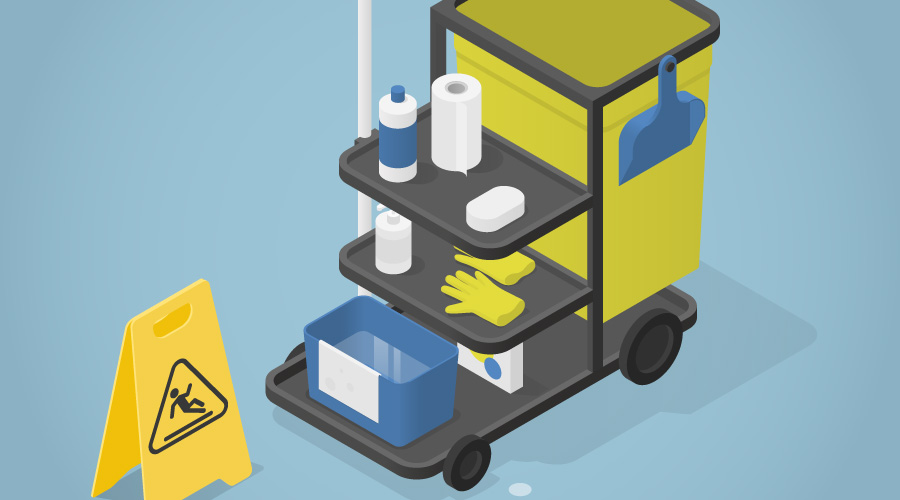
Consider a housekeeping cart left unattended with ready-to-use chemicals, open buckets, or soiled cloths visible and within reach. Even a short lapse can create an opportunity for unintended handling by a curious student, a patient with cognitive impairment, a visitor, or a well-meaning employee trying to “help.” The next cleaning professional who steps in may also be exposed to unknown products, unknown dilutions, or contaminated tools.
Stop Cross-Contamination
Safety is also about what’s on–and coming off–the cart. Used cloths draped over handles, uncovered containers of spent solution, and poor separation of clean versus soiled tools can increase hand contact with irritants and microbes that contribute to cross-contamination. In healthcare, education, and hospitality settings, where cleaning outcomes are closely tied to public health expectations, disciplined procedures protect both the workforce and the people they serve.
Chemical Safety Checklist
The good news is that reducing risk does not require complicated solutions. It requires the usual processes–clear procedures, good training, and consistent reinforcement–so the safest way becomes the easiest way. The practices below help commercial cleaning teams and their supervisors apply a simple message in a practical way: Put it away every time.
Control access when carts are unattended–even briefly. If a cart must leave your direct line of sight, close and secure chemical compartments, move it into a locked closet, or position it in a staff-only area. Where feasible, use carts with lockable doors or boxes for concentrates and ready-to-use products, and set a clear expectation for high-traffic spaces: do not leave chemicals and soiled items accessible.
Use only what you need, then return the rest to storage. Pull the amount needed for the task and put containers away immediately. This reduces clutter on carts and counters and limits what is accessible if you are interrupted by an urgent call, a spill, or an occupant request.
Keep products in original, properly labeled containers. Labels are a primary safety tool–they communicate hazards, precautions, first aid, and directions for use. Do not transfer chemicals into food or beverage containers, and do not remove or cover labels. If secondary containers, like spray bottles, are necessary for operations, label them according to your facility’s hazard communication program and do not leave them in public areas.
Close caps securely and store containers upright. Packaging features intended to reduce unintended access only work when containers are fully closed. Build a quick “cap-check” at the end of each task: wipe threads if needed, secure the cap, and return the container to its assigned place.
Separate clean and soiled materials to reduce exposure and cross-contamination. Use covered bins or bags for used cloths and mopheads, keep waste contained, and avoid storing soiled textiles on open shelves or cart handles. If you use a color-coding system, reinforce what each color means and audit carts to check that tools and textiles are in the correct place.
Never mix products and follow label directions for ventilation, contact time, and surfaces. Commercial operations may use multiple chemistries back-to-back, including disinfectants, descalers, and glass cleaners. Train teams to follow label directions and to avoid combinations that can produce hazardous vapors or damage surfaces.
Use dilution and dispensing controls to reduce overexposure and improve consistency. Over-concentrated solutions can increase irritation and inhalation hazards, while under-dosing can compromise cleaning outcomes. Where possible, use closed-loop dispensing, pre-measured portion packs, or calibrated dilution control stations – and document the process so it is repeatable across shifts and sites.
Match PPE and ventilation to the task every shift. Select gloves and other PPE appropriate for the product and the job, ensure ventilation where required, and reinforce handwashing after chemical use and after handling soiled materials. Simple habits–like keeping food and drink away from chemical areas and avoiding touching your face with gloved hands–reduce unintended exposures.
Reinforce training, oversight, and response readiness. Refresh chemical safety training routinely, especially for new hires and float staff. Supervisors can spot check carts for open containers, unlabeled bottles, and exposed soiled textiles. Ensure teams know what to do if an exposure occurs, including how to follow the label’s first-aid instructions and how to quickly reach Poison Help (1-800-222-1222) for expert guidance.
For frontline teams, these practices reduce the likelihood of skin and eye irritation, inhalation issues, and accidental splashes that can occur when products are handled in a hurry or stored inconsistently. They also reduce uncertainty and extra work when a worker encounters an unlabeled bottle or an unknown dilution on a cart.
For facility leaders, the same habits support compliance expectations, reduce incident risk, and protect service quality. And for occupants, they reinforce confidence–especially in schools, healthcare, and hospitality settings where people are understandably attentive to what is being used around them.
Plan for Occupied Cleaning
It also helps to plan for the realities of occupied cleaning. When feasible, schedule higher-risk tasks for lower-traffic times, use signage and temporary barriers where appropriate, and avoid staging multiple open containers in areas where customers, students, or patients may approach out of curiosity. In many facilities, a consistent standard–never leave a cart unattended and open–can do more to prevent incidents than any single piece of equipment.
If the unexpected does happen–an eye splash, a skin spill, or an occupant who may have handled a product–act quickly. Follow the product label’s first-aid instructions and your site’s exposure-response procedures and seek expert guidance when needed.
Whether in the home or across a busy commercial facility, preventing unnecessary exposures comes down to consistent habits. Put it away every time.
Dr. James Kim is SVP of Science & Regulatory Affairs at the American Cleaning Institute (ACI), where he helps advance the safe and responsible use of cleaning products and supports science-based policies and practices across the cleaning value chain.
posted on 5/7/2026
