
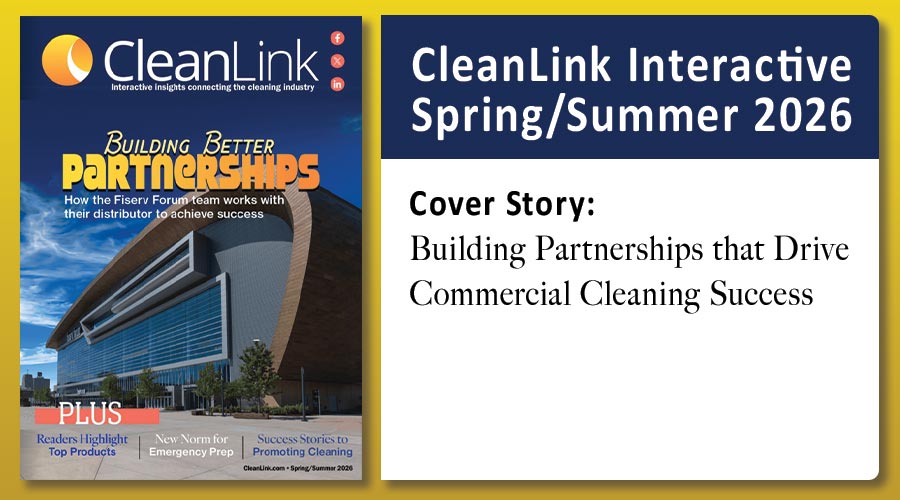
 CleanLink Interactive Spring/Summer 2026 Issue
 Recognizing the 2026 Reader Choice Award Winners
 2026 Emerging Leader Award
 How Surfactant Use is Expanding in Commercial Cleaning
By David Green
Across the cleaning industry—from hospitals and hotels to commercial offices, campuses, and large-scale facilities—one challenge continues to surface: How do we maintain consistent quality while managing labor pressures, rising costs, and evolving client expectations?
For decades, the traditional model has been straightforward. Frontline cleaners clean, and supervisors inspect. This layered approach was designed to ensure accountability and protect standards. But as operations scale and workforce dynamics shift, that structure is starting to show limitations.
A new approach is gaining traction: self-inspection models—also referred to as “operator-driven quality assurance” or “frontline validation systems.” In this model, cleaners are trained, equipped, and empowered to inspect their own work before turning over a space.
The question is no longer if this model can work—but how to implement it effectively without sacrificing quality.
Why the Traditional Inspection Model Is Under Pressure
The conventional inspection system relies heavily on supervisors or managers to validate cleanliness after the work is completed. While this provides a second set of eyes, it also introduces inefficiencies:
• Delays between cleaning and inspection
• Bottlenecks during peak service windows
• Over-reliance on a limited number of inspectors
• Missed opportunities for real-time correction
In large-scale environments—whether it’s a multi-tenant office building, a healthcare campus, or a full-service resort—this model often becomes reactive instead of proactive. Inspectors spend more time catching issues than preventing them.
The Case for Operator-Driven Quality
Self-inspection—or operator-driven quality assurance—flips the script. Instead of relying solely on a supervisor to catch defects, the cleaner becomes the first line of quality assurance.
When structured correctly, this approach delivers measurable benefits:
Real-Time Accountability: Cleaners validate their own work immediately, allowing for instant corrections before the space is released.
Increased Productivity: Reducing inspection bottlenecks allows for faster turnover and smoother workflows across all facility types.
Stronger Ownership Culture: When team members are trusted to validate their own work, pride and accountability increase. The role shifts from task completion to quality delivery.
Scalable Quality Systems: This model allows organizations to maintain consistency across large portfolios without significantly increasing supervisory layers.
Labor Optimization Opportunities: Rather than adding layers of inspection, organizations can optimize labor deployment—freeing leaders to focus on coaching, training, and performance improvement. In many cases, this approach contributes to meaningful cost efficiencies without compromising quality.
The Risk of “Self-Inspection Without Structure”
Here’s where many organizations miss the mark.
They introduce the concept—but fail to build the system around it. Without defined standards, training, and validation tools, self-inspection can quickly become self-assumption—and assumption is the enemy of quality.
Common pitfalls include:
• Inconsistent or unclear standards
• No measurable criteria for success
• Lack of structured checklists
• Limited leadership validation
• Insufficient training on identifying defects
The result is a false sense of confidence—and declining performance.
Building an Effective Self-Inspection Model
For this model to succeed, it must be structured, measurable, and supported by both process and technology.
1. Define Clear, Repeatable Standards: Cleaners must understand exactly what “clean” looks like—visually and functionally. Standards should be detailed, consistent, and easy to follow across all facility types.
2. Digitize Assignments and Validation: This is a critical evolution point. By digitizing work assignments and integrating check-off validation tools, organizations can ensure that each space is not only cleaned but confirmed as inspected. Digital platforms allow teams to:
• Timestamp completed work
• Capture self-inspection confirmations
• Track accountability by individual or team
• Create a verifiable record of performance
This level of visibility transforms self-inspection from a concept into a measurable, accountable system.
3. Implement Simple, Consistent Checklists: Checklists translate standards into action. Categories may include:
• High-touch surfaces
• Restrooms or sanitation areas
• Floors and edges
• Overall presentation and readiness
The goal is to keep them efficient but effective.
4. Train for Awareness, Not Just Tasks: Training should develop the cleaner’s ability to identify defects—not just complete steps. This includes multi-sensory inspection: sight, touch, and even odor awareness.
5. Maintain Leadership Validation: This model does not eliminate leadership—it elevates it. Supervisors transition from constant inspectors to strategic validators, conducting targeted audits to ensure standards are upheld, and trends are identified early.
6. Use Data to Drive Performance: Digital tracking and scoring create visibility. Over time, this data highlights opportunities for coaching, recognizes top performers, and reinforces accountability.
A Hybrid Approach: Practical and Proven
For many organizations, the most effective path forward is a hybrid model. A portion of the workforce operates under self-inspection while supervisors conduct targeted validations instead of inspecting every space. High-risk or high-visibility areas may receive additional oversight. This approach balances efficiency with control—delivering both quality and productivity.
Leadership: The Make-or-Break Factor
This shift is more than operational—it’s cultural.
Leaders must:
• Trust their teams while maintaining accountability
• Reinforce standards consistently
• Provide real-time coaching
• Recognize quality performance—not just speed
Most importantly, they must create an environment where quality is owned at the frontline, not just enforced from above.
A Shift Toward Ownership
So, can cleaners become their own quality inspectors? Yes—with the right system, structure, and support.
Whether you call it self-inspection, operator-driven quality, frontline validation, or decentralized quality assurance, the principle remains the same: move responsibility closer to the work.
In an industry where consistency defines success, the future belongs to organizations that shift from inspection-dependent models to ownership-driven cultures.
Because the goal isn’t just to clean. It’s to deliver consistent, measurable quality—every time.
David Green is the Founder and CEO of Rediscover Clean, a consulting and leadership development company focused on luxury hotel housekeeping, healthcare EVS, and operational performance improvement. With nearly 40 years of experience in hospitality and healthcare operations, David has led teams for organizations including Cleveland Clinic and The Ritz-Carlton Hotel Company.
David specializes in leadership development, workforce engagement, operational assessments, labor optimization, sustainability initiatives, and service excellence strategies for hospitals, hotels, and facility service organizations. Through Rediscover Clean and the Yer A Rockstar Leadership Academy, he works closely with frontline leaders and executive teams to create practical systems that improve quality, accountability, employee engagement, and operational consistency.
Known for his “Leading with Kindness is the New Cool” philosophy and his Kindness Metric Driven Leadership approach, David combines operational expertise with entertaining and engaging teaching methods designed specifically for frontline service industries. He is a frequent speaker on topics including leadership, employee engagement, cleaning for health, sustainability, and operational efficiency. David is also a contributing industry writer for Cleanlink as well as other publications and podcast host who enjoys blending leadership development with music, storytelling, and real-world operational experience.
Follow David on LinkedIn here.
posted on 5/13/2026
