
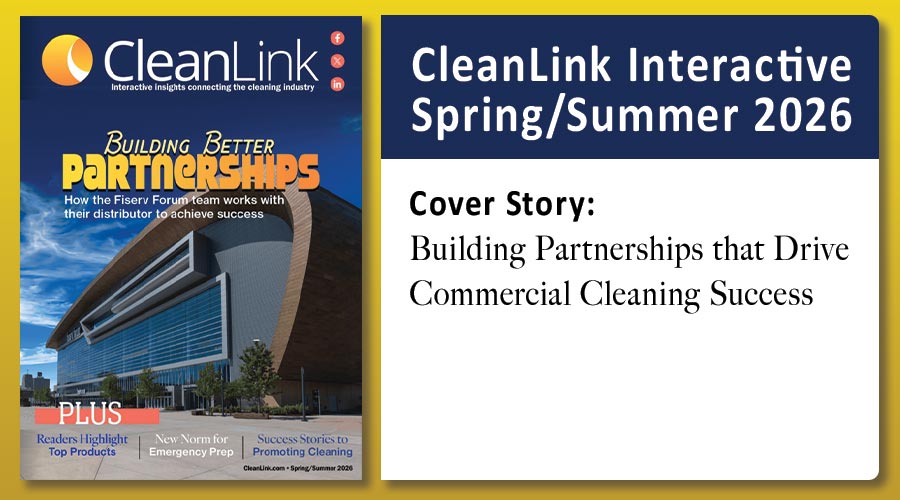
 CleanLink Interactive Spring/Summer 2026 Issue
 Recognizing the 2026 Reader Choice Award Winners
 2026 Emerging Leader Award
 How Surfactant Use is Expanding in Commercial Cleaning

By Shari Cedar, CEO & Co-Owner, AK Building Services
Growth is always a goal, but in the commercial cleaning industry, how you grow matters far more than how fast you grow.
In janitorial, growth is never just growth. It creates opportunities, increases revenue, expands your market presence, and opens doors for your team. But it also introduces strain, overextension, margin pressure, and—if you’re not careful—culture erosion. Growth is both a gift and a risk, and how you manage that balance will define the long-term success of your company.
Jan/San Growth is Different
Janitorial is not a typical business model. Members operate in a labor-dependent environment with thin margins, high client expectations, and a 24/7 service structure. Revenue is contract-driven, which means retention isn’t optional—it’s survival.
That changes the way growth should be approached. Every decision must be filtered through both operational and financial reality. You don’t have room for costly mistakes, and you can’t outgrow a weak foundation.
Foundation Matters More
Too many companies focus on top-line revenue without asking a more important question: “Is our business actually built to support this growth?”
Positioning a company for sustainable growth requires five core foundations: operational leadership, leadership depth, financial discipline, systems that drive consistency, and a culture that keeps teams aligned.
If one element is missing, growth will quickly expose it.
Lean vs. Under-Resourced
One of the biggest traps I see is companies confusing being “lean” with being under-resourced.
Lean is intentional. It means your workflows are optimized, your structure is clear, and your teams are operating at capacity by design.
Under-resourced is something else entirely. It means your team is stretched beyond what’s sustainable, issues are patched instead of solved, and you’re one lost contract or key teammate away from a breakdown.
The warning signs are always there before the crisis:
- Firefighting replaces planning
- Leaders are in the weeds daily
- Client complaints increase
- Strong people look drained
- High performers disengage
If you recognize more than a couple of these, you’re not operating lean; you’re operating at risk.
Lack of Leadership Breaks Companies
One of the most important lessons in scaling is this: supervision does not cost you margin—it protects it.
When companies delay investing in leadership to “save money,” they often end up paying far more in overtime, turnover, and lost contracts. The numbers don’t lie. Poor supervision leads to burnout, which leads to turnover, which leads to understaffing, and the cycle repeats.
The reality is simple: you need to invest before the crisis, not after.
Systems Before Headcount
Not every problem requires a new hire. In fact, one of the biggest mistakes companies make during growth is adding headcounts without fixing underlying inefficiencies.
Before you hire, ask yourself:
- Are your systems fully optimized?
- Are your routes efficient?
- Do you have documented Standard Operating Procedures (SOPs)?
- Are you using the right equipment?
Technology and systems can support growth. When used correctly, they create consistency, improve productivity, and support both your teams and your customers.
Culture: Carrying You or Breaking You
You can fix a broken process overnight, and you cannot fix a broken culture quickly.
During periods of growth, culture is often the first thing to slip and the hardest thing to rebuild. Training gets rushed, accountability becomes inconsistent, leadership visibility decreases, and standards start to erode.
The companies that scale successfully are the ones that stay aligned. They have clear key performance indicators (KPIs) at every level, defined ownership of outcomes, consistent field inspections, visible leadership, and ongoing training programs.
Aligned teams don’t just survive growth—they drive it.
Revenue vs. Real Value
At the end of the day, growth is not the same as value.
A valuable company isn’t defined by top-line revenue; it’s defined by margin stability, leadership depth, recurring contracts, documented systems, and operational predictability.
That’s what long-term partners, investors, and clients are actually looking for. And all of it ties back to the same thing: a strong, reinforced foundation.
Growth may be the goal. But in our industry, the true standard is growth that is sustainable, profitable, and built around people. Anything less isn’t success, it’s risk.
Shari Cedar is the CEO & Co-Owner of AK Building Services, an industry-leading, family-owned and operated commercial janitorial services provider in Florida, where she drives the company’s vision to redefine what clean means through innovation, leadership, and a people-first culture.
AK Building Services is proud to be GBAC-Certified (Global Biorisk Advisory Council), WBEC-Certified (Women’s Business Enterprise Council), and ISN-Certified, reflecting its commitment to safety, quality, and excellence. Learn more at www.akbuildingservices.com.
posted on 4/29/2026
