
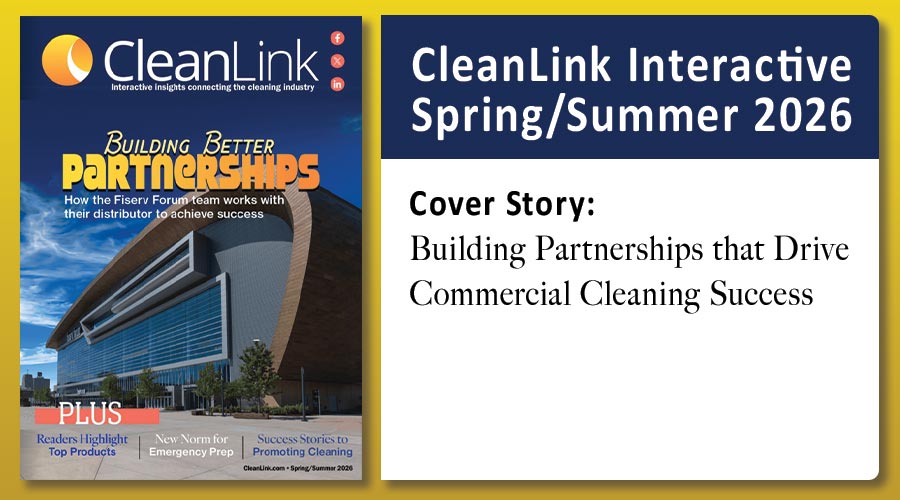
 CleanLink Interactive Spring/Summer 2026 Issue
 Recognizing the 2026 Reader Choice Award Winners
 2026 Emerging Leader Award
 How Surfactant Use is Expanding in Commercial Cleaning

By Donald Sipp
The cleaning industry has not lacked innovation. Autonomous equipment runs across floors. Sensors track traffic and consumables. Software platforms generate performance, inventory, and staffing data. Advanced disinfecting tools are widely available, and AI is starting to influence scheduling and decisions.
On paper, the tools are there. Yet many teams keep seeing the same issues: staffing gaps, inconsistent outcomes, and relentless labor pressure. In most cases, the limiting factor is not technology. It is the system around it, including standards, workflows, training, and follow-through.
Where Technology Is Being Applied
Cleaning operations are adopting multiple technology categories at once. Each adds real capability. Each also exposes the same underlying issue: tools improve pieces of the work, but workflows and expectations often stay the same.
Autonomous equipment now goes beyond basic floor care, scrubbing and vacuuming with consistent coverage and reducing manual burden.
But edges, fixtures, and high-touch surfaces still depend on manual execution. When workflows are not redesigned and staff are not deliberately redeployed to detailed work, quality becomes uneven. Automation improves what it touches, while the rest drifts.
A variety of technologies are being used by cleaning operations. However, the way these technologies are used can improve.
UV systems add an additional disinfection step in certain environments, such as healthcare, education, gyms, and high-traffic public areas, by inactivating microorganisms on exposed surfaces.
Their effectiveness depends on what happens before use. Surfaces must be properly cleaned, line-of-sight must be managed, and the process must be followed consistently. UV enhances disinfection. It does not compensate for inconsistent execution.
Advanced application systems (hydrogen peroxide and electrostatic methods) can distribute disinfectants more evenly and reach areas traditional methods miss.
Results still hinge on pre-cleaning, correct technique, and adherence to dwell times. Better coverage helps, but it cannot fix a process that varies from shift to shift. When disinfectants are used, teams also need clear labeling, safety data sheets, and training appropriate to the chemicals on site.
Sensors reveal how spaces are used, tracking foot traffic, monitoring consumables, and triggering alerts, so resources can be aligned with real demand. But in many operations, schedules remain fixed. Data is collected, yet priorities do not shift. High-use, high-risk areas are not consistently serviced differently than low-use areas.
Tracking does not confirm whether cleaning or disinfection was done correctly. Visibility improves; accountability for outcomes only follows when standards and validation are strong.
AI is starting to forecast staffing needs, adjust schedules, flag coverage gaps, and manage inventory. But AI does not correct inconsistent systems; it scales them. If workflows are not standardized, AI optimizes variability. If expectations are unclear, AI will not define them.
Digital inspection tools document task completion and produce reporting leaders can act on, but if validation focuses on appearance over thoroughness, or inspections vary by person and shift, documented quality will not equal improved outcomes.
Why Results are Poor
Across these technologies, the pattern is consistent: the tools are capable, but the operating system around them is not aligned. Technology is often expected to reduce labor without changing scope, improve quality without redefining standards, and create consistency without regulating execution. That is where the gap forms—technology improves part of the process while the rest remains unchanged. When workflows are compressed, the easiest-to-miss touchpoints, such as door handles, faucet levers, dispensers, switches, and shared equipment controls, are exactly where complaints, rework, and risk concentrate.
Closing the gap requires leaders to define and reinforce what “done” looks like, not just whether tasks were completed.
Before deployment, define the problem precisely—where results are inconsistent, where quality breaks down, and what outcome must improve. Without that clarity, tools get applied broadly and deliver limited impact.
When technology changes the work, workflows must change with it. Automate routine tasks, then deliberately reallocate time to the detail work technology cannot reach.
Use data to change decisions. For example, shift staffing based on demand, prioritize high-traffic and high-visibility areas, and surface repeat gaps early. If data does not influence action, it will not change results.
Technology improves consistency in repeatable tasks, but it does not replace attention to detail in variable environments. Leaders must protect time for touchpoints, restrooms, spill response, detail work, and meaningful inspection.
If expectations stay the same while available time shrinks, work gets compressed, and the hardest-to-see steps get cut. Leaders must align workload, time, and required execution so “checked off” does not replace “done all the way through.”
The next wave of innovation is already coming. Robotics will move beyond floors; systems will integrate with buildings, and AI will become more autonomous. The tools will improve. The core challenge will not. Cleaning falls short when work is not finished all the way through, shift after shift.
The difference is not how much technology is deployed. It’s whether the system around it is built to finish the job.
Donald Sipp, MBA, is an operations and performance improvement consultant with more than 25 years of experience across environmental services, facility operations, and healthcare systems. He serves as Senior Director with Ruch-Shockey Associates, Inc. and is the founder of Impact Training Company, where he focuses on improving execution, workforce performance, and operational reliability.
posted on 5/19/2026
