
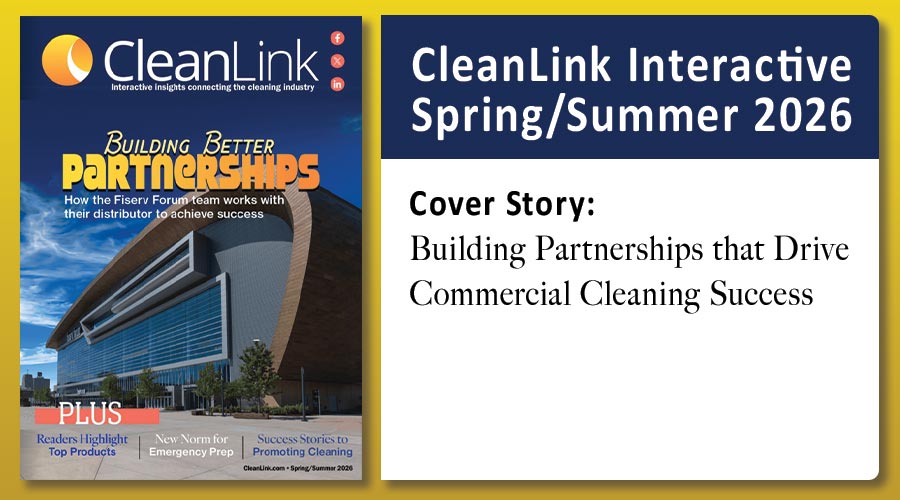
 CleanLink Interactive Spring/Summer 2026 Issue
 Recognizing the 2026 Reader Choice Award Winners
 2026 Emerging Leader Award
 How Surfactant Use is Expanding in Commercial Cleaning
Key Takeaways:
• Hotels can learn healthcare’s cleaning discipline.
• Hospitals can learn hospitality’s personal touch.
• Both are stronger when they learn from each other.
By David Green
The word hospitality is often defined as the friendly and generous reception and care of guests, visitors, or strangers. While we traditionally associate hospitality with hotels and restaurants, the concept reaches far beyond those industries. At its core, hospitality is about how people are welcomed, cared for, and made to feel during their experience.
For many years, healthcare organizations have increasingly worked to bring that same spirit of hospitality into the patient experience. Hospitals have recognized that clinical outcomes and patient safety are essential, but so is how patients and their families feel while receiving care. The environment, communication, service, cleanliness, and personal interactions all contribute to that experience.
At first glance, hotel housekeeping and hospital environmental services may appear to be very different operations. One prepares rooms for guests, while the other helps protect patients, visitors, and healthcare workers. However, after spending much of my career working in both luxury hotels and major healthcare systems, I have found that the two industries have more in common than many people realize.
Both are responsible for maintaining clean, safe, and welcoming environments. Both operate around the clock, experience staffing and productivity pressures, and depend on frontline employees whose work directly affects the people they serve. Most importantly, both industries have developed practices and strengths that the other can continue to learn from.
What Hotels Can Learn from Hospitals
Hospitals operate in an environment where cleaning is closely connected to safety and infection prevention. Because the stakes are so high, environmental services departments are expected to follow clearly defined procedures and demonstrate that those procedures are producing the intended results.
Hotels can benefit from adopting more of this disciplined approach.
One example is the use of standardized cleaning procedures. In a hospital, employees are trained to follow specific processes for cleaning patient rooms, disinfecting high-touch surfaces, handling isolation rooms, and preventing cross-contamination. The expectation is not simply that a room looks clean. The cleaning process must be performed correctly and consistently.
For hotels, the opportunity is not to turn guest room cleaning into a clinical process, but to bring greater consistency and intentionality to how critical areas are cleaned. Frequently touched surfaces—such as remote controls, light switches, door handles, faucets, and thermostats—can easily receive varying levels of attention when processes are not clearly defined. Well-written procedures, practical training, and routine observation can help ensure these important details are addressed consistently while still maintaining the efficiency and presentation standards expected in hospitality.
Hospitals also place greater emphasis on validation. Many healthcare environmental services programs use inspections, fluorescent-marking systems, ATP testing, quality audits, and infection-prevention data to evaluate cleaning effectiveness. Although every hotel may not need the same technology, housekeeping leaders should consider moving beyond relying exclusively on visual room inspections.
Appearance will always matter in a hotel, but appearance alone does not confirm that the correct cleaning process was followed. Hotels can strengthen their programs by identifying high-touch surfaces, monitoring cleaning compliance, reviewing recurring deficiencies, and using inspection results as coaching opportunities.
Another lesson is the importance of interdisciplinary collaboration. Environmental services leaders regularly work with infection prevention, nursing, facilities, safety, and clinical leadership. Hotel housekeeping departments can benefit from equally strong partnerships with engineering, front office, food and beverage, security, and human resources. Cleanliness is not solely a housekeeping responsibility. It is an organizational commitment requiring shared ownership.
What Hospitals Can Learn from Hotels
Hospitals have also recognized that creating an exceptional environment involves more than technical cleaning performance. Healthcare has made tremendous progress in incorporating hospitality principles into the patient experience, and there are additional lessons from luxury hospitality that can help continue that evolution—particularly around service, presentation, personalization, and the human experience.
Luxury hotels understand that cleanliness is both an operational outcome and an emotional experience. Guests notice how a room looks, feels, and smells. They notice whether employees acknowledge them, demonstrate care, and take ownership of concerns. These details shape the guest’s overall perception of the property.
Patients and families evaluate hospitals in much the same way.
A patient may not understand the hospital’s disinfection protocols, but they understand what they can see and experience. They notice dust on a windowsill, a stained floor, an overflowing waste container, or an employee who enters the room without introducing themselves. They also remember the environmental services employee who smiled, explained what they were doing, and asked whether anything else needed attention.
Hospital environmental services teams can continue building upon the hospitality practices many organizations have already introduced by focusing on anticipating needs and creating positive interactions. Employees should be trained not only in how to clean a room, but also in how to enter it, introduce themselves, communicate with the patient, protect privacy, and conclude the interaction professionally.
Hotels also understand the importance of presentation. In hospitality, a technically clean room can still fail inspection if it does not feel prepared for the arriving guest. Linens must be properly placed, supplies consistently arranged, and the overall room presentation must communicate care and readiness.
Hospitals can apply—and in many cases are already applying—this same attention to detail when preparing patient rooms. The opportunity is to continually refine these practices so that a clean room not only meets infection-prevention and operational standards but also appears organized, welcoming, and ready for the next patient. Consistent room setup can improve efficiency for clinical teams while helping patients and families feel more confident in the environment.
Recognition is another area where healthcare has made significant progress. Many hospital environmental services departments have developed creative ways to recognize employees, celebrate accomplishments, reinforce organizational values, and build stronger team engagement. Luxury hospitality offers another source of ideas for continuing those efforts, particularly by recognizing employees who create memorable experiences and meaningful personal connections.
Recognition in either industry should go beyond productivity numbers and attendance. It should celebrate compassion, teamwork, quality, safety, service, innovation, and employees who demonstrate the organization’s values through their everyday actions.
Best of Both
Perhaps the greatest opportunity is not for one industry to simply copy the other, but for both to continue learning from what the other does exceptionally well.
Healthcare environmental services has evolved significantly. Many hospitals today already incorporate strong service standards, employee recognition, patient-centered communication, technology, innovation, and creative engagement strategies alongside the rigorous cleaning and infection-prevention practices for which healthcare is known. At the same time, hospitality continues to strengthen its focus on cleaning science, consistency, safety, validation, and operational discipline.
The opportunity is to bring the strongest elements of both approaches together.
Imagine a hotel housekeeping department that approaches high-touch surface cleaning with the same consistency and validation used in healthcare while preserving the warmth and attention to detail expected in hospitality. Now imagine a hospital environmental services team that combines technically excellent cleaning and infection prevention with an exceptional level of personal connection, presentation, and service.
That combination produces something greater than a clean room. It creates an environment where people feel safe, cared for, welcomed, and respected.
Whether we call them guests, patients, visitors, or occupants, the people entering our facilities are placing their trust in us. Healthcare can continue to challenge hospitality to strengthen the science, consistency, and validation behind cleaning. Hospitality can continue to challenge healthcare to make that cleanliness—and the care behind it—visible, personal, and memorable.
Neither industry has all the answers. But both have decades of experience, innovation, and best practices worth sharing.
And both industries become stronger when they are willing to learn from each other.
David Green is the Founder and CEO of Rediscover Clean, a consulting and leadership development company focused on luxury hotel housekeeping, healthcare EVS, and operational performance improvement. With nearly 40 years of experience in hospitality and healthcare operations, David has led teams for organizations including Cleveland Clinic and The Ritz-Carlton Hotel Company.
David specializes in leadership development, workforce engagement, operational assessments, labor optimization, sustainability initiatives, and service excellence strategies for hospitals, hotels, and facility service organizations. Through Rediscover Clean and the Yer A Rockstar Leadership Academy, he works closely with frontline leaders and executive teams to create practical systems that improve quality, accountability, employee engagement, and operational consistency.
Known for his “Leading with Kindness is the New Cool” philosophy and his Kindness Metric Driven Leadership approach, David combines operational expertise with entertaining and engaging teaching methods designed specifically for frontline service industries. He is a frequent speaker on topics including leadership, employee engagement, cleaning for health, sustainability, and operational efficiency.
David is also a contributing industry writer for Cleanlink as well as other publications and podcast host who enjoys blending leadership development with music, storytelling, and real-world operational experience.
LinkedIn: www.linkedin.com/in/david-green-5b300426
posted on 9/29/2026
