
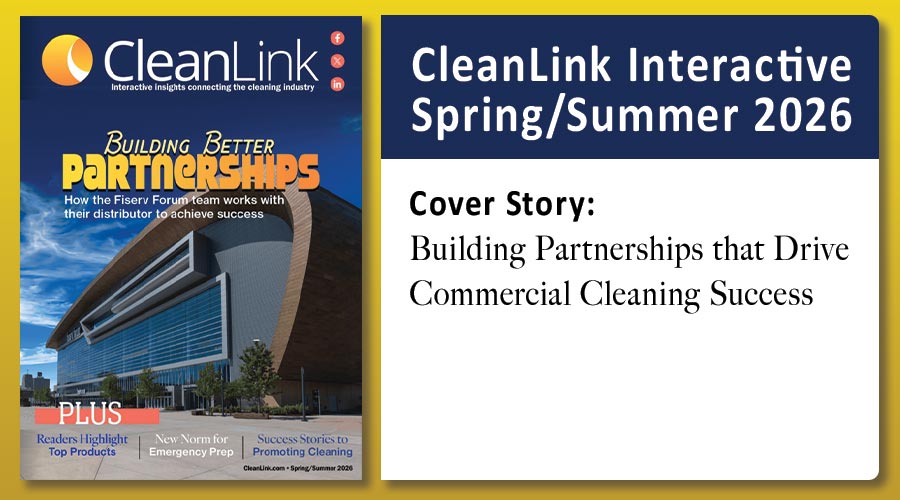
 CleanLink Interactive Spring/Summer 2026 Issue
 Recognizing the 2026 Reader Choice Award Winners
 2026 Emerging Leader Award
 How Surfactant Use is Expanding in Commercial Cleaning

Key Takeaways:
• The Best CRM for a commercial cleaning company is one that supports its sales process—not the one with the most features.
• CRM integration, automation, and AI should streamline workflows while strengthening customer relationships.
• Successful CRM adoption depends on implementation, training, and data quality—not software alone.
By Christian Morales
Commercial cleaning companies often fall into the new-tech trap when purchasing a custom relationship management (CRM) system. They get excited about a shiny new tool, are sold on its potential, but have no idea how all these fancy features will fit into daily business operations.
Every CRM promises better follow-up, forecasting, and improved growth—and software demos often make those promises seem easy to keep. However, once a CRM goes live, it rarely works out that way. Salespeople don’t log notes in the system; managers continue chasing cleaners for updates; and opportunities stall because the office team isn’t using the system to communicate with its cleaning team. Although the sales pipeline looks busy, no one really trusts it because they don't believe the CRM was integrated properly.
CRMs usually fail at commercial cleaning companies because the owner bought a system based on features rather than fit.
Commercial cleaning is not a simple sales transaction. It is a business-to-business (B2B) sales process with longer nurture cycles, multiple stakeholders, and shifting work requirements. Sales outreach can start with simple janitorial work for one office and evolve into multi-site service needs. The right CRM must track every step in that transformative process and alert the appropriate team members along the way. It must accurately reflect how a team sells and performs custodial work.
Aligning Systems with Processes
The most important question is not which CRM has the most features, but whether it aligns with how a cleaning company wins business.
Professional cleaning companies manage long sales cycles, repeat site visits, proposals, and contacts within the same organization. One account may involve a property manager, operations manager, office administrator, and finance contact—all of whom play roles in the buying process. Every opportunity is dynamic because each facility, budget, and service expectation differs.
CRMs need to reflect movement, nuance, and accountability. They should alert everyone on the team to the stage a deal is in, who is responsible for the next steps, what has already been done, and any issues that came up along the way. If a CRM is only storing names, phone numbers, and notes, it's not supporting the sales process and becomes a waste of money.
Rather than purchasing an expensive Rolodex to sort through surface-level information, a CRM needs to perform real work during the sales process. Cheap CRMs often fall into the trap of functioning like a phone book.
A small business with a short sales cycle might find this limited functionality useful, but it is not enough for a cleaning team that is actively building a pipeline and managing long-term business relationships. In fact, a CRM filled with noise is not helpful to anyone. Activities such as broad prospecting or cold emails must remain outside of a CRM until they lead to meaningful engagement.
Otherwise, it can become filled with useless contacts, leading to jan/san sales reps wasting time sorting through unqualified records, managers not knowing which deals are worth monitoring, and difficulties following up and forecasting future work.
The best approach is to separate cold outreach from qualified opportunities. While this type of contact exists, it should not be recorded in the CRM on day one. Not every prospect needs to be in a CRM system until the contact responds and engages in a real sales conversation. This will keep the data clean and credible.
Commercial cleaners sell to organizations, not individual consumers. This means an organization’s CRM needs more than contact storage—it needs the ability to understand and log a deal’s nuances.
Tracking Company Culture
A key difference between a weak and useful CRM is whether it recognizes that B2B sales occur at the company level, not the individual level.
Commercial cleaners rarely deal with one person in isolation. Instead, they work within a company account that has many layers. The complex structure of business is why CRM must do more than preserve context. A good CRM helps cleaning teams manage a living, changing account. Every deal and professional cleaning company is dynamic, and an effective CRM will make it easier to see those moving parts.
No software does everything well. One tool may be better for calling, another for proposals, and another for invoicing. Since no single tool can do everything, it is important that an organization’s CRM aligns with all the tools it uses.
Alex Radulovic, CEO of Purple Owl, says that a CRM with an Application Programming Interface (API) is a bare minimum requirement for any business.
“Any CRM you buy needs an API so other programs can communicate with it,” Radulovic shares. “A system without an API limits your cleaning company's ability to integrate with other systems.”
A cleaning company should expect its main CRM to integrate with the other systems it relies on, enabling useful automation across them. If the team has to re-enter information manually across multiple platforms, productivity slows, and errors multiply. If systems can share data, the entire operation becomes more efficient.
This is why an open system is so important. A company’s CRM should not lock its data. Instead, it should be able to retrieve information, connect to other tools, and build around workflows.
Radulovic notes that an open CRM is important not just for workflow but also if one decides to switch to a different CRM.
“Your CRM should be open because that is how you ensure the information you put in it can come back out,” Radulovic says. “A closed system can permanently lock your business into that CRM, risking the loss of all your data. An open CRM ensures you can move that data to your new system when you need to make a change.”
Human Interaction is Key
A CRM's ability to integrate with modern artificial intelligence (AI) tools has become a major sticking point for many business owners, including commercial cleaning companies.
AI and its capabilities can be an amazing tool for cleaning companies when used correctly. It can nudge team members toward action by assigning tasks and prompting them on follow-ups and next steps. But it needs to be applied to a CRM in practice.
Instead of jumping on the hype train, connect the CRM to a favorite AI model. Once applied, it can start asking better questions around an organization’s data. For example, a manager could ask AI to pull the last 100 customers their team called, summarize outreach activity, identify communication loop gaps, or find trends that would otherwise be found manually.
Automation is also an important aspect to consider. When commercial cleaning executives talk about CRM automation, they focus on tasks and reminders. Those are great use cases, but they are not the most strategic function of its automation features.
The more important question for a professional cleaning company is what happens when one stage of work ends and the next begins.
A strong CRM should be able to automate handoffs. For example, when a site visit is complete, the next owner should be notified or assigned automatically. When a proposal goes out, the CRM should schedule the next follow-up. The steps in the process should be automatically distributed to the next person instead of someone doing it manually.
That kind of workflow makes a company internally reliable. It prevents deals from stalling between departments and reduces the risk that someone will forget the next step. Automating handoffs creates accountability because the automation pushes the work forward for you. A well-built CRM keeps your entire team accountable.
Overall, AI and automation are tools to help employees improve customer-facing relationships. However, it should not replace employees. Human interaction remains king in commercial cleaning. Great client relationships are built on trust, responsiveness, and professionalism.
The value of real relationships is client retention and business growth. The value of AI and CRM integration is a reduction in behind-the-scenes friction, allowing the human side of the business to thrive.
Strategically Selecting a CRM
The best way to evaluate a CRM is to identify the biggest problems at a cleaning company. Where are opportunities being lost? What are customers complaining about? Which tasks are redundant or getting done inefficiently?
A CRM should be chosen based on the problems the business is facing and how that CRM can solve them.
Base features are similar across CRM platforms. What separates a bad CRM from a great one is whether its system can be configured to solve the organization’s specific operational problems. A CRM’s goal isn’t to spend money on new tools—it’s to find a specific set of tools that reduce recurring friction. A CRM with 1,000 features won’t work as efficiently as a CRM with 10 if those hundreds of features don’t help your company.
After all, buying a CRM is buying potential. A commercial cleaning executive can buy the perfect aligned system, but it will be a waste of money if it’s not set up correctly.
Cleaning companies make this mistake all the time. They buy the software, move everyone onto the platform, and declare victory. Yet, the team is never trained on the CRM or asked about it, and its poor implementation leads to low adoption among team members and poor data quality. Eventually, the team will blame the CRM the company invested in.
The failure is not the software; it is in the setup.
Before choosing a CRM, commercial cleaners should gather feedback from the team on what is not working. After choosing one concern, leadership should take the time to map out an integration process—defining stages, ownership, entry standards, automations, and follow-up expectations. This outline should also include training the team on adoption rules and explaining why those rules exist.
Finally, commercial cleaners should not overlook security when selecting a CRM.
A CRM holds valuable company and client information, making security essential, not optional. Two-factor authentication should be enabled, and passkeys used if available. Teams should take phishing risks seriously because a single compromised login can expose a significant amount of sensitive data.
Security is not an exciting aspect of CRMs, but it is part of responsible integration.
For commercial cleaning companies, the best CRM is rarely the one with the flashiest features. It is the one that matches the company’s needs and supports a process for improvement.
A CRM should not feel like a database the company must feed. It should feel like a system that helps the organization’s team work better, follow through more consistently, and grow with greater control. If it can’t do that, don’t buy it.
Christian Morales is the Owner of American Commercial Cleaning, a commercial cleaning company in Phoenix, Arizona.
posted on 7/22/2026
