
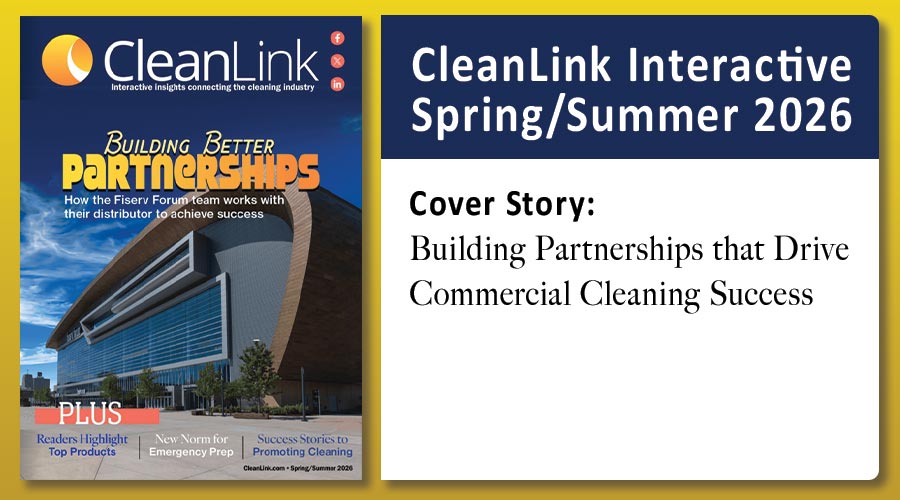
 CleanLink Interactive Spring/Summer 2026 Issue
 Recognizing the 2026 Reader Choice Award Winners
 2026 Emerging Leader Award
 How Surfactant Use is Expanding in Commercial Cleaning
This week marks National Cleaning Week, a celebration of commercial cleaning professionals investing in this important industry. This month, CleanLink solicited its audience to share their perspectives on how cleaning has evolved as a trade and in the public’s perception. The results highlight how cleaning transparency has transformed operations, and why public health remains the overall outcome.
Readers were asked the following questions with their accompanying responses:
1) How have client expectations for cleanliness changed in the past year?
Health—Cleaning emphasis shifted from perceptions of clean to proof of clean
Data-Driven—Increased requests for reports, cleaning schedules, and more
Sustainability—Greater demand for eco-friendly products and practices
Flexibility—Systems organized around fluctuating staff and occupancy levels
2) What’s the most overlooked area for commercial cleaning?
High-touch points
Indoor air quality
Shared electronics
Facility periphery
3) How have evolving health and safety regulations impacted operations?
Increased staff training
Higher operational costs
Greater technology adoption
Stricter compliance and documentation reporting
4) What message would you like the public to understand about professional cleaning?
Health is greater than aesthetics
Cleaning is a skilled trade and essential service
Cleaning services are an investment, not a cost
Cleaning improves buildings and occupant well-being
Cleaning Evidence Matters
Customers are no longer looking for signs; they want data proving that the environment is clean. About 38 percent of respondents believe client expectations have shifted to prioritize health and data-driven cleaning systems. Building service contractors (BSCs) surveyed report more feedback regarding cleaning for health, whereas in-house facility managers are tasked with reporting on cleaning procedures and schedules. Only 19 percent identified flexibility as a client's expectation, and just 6 percent indicated sustainability is key to customer satisfaction.
Critical Areas of Clean
Most survey participants (38 percent) have redirected their energies to improve indoor air quality (IAQ). Amid climate change disasters, including wildfires, and tumultuous nationwide events, such as the deployment of chemical irritants, commercial cleaning executives need to prioritize indoor environmental health and safety.
According to 31 percent of respondents, high-touch points are also a missed opportunity. As the U.S. has faced increased influenza and measles outbreaks, ensuring frequently touched surfaces are sanitized and disinfected remains critical for infection control.
Committing to Compliance
Evolving health and safety regulations have impacted how daily operations are carried out. More than half of CleanLink’s audience shared that these changes have resulted in stricter compliance and documentation reporting. To ensure frontline teams adhere to these new standards, 44 percent of respondents, all BSCs or in-house management, have invested in increased staff training.
Due to the fluctuating nature of these regulations, 31 percent of people share that rising operational costs and technology implementation are now integrated within daily duties.
Shifting Public Perception
When it comes to the public’s understanding of commercial cleaning, 38 percent want their clients to understand that these services are a lifelong investment. Cleaning products and services are solutions to everyday health and safety concerns, as 31 percent of respondents share, and they improve buildings and occupant well-being—making them greater than their price point.
A quarter of readers would like the public to shift their perceptions of the job itself and view cleaning as the public health service it is. Just 6 percent prefer acknowledgement that attaining a quality level of cleanliness is greater than the appearance of such.