
 CleanLink Interactive Spring/Summer 2026 Issue
 Recognizing the 2026 Reader Choice Award Winners
 2026 Emerging Leader Award
 How Surfactant Use is Expanding in Commercial Cleaning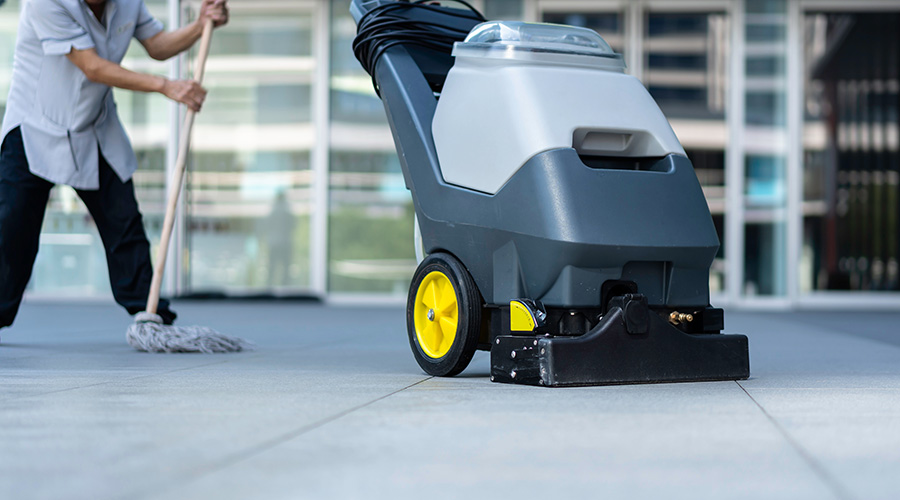
A new industry analysis on robotic floor care equipment shows how staffing pressures are influencing automation adoption.
Nassco, Inc., a New Berlin-based janitorial solutions and floor-care equipment provider, reviewed current and historical industry research to highlight the rapid growth of planned robotic floor care equipment integration. Utilizing data from the 2026 Building Service Contractor Market Study, conducted jointly by Contracting Profits and Building Service Contractor Association International (BSCAI), alongside 2019 AACEM/ISSA Autonomous Cleaning Survey results, Nassco identified the context for this industry shift.
The 2026 Building Service Contractor Market Study reports that around 32 percent of building service contractors (BSCs) plan to adopt robotic floor equipment within the next 12 months, roughly double the share reported in 2025. The study also found that 38.3 percent expect demand for automation or technology in cleaning contracts to increase, while 44.6 percent expect labor challenges, and 72.5 percent expect wage or salary demands to increase.
Those current findings were compared with the results of the 2019 Autonomous Cleaning Survey, which documented how cleaning contractors, in-house service providers, and facility cleaning managers evaluated autonomous equipment earlier in the technology's adoption cycle. Among respondents who had not yet adopted autonomous cleaning equipment and were evaluating it, labor savings was cited by 77 percent as a purchase influence, while roughly 70 percent expected payback within two years.
Pressures Double Demand
The 2026 BSC Market Study provides the current context missing from an analysis based only on the 2019 survey. Within the next 12 months, around 32 percent of BSCs say they plan to adopt robotic floor equipment, about twice the percentage reported in the 2025 study.
Overall, the broader technology picture points in the same direction. The study found that 38.3 percent of respondents expect demand for automation or technology in contracts to increase, while 37.4 percent expect adoption of technologies such as Internet of Things (IoT) or robotics to increase as cleaning expectations evolve.
Those figures don't establish how many facilities currently use autoscrubbers, nor do they show that every contractor intends to automate floor care. They do indicate that robotics has become a more prominent part of near-term planning. Yet, growing industry interest isn't enough of a foundation for facility leaders to decide and invest. The financial case still depends on repeatable floor work, equipment utilization, and whether frontline staff's time can be redirected productively.
The current study also gives context for why robotic equipment is gaining attention. Among respondents, 44.6 percent expect labor challenges to increase in 2026, and 72.5 percent anticipate wage or salary demands to rise. At the same time, 38.3 percent predict customer demand for automation and technology in contracts to increase.
These figures don't prove that labor pressure is causing contractors to buy robotic equipment. They show that automation decisions are being made in an environment where many commercial cleaning executives expect staffing and wage pressures to remain significant. That makes the older AACEM/ISSA findings useful for historical context. In 2019, among respondents who had not yet adopted autonomous cleaning equipment and were evaluating it, labor savings was cited by 77 percent as a purchasing influence.
For facilities, the potential benefit doesn't necessarily come from eliminating cleaning jobs. Autonomous floor-care equipment can take on repeatable routes while employees engage with higher-priority tasks—restrooms, detailed cleaning, inspections, and other cleaning demands that require direct attention. A useful evaluation starts with the workload: how many labor hours go to repetitive floor routes, and how much of that work could realistically be automated?
Cost Comparisons
Technology interest is increasing as operating costs are expected to rise. The 2026 BSC Market Study found that 69 percent of BSCs anticipate the overall cost of cleaning to increase, while 82.3 percent believe the cost of supplies and doing business will rise.
That makes return on investment (ROI) more important. A facility cleaning manager considering robotic floor-care equipment should weigh potential labor and productivity gains against acquisition cost, maintenance, training, service requirements, and utilization.
The 2019 AACEM/ISSA survey provides a historical benchmark. Among respondents who hadn't yet adopted autonomous cleaning equipment, 27 percent expected payback within 12 months, 23 percent within 13 to 18 months, and 20 percent within 19 to 24 months. Combined, roughly 70 percent of professional cleaning industry respondents expected recovery within two years.
Those figures exemplify expectations from 2019, not measurable 2026 returns. Equipment capabilities, pricing, labor costs, and facility requirements have changed. They shouldn't be used to promise that a current autonomous scrubber will recover its cost within 24 months. Instead, the takeaway from the technology trend is the framework: labor savings and payback were central questions in 2019, and the 2026 data shows why they remain relevant as robotic equipment plans and operating costs rise.
To access the rest of the Nassco, Inc. analysis, click here.