
 CleanLink Interactive Spring/Summer 2026 Issue
 Recognizing the 2026 Reader Choice Award Winners
 2026 Emerging Leader Award
 How Surfactant Use is Expanding in Commercial Cleaning
By Taylor Vraney
In an ever-evolving world, comfort may be found in foundational practices. However, reliance on past customs could prove ineffective when meeting current challenges and innovations in the commercial cleaning industry. To face the future, it is necessary to embrace change. After all, as Ben Walker, President of Walker Foundry, LLC., San Diego, says, "Once you introduce change, you have to stick to it, and you must see it through."
Walker, an avid proponent of team cleaning, insists that effective education will create actionable outcomes by increasing staff morale, stabilizing overall occupant health, and securing profits. Team cleaning is an operational, standardized process that, according to Walker, results in an estimated 25 to 30 percent improved efficiency. In the current climate—where budgets face increasing scrutiny—a critical question that arises is how to improve the consistency and efficacy of cleaning processes across facilities. Team cleaning could be the answer.
"With clear roles, synchronized routes, and consistent training, the team moves through a facility with purpose and awareness," Walker says. "The result is a safer environment built not on enforcement or luck, but on design—where safety is the outcome of an intelligent system, not an added rule."
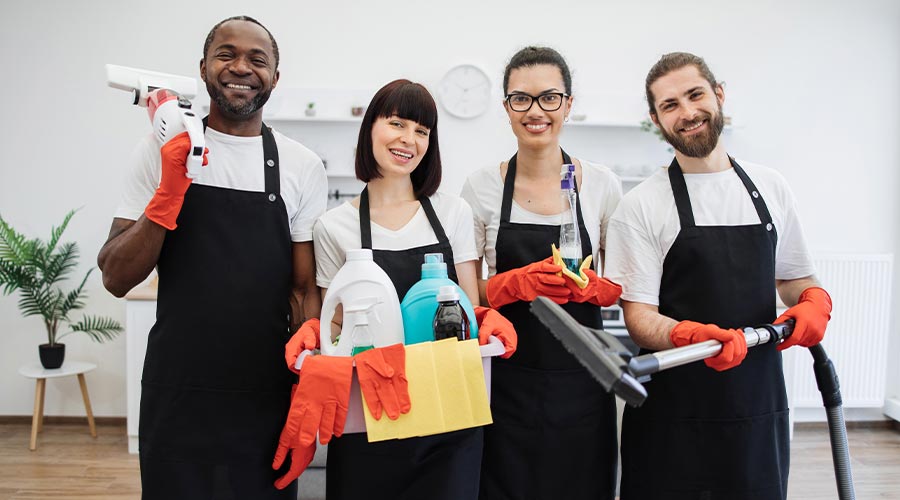
Team cleaning is an inclusive system that affords every frontline cleaner the opportunity to act as a specialist rather than a generalist. Divided into four roles, each member has outlined tasks that serve to fulfill their function. Additionally, the advent of new technology and products has supported everyone to execute their role in a way that reduces the number of products needed, promotes health and safety for the building and its occupants, and improves the efficiency and effectiveness of the entire cleaning operation.
Each specialist has responsibilities that are clearly defined and supported by specific products:
Light Duty Specialist: Leading the charge, this collection expert focuses on surfaces above the floor. Necessary tools to support this role include aprons, all-purpose cleaners, ergonomic grabbers, and a dusting tool.
Vacuum Specialist: Next, the vacuum specialist covers floor surfaces. A backpack vacuum is recommended for this task. It is an essential tool that improves cleaning efficiency in a reduced amount of time, thereby increasing work productivity and efficacy.
Restroom Specialist: This role prioritizes cleaning and disinfecting all restrooms. A restroom specialist requires a solid cleaning cart—complete with red-coded tools, dual-sided buckets, microfiber flat mops, and a germicidal disinfectant cleaning chemical.
Utility Specialist: The utility specialist's tasks are differentiated based on the needs of a building. They complete custom tasks that are facility driven; therefore, required tools can range from autoscrubbers to big tilt trucks.
Apart from the provision of clearly defined job cards and prioritized products, the most important component to successfully implement team cleaning is a comprehensive educational program that emphasizes communication and training. Positive case studies of team cleaning implementation are reliant on frequent communication about the plan and proposed outcomes, the provision of opportunities to take volunteers and feedback, and an application of a trial run to a section rather than the whole of an operation. The resulting impacts of successful team cleaning programming are reduced costs and improved outcomes for all stakeholders.
“People thrive in systems,” Walker says. “It’s all worth it in the end because what you’re going to be doing is creating a better system for people, a better overall cleaning product.”
Competing Systems
Despite the innumerable benefits to the team cleaning approach, there remains a reliance on old systems. Often juxtaposed as a counterstrategy, zone cleaning is a method that relies upon the worker as an individual to specialize in cleaning an area, versus specializing in an individual cleaning task.
While zone cleaning had its merits, it operates on preferred habits rather than strategically defined systems, which can lead to inconsistent cleaning outcomes across a facility. For the manager, Walker comments that zone cleaning makes it difficult to evaluate progress and promote staff safety. Moreover, it can lead to low morale, overload, and subsequent burnout for staff.
Why then is there a reliance on a method that is less effective when compared to its natural successor? Walker suggests it all comes down to change.
“Resistance to change is definitely something that you want to keep in mind, and it’s something you want to communicate the benefits of frequently, firmly, and often,” he says.
Along with communication, an equally important opportunity to encourage change is instruction. Since the pandemic, Walker has found that the need for education has become essential. Through the provision of teaching and training, all stakeholders will be able to perform sanitary and maintenance operations with accuracy, efficiency, and adaptability. The flexibility of team cleaning allows its application across diverse building settings, meaning any facility can achieve safe and clean environments at lower costs. For it to be successful across a range of building types, the roles of team cleaning should be adjusted to meet the specified needs of that facility.
Navigating forward, team cleaning is not only attainable but also indispensable. According to Walker, there are multiple, large-scale organizations that transitioned to team cleaning and subsequently improved their cleaning operations. Notable characteristics of these successes were persistence in the implementation of the programming, as well as the delivery and maintenance of impactful, educational training, and continuous communication.
When proposing to make this shift, Walker recommends looking at benchmark exemplars that align with the overall facility. To start, cleaning managers should design a plan that is geared toward workloading, safety, and standards of appearance levels. Then comes the challenge of convincing current staff to embrace the novelty of a new procedure. The key when introducing any new system is to inform and involve.
“Zone cleaning doesn’t recognize interconnectedness; it doesn’t recognize the building as a whole,” Walker says.
Instead, team cleaning aids in bridging the gaps between managers and staff by embedding communication into the system, as well as ensuring employees have effective training. Together, productive programming based off benchmarks and the integration of educational curricula and communication will support workers in delivering sustained levels of clean through team cleaning.
Taylor Vraney is an Assistant Editor for CleanLink.com, Facility Cleaning Decisions, Contracting Profits, and Sanitary Maintenance.
posted on 12/16/2025
