
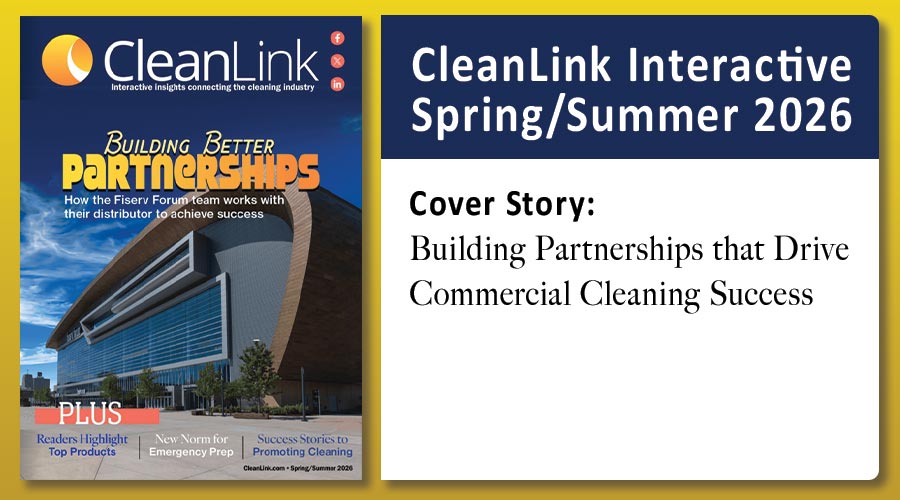
 CleanLink Interactive Spring/Summer 2026 Issue
 Recognizing the 2026 Reader Choice Award Winners
 2026 Emerging Leader Award
 How Surfactant Use is Expanding in Commercial Cleaning
By Keith Schneringer
The COVID-19 pandemic fundamentally changed how cleaning and disinfection are perceived. What was once viewed as a behind-the-scenes operational necessity became a visible, mission-critical component of building safety. While emergency protocols have eased, the expectation for healthier indoor environments has not.
For building service contractors (BSCs) and facility managers, the challenge, and quite frankly the opportunity, that lies ahead is to be able to apply the lessons learned from COVID-19 to broader infection prevention strategies that can be implemented every day to protect building occupants from the wide range of pathogens being introduced into their spaces.
Infection prevention today is not just about reacting to the next outbreak. It is about implementing consistent, science-based cleaning and disinfection protocols that reduce risk from common viruses, bacteria, and fungi every day. Proper product selection, correct usage, and disciplined and repeatable procedures separate routine cleaning from true infection prevention.
Understanding Infection Risk
Pathogens such as influenza, norovirus, MRSA, E. coli, and RSV continue to pose significant risks in commercial buildings, healthcare settings, schools, and other public facilities. These germs spread through contact with contaminated surfaces, respiratory droplets, and poor hand hygiene. High-touch surfaces such as door handles, elevator buttons, restroom fixtures, shared equipment, and breakroom surfaces remain primary transmission points in the chain of infection.
BSCs are uniquely positioned to interrupt this chain of transmission. However, doing so requires moving beyond appearance-based cleaning and toward outcome-based protocols designed to reduce microbial load. In other words, moving from “cleaning for appearance” to “cleaning for health.”
Cleaning vs. Disinfecting
One of the most persistent misconceptions in infection prevention is that cleaning and disinfecting are interchangeable. They are not. Cleaning removes soil, organic matter, and debris from surfaces. This step is essential because organic matter can shield microorganisms and reduce the effectiveness of disinfectants.
Disinfecting uses chemical agents to kill or inactivate microorganisms on surfaces after they have been cleaned.
Skipping or rushing the cleaning step undermines the disinfecting process. For BSCs, reinforcing this distinction through training and documentation is essential to achieving consistent results and managing client expectations.
Product selection plays a central role in effective infection prevention. Not all disinfectants are created equal, and using the wrong product, or even using the right product incorrectly, can compromise safety and compliance.
Disinfectants should be EPA-registered and selected based on the pathogens most relevant to the facility. For example, a product effective against influenza and norovirus may be more appropriate for schools or office buildings than one designed solely for emerging pathogens or more stubborn pathogens like C.diff.
Every disinfectant requires a specific amount of time to remain wet on a surface to achieve its kill claims. Shorter dwell times can improve compliance in fast-paced environments, but only if staff are trained to apply sufficient product.
Harsh disinfectants can damage floors, finishes, electronics, and touchscreens. Using surface-appropriate products extends asset life while maintaining infection prevention standards.
Overuse or misuse of disinfectants increases chemical exposure risks for both occupants and cleaning staff. Selecting products with safer active ingredients and clear usage instructions supports long-term sustainability.
Even the best products fail without proper application. Infection prevention depends on consistency of application, not intensity. Lessons learned from the pandemic teach us to focus on consistent, focused, and measured use of disinfectants on high-touch surfaces as opposed to general mass application of disinfectants throughout a facility and on all surfaces.
Best Practices
- Standardized Dilution and Dispensing
Manual dilution errors are common and can render disinfectants ineffective or unsafe. Closed-loop dispensing systems ensure accurate concentrations and help to protect workers from chemical exposure. - Adequate Wetting of Surfaces
“Spray and wipe” practices that immediately dry surfaces do not allow disinfectants to work as intended. Staff must be trained to apply enough disinfectant product to maintain wetness for the full contact time. - Clean Tools
Contaminated cloths, mops, and pads spread pathogens rather than remove them. Color-coding, frequent laundering, and microfiber programs help prevent cross-contamination between spaces. Remember, you can’t produce a clean surface with dirty tools. - Sequencing and Workflow Control
Cleaning from low-risk to high-risk areas, and from clean to dirty surfaces, minimizes pathogen spread. Restrooms, breakrooms, and healthcare-adjacent areas require dedicated tools and protocols.
Training
Protocols are only effective when frontline staff understand not just what to do, but why they are doing it. Infection prevention training should go beyond product labels and focus on real-world applications.
Effective training programs emphasize:
- The difference between cleaning, sanitizing, and disinfecting
- Pathogen transmission basics
- Correct product usage and dwell times
- PPE requirements and chemical safety
- Documentation and quality assurance
Ongoing training—and not just one-time onboarding—is essential, especially as products, regulations, and facility needs evolve.
Precision Over Excess
During COVID-19, many facilities adopted aggressive, whole-building disinfection practices. Today, smarter infection prevention focuses on frequency and targeting rather than blanket application.
High-touch surface disinfecting programs should:
- Identify the most frequently contacted surfaces.
- Increase cleaning and disinfection frequency in those zones.
- Use products compatible with repeated application.
- Adjust schedules based on occupancy and risk level.
This targeted approach improves outcomes while controlling labor and chemical costs.
Documentation and Transparency
Clients increasingly expect evidence that infection prevention protocols are being followed. BSCs that can document their processes gain trust and differentiate themselves in an ever-competitive market.
Useful documentation include:
- Written infection prevention plans
- Product safety data and EPA registrations
- Cleaning logs and checklists
- Training records
- Quality assurance inspections
Transparency turns cleaning from a commodity service into a risk-management partnership and helps to turn BSC’s from vendors to be managed into partners to be trusted.
Coexisting
A common misconception is that effective infection prevention requires excessive chemical use. In reality, smarter protocols often reduce overall product consumption.
Strategies that support both safety and sustainability include:
- Using the least aggressive product that meets pathogen requirements.
- Applying disinfectants only where and when needed.
- Choosing concentrates and closed-loop systems to reduce packaging waste.
- Maintaining surfaces properly to reduce the need for harsh chemicals.
A BSC’s Role
Infection prevention beyond COVID-19 represents a shift in how cleaning services are valued. BSCs are no longer just maintaining appearance—they are actively supporting occupant health, business continuity, and organizational resilience.
By implementing disciplined protocols, selecting appropriate cleaners and disinfectants, teaming up with distribution partners, training staff effectively, and communicating transparently with clients, BSCs can help to lead this evolution. The result is safer buildings, stronger client relationships, and a more professional, future-ready cleaning industry.
Infection prevention is not a temporary response to a crisis. It is now becoming a permanent standard of care and building service contractors and their distribution partners are on the front lines of delivering this new standard of care every day.
Keith Schneringer has been in the sanitary supply industry since 1990 and is currently the Senior Director of Marketing Jan/San + Sustainability for BradyPLUS, a specialized distributor and solution provider in facility care, foodservice, and industrial packaging. In his current role, Keith is responsible for marketing to the jan/san and facility care industry, for developing vertical-market-specific programs to better assist customers, and for leading the company's sustainability initiatives. Before assuming his current responsibilities, he worked as an account consultant, sales manager, marketing manager, and director of channel marketing + sustainability for WAXIE Sanitary Supply.
posted on 2/17/2026
