
 CleanLink Interactive Spring/Summer 2026 Issue
 Recognizing the 2026 Reader Choice Award Winners
 2026 Emerging Leader Award
 How Surfactant Use is Expanding in Commercial Cleaning
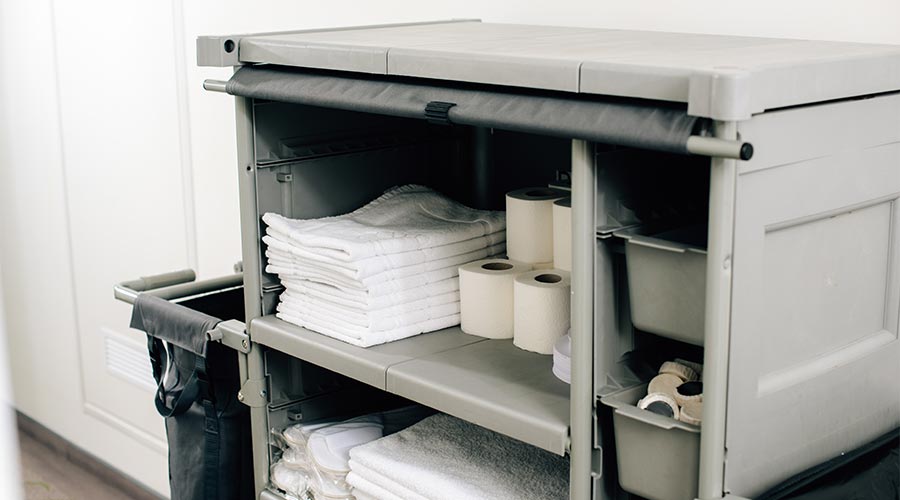
The cleaning cart is one of the most vital, visible, and potentially efficient tools in a cleaner's armory, yet they are often overlooked or neglected. A well-stocked cleaning cart drives productivity and efficiency, allowing frontline workers to focus on their tasks rather than desperately searching for equipment. Unfortunately, carts are often disorganized, congested, or even hazardous, which can be indicative of the state of the overall operation.
Ben Walker, President, Walker Foundry, LLC., San Diego, says carts are one of the first things he looks at when consulting an organization.
“The carts tell you everything about what’s going on in the operation,” he says. “If there’s more than three or four chemicals, multiple pieces of equipment, or it’s overflowing with rags, it’s probably overloaded and not optimized. It’s hard on the worker and portrays a poor image on the department.”
Cleaning carts in this state present a number of issues. Having too many products, like chemicals and equipment, can lead to confusion and irritating overflow. A cart that is overstuffed and unbalanced can easily tip over, creating more work for staff who have to pick up any dropped material or even clean up a spillage.
Another major concern is the presence of personal items. Things like car keys, phones, and especially water bottles and food are highly problematic. Aside from taking up valuable space, they can be considered hazardous. Consumables should not be anywhere near cleaning products, whether they’re clean or dirty. According to Walker, it is not uncommon for cleaning workers to mistakenly grab a bottle of chemicals thinking it’s a personal water bottle.
A disorganized cart is likely losing organizations money, too. When workers must continuously return to the closet to stock up or replenish their carts, it cuts into time that should be dedicated to cleaning. It also means they may not be completing all their tasks by the end of their shift. All that extra labor and unnecessary movement adds up over time.
“Studies have shown that going back and forth to the closet results in wasted motion and it can really burn up a lot of the productive time for cleaning,” says Walker.
Standardization and Systems
So, what does an optimized, productive, and efficient cleaning cart look like? The answer is founded on a single principle: standardization. Carts, based on function, should look identical across an operation. That way, cleaners can grab any cart at the start of the day and know they will have the proper supplies in their proper places, negating the need for continuous trips to the closet.
Walker believes the task of getting and keeping a cart in order is distinctly split between supervisors and staff.
“The supervisor's job is making sure everything is logistically sound before the shift starts every day,” he says. “And by the end of the shift, the worker's responsibility is to execute tasks in the field that the supervisor has prepared them for.”
To properly stock carts, supervisors must understand what the daily cleaning tasks are and what the corresponding kit looks like. Crucially, they must also identify the function of individual pieces of equipment and chemicals. While one can seek out checklists for carts, managers should be able to organize and stock them based on existing knowledge of their operation and supplies. This allows them to make brief visual inspections of carts at the beginning and end of shifts.
While managers should take charge of standardizing carts, communication with staff is key. Walker recommends doing a process inspection once a week to once a month with the entire crew to go through all the products on the cart and ensure they know how each is used. In addition to reinforcing what’s in the training program, these check-ins prevent items from home from creeping on to carts.
During these inspections, staff can also offer insights into what products haven’t been used much and those that need to be stocked more often. For instance, a quick fix is removing anything that hasn’t been used in a week. Providing such an outlet allows cleaners to have some input on carts without the pressure and responsibility of stocking it themselves.
Another benefit of standardization is a reduction in interpersonal conflict. When staff start to feel ownership over carts, Walker describes, problems may arise.
“It's when someone says: ‘I used that cart last week and I had it cleaned. You messed it up, but I'm going to make it even messier for you,’” he says. “When you standardize the carts, the ownership of my cart versus your cart goes away and it becomes everyone's tool rather than an individual's.”
Cleaning carts may not get replaced often, but it’s important to keep them updated and clean. Walker encourages quality over quantity when shopping for carts. In the last 10 years, carts have evolved to be modular and task-specific, and while they may be more expensive, they are worth the investment. Investing in products communicates an investment in the team as well, boosting morale and encouraging a team mindset.
But it isn’t enough to just establish standardization; operations must maintain them. Walker warns of devolving back into homeostasis. This can happen when organizations don’t have continuous improvement or if supervisors don’t have good direction and guidance.
He reminds such organizations of their past progress, asking them to compare it with their current state.
“It's kind of like therapy,” Walker explains. “People don't know that they have issues, or that they have things that they need to work through, or don't realize how much they have to work through until you put a mirror up in front of them.”
Ultimately, standardized carts make for productive, happy operations. Walker says setting up these systems of organizations can be life changing.
“When it’s chaos, it affects everything else that they do. It affects their livelihood. It affects their life at home,” he says. “One of the most rewarding things about the work is once you make something simpler for somebody and give them a chance to succeed, then they start succeeding.”
Elisa Miller is an Assistant Editor for CleanLink.com, Facility Cleaning Decisions, Contracting Profits, and Sanitary Maintenance.
posted on 12/2/2025
