
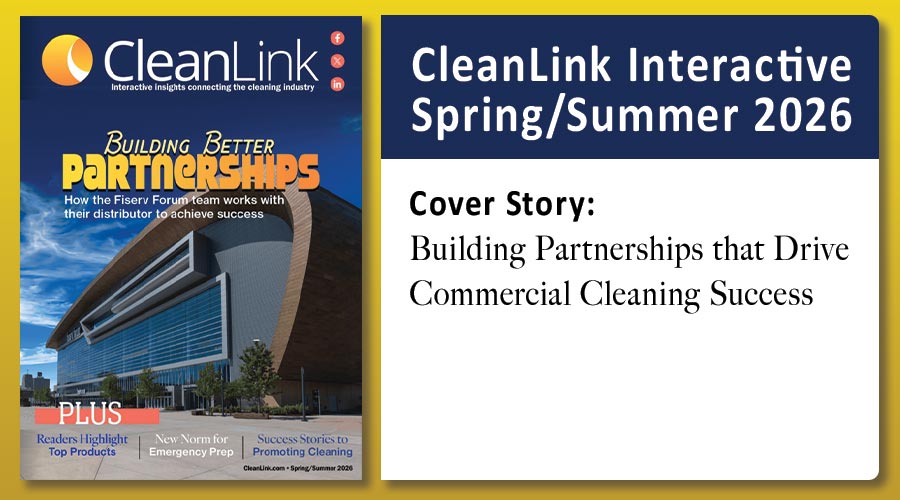
 CleanLink Interactive Spring/Summer 2026 Issue
 Recognizing the 2026 Reader Choice Award Winners
 2026 Emerging Leader Award
 How Surfactant Use is Expanding in Commercial Cleaning

Dale Franke
When we talk about trends in the commercial cleaning industry, the biggest story right now is steady growth and market expansion. Janitorial and commercial cleaning services in the U.S. are approaching a $100 billion market, driven by a heightened awareness of cleanliness in commercial office space, healthcare facilities, schools, restaurants, and other shared spaces.
Cleanliness today goes far beyond appearances. From heightened sanitary expectations to technology-driven operations, today’s trends reflect a new reality. Cleaning is no longer a behind-the-scenes function. It is an expected occupant experience, and one that directly impacts trust, comfort, and operational performance.
This shift is especially evident in high-traffic and high-risk environments. Healthcare is a great example. Over the past decade, we have seen rapid expansion not only in hospital systems but of urgent and express care centers, skilled nursing facilities, and outpatient clinics. Each new space brings an increased need for high-quality hygiene. Add to that, the increased demand in education, retail, restaurants, and public-sector facilities, and it’s clear why professional cleaning services are more essential than ever.
Other Pressures
Labor remains one of the cleaning industry’s biggest challenges. As a result, more organizations are outsourcing cleaning services rather than managing in-house teams. For many, it’s a cost-effective and operationally simpler approach, eliminating or minimizing the need to manage in-house cleaning crews and dealing with persistent labor shortages and wage increases.
Premium and specialized cleaning services are also on the rise. What was once considered “extra” is now standard. High-touch surface disinfection, for example, is now the norm, not the exception. Areas that were once overlooked, like door handles, dispenser levers, elevator buttons, and shared workspaces, are now expected points of disinfection focus. Sanitary expectations have changed, and facilities need to respond accordingly.
The Solutions
One of the most impactful trends today is the adoption of technology and digital operations. Cleaning is becoming increasingly data-driven, giving facility leaders better visibility and accountability.
Today, many spaces use check-in/check-out systems, QR codes, or barcode scanning to verify service completion. These “proof of clean” tools help reassure occupants while giving building owners confirmation services are being delivered as promised.
Data-driven feedback systems also allow occupants to report issues in real time. Airports have widely integrated feedback tools into cleaning processes, allowing restroom occupants to report issues like empty paper towel dispensers or cleanliness concerns instantly. Those alerts feed into dashboards that direct staff exactly where attention is needed, eliminating guesswork, accelerating response time, and improving user satisfaction.
On the product side, eco-friendly and green cleaning solutions are now the standard. Today’s formulations are more biodegradable, non-toxic, and plant-based, replacing the harsh chemicals of the past while still delivering effective results.
Highly concentrated products and dilution control systems are also making a major impact on cleaning best practices. These systems are engineered to work with the water flow, taking the guesswork out of product dilution, ensuring products are used consistently and safely, while also eliminating waste and controlling costs.
Also great tools, robotics and smart equipment are no longer ideas of the future; they are making their way into all types of facilities, especially in large spaces. Autonomous scrubbers and vacuums allow crews to cover more ground efficiently, supplementing human labor rather than replacing it—a critical factor among ongoing workforce challenges.
Smart dispensers, sensor-driven trash bins, and IoT-enabled restroom systems eliminate waste and improve sanitation. These smart systems connect directly to dashboards and mobile apps, alerting teams when supplies run low or maintenance is needed. Having real-time visibility improves operations across the board.
Looking Ahead
While cleaning has always mattered, today it is more visible, more measurable, and more connected to how people feel about the spaces they use every day. The integration of building and facility management systems that work and talk together makes operations more efficient and effective. As we move into 2026, product formulations will keep evolving and improving, technology will continue to drive operational efficiency, and robotics and AI-enabled smart cleaning systems will become more accessible through leasing and trade-in programs, allowing facilities to stay current without a massive capital investment.
Operational efficiency is a driving force in the cleaning industry, and facilities will continue to implement integrated cleaning systems that combine products, equipment, and data with essential human expertise and awareness to deliver clean spaces people trust.
Dale Franke is the Vice President of Sales and Marketing at Acme Paper and Supply Company,?one of the nation's largest suppliers of sanitation solutions, disposable food service packaging, restaurant equipment and supply, retail and industrial packaging, and custom-designed packaging. Franke has nearly 30 years of experience in the facility supply industry and more than 10 years of experience in sales leadership. He can be reached directly at?dfranke@acmepaper.com. For more information visit?https://store.acmepaper.com/. ?
posted on 1/2/2026
