
 CleanLink Interactive Spring/Summer 2026 Issue
 Recognizing the 2026 Reader Choice Award Winners
 2026 Emerging Leader Award
 How Surfactant Use is Expanding in Commercial Cleaning
By Lauren Belskie
When it comes to janitorial equipment, one size definitely doesn’t fit all. Choosing the right size isn't just about fitting through a doorway; it's about cleaning efficiency, labor savings, safety, and getting the most out of your investment.
Imagine a community center that has recently undergone a major expansion. What started as a small space—with classrooms, a gym, and offices—has now grown to include a large event hall, a full-sized basketball court, a cafeteria, and additional restrooms.
Now, the community center must clean both small, intricate areas—like restrooms and offices—as well as large open spaces—like the gym and event hall. Additionally, increased foot traffic demands more frequent cleaning. Budget constraints and storage limitations can add further obstacles.
With more space comes new cleaning challenges and a greater demand for efficient cleaning. The right janitorial equipment lineup can make all the difference in maintaining a sanitary, safe, and welcoming environment for the community. But with so many options available, how does one determine what’s best for a facility?
Bigger isn’t always better, yet neither is staying small when a facility’s square footage (or expectations) say otherwise.
The Right Fit
Choosing suitable janitorial equipment is crucial. Let’s break down when to go big and when to go small. Here are six things to consider when selecting your next piece of janitorial equipment:
- Assess the Facility Layout
- Examine Cleaning Capacity
- Consider Portability
- Identify Ease of Use
- Review Storage Requirements
- Determine ROI
Assess the Facility Layout
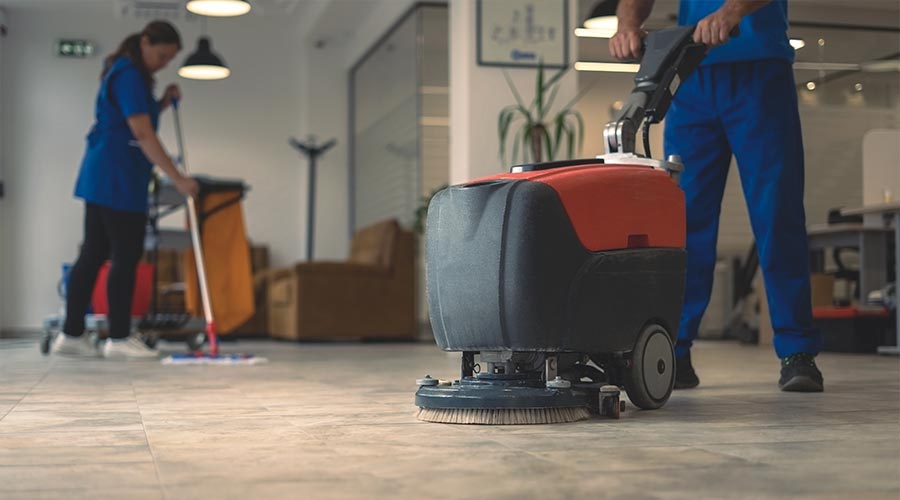
Appraise a facility’s size and layout. Large, open buildings may benefit from ride-on scrubbers or wide-area vacuums, while smaller facilities with tighter spaces can stick to compact walk-behind machines or manual tools. Equipment for one area may not be the best fit for another.
Examine Cleaning Capacity
Consider the cleaning capacity and path of a potential machine. Large equipment covers more ground in less time with its wider cleaning path and handles bigger messes with ease.
On the other hand, small equipment is great for spot cleaning and detail work. For large areas with many obstacles, a smaller piece of equipment is optimal for maneuverability.
Consider Portability
Small equipment is lightweight and easy to transport—perfect for navigating between rooms and tight spaces. Large equipment is less portable but ideal for cleaning expansive areas quickly and efficiently.
Identify Ease of Use
Smaller machines are often plug-and-play with minimal training required, while larger machines may require more instruction but can significantly reduce manual effort and improve cleaning efficiency over time.
Review Storage Requirements
Don’t forget to review your facility’s available storage space. Compact scrubbers and vacuums can fit into small janitorial closets, while ride-on scrubbers and industrial sweepers require larger storage areas with proper charging stations—especially if they’re battery-operated.
Determine ROI
Consider the potential return on investment, both in the short term and long term.
Smaller equipment has a lower purchase price, making it accessible for limited budgets. Large equipment, while more expensive initially, offers long-term time and cost savings through cleaning efficiency and labor reduction.
After going through that exercise, it may feel like both big and small equipment is the right fit for the facility. For most, this is true.
Best of Both Worlds
Today, the most successful cleaning programs aren’t choosing between big and small; they’re strategically combining both. Hybrid equipment programs maximize coverage, agility, and efficiency.
For example, a facility might have this equipment line up:
- A ride-on autoscrubber for main hallways
- A compact 14–20 inch scrubber for restrooms and tight areas
- Cordless equipment for high-frequency cleaning
- Wide-area vacuums plus backpack vacuums for varied open and congested spaces
Choosing equipment that is either too small or too large can lead to significant drawbacks, so understanding the specific needs of your facility—including its size, layout, and cleaning demands—is crucial in making an informed equipment decision.
Smaller machines, while highly portable and easy to store, may struggle with larger cleaning tasks, leading to longer cleaning times and reduced efficiency. Larger machines, which are capable of covering vast areas quickly, can be difficult to maneuver in tight spaces and require additional storage.
Leveraging both is key. Determine what size is needed to be most efficient and effective in an area.
Lauren Belskie is a major contributor and the primary editor for the Imperial Dade Learning Center, a platform designed to answer common questions, provide insights on trends and offer creative solutions to help businesses create safer, healthier and cleaner facilities. She is the Marketing Operations Manager at Imperial Dade, producing articles, videos, trainings, and other educational content targeted to the janitorial services market.
posted on 12/26/2025
