
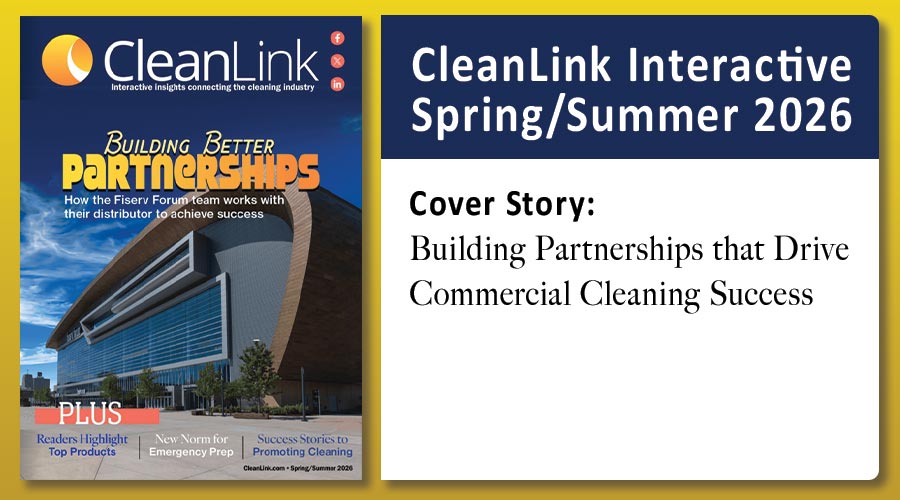
 CleanLink Interactive Spring/Summer 2026 Issue
 Recognizing the 2026 Reader Choice Award Winners
 2026 Emerging Leader Award
 How Surfactant Use is Expanding in Commercial Cleaning

Key Takeaways:
• Grow commercial cleaning consumable sales by positioning tools and equipment as solutions—not add-ons.
• Jan/san sales reps should quantify the operational costs of preventative maintenance.
• Strengthen distribution growth with e-commerce, IoT readiness, and consultative sales support.
Consumables sales are undeniably important. Sanitary Maintenance’s End User Purchasing Trends Survey found that BSCs and in-house facility cleaning managers already plan to buy plenty of batteries, brushes, chemicals, and floor pads. Exactly how distributor salespeople should approach those conversations is an interesting discussion. One way is to think of selling as a solution to a customer’s problem, rather than dealing with a product. That means not being afraid to attempt a $500 consumables sale after recently selling the same customer a $100,000 machine.
“That’s the wrong mindset,” insists Reilly. “It’s a relatively low dollar amount compared to what they just invested. If you come back in a few weeks, you’re starting at zero again."
Because of this, the point of sale is the ideal time to talk about consumables.
“We should mention the consumables during the needs assessment or initial product presentation without overwhelming the buyer,” says Niffenegger.
How does one avoid overwhelming the buyer? Never pitch more than two complementary consumables at a time.
What’s good for consumables sales isn’t practical for all deals. The sales mindset shifts for preventative maintenance packages because the salesperson is asking the customer to invest in the present, which benefits the future.
“Before trying to sell a preventative maintenance package, ask the customer what would happen and what it would cost if their machine wasn’t functioning at an optimum level or went down entirely in six months,” encourages Reilly. “That gets them thinking about the future.”
The idea of being future focused goes beyond sales. While belts and brushes don’t dramatically change over the years, the machines they connect to and the way customers buy them will. The Internet of Things (IoT) and the rise of e-commerce are big, 500-pound technological gorillas that successful distributors must address.
The interest is already there. That same survey on end user trends found over half of respondents plan to buy products that leverage IoT technology over the next year. Dale Franke, Vice President of Sales, Acme Paper & Supply Co., Inc., has some advice for salespeople on that call.
“Customers love the idea of connected products and equipment, but IT departments have other ideas,” he says. “They see it as another way a threat can get into the business. That concern has been slowing adoption.”
The cost of IoT technology also holds back some customers. All that extra technology doesn’t come cheap, and that price may be an instant nonstarter for some end users. But that doesn’t mean the opportunity has passed.
“It’s not a consumable, but I consulted with a lighting manufacturer that was trying to win a bid for an airport expansion,” shares Ogilvie. “Their IoT-enabled technology was too expensive for airport operators. But individual airlines that used the terminal were very interested in that lighting’s ability to track available wheelchairs. That knowledge lets them operate more efficiently. That’s what sold the product."
Where and how customers purchase consumables is changing, too, with 42 percent of end user survey respondents reporting they purchase at least half of their products via their distributor’s website. This trend emphasizes the importance of a digital marketplace.
“Distributors without an e-commerce purchasing platform risk losing market share, customer loyalty, and operational efficiency as younger, digitally native buyers demand instant self-service access, real-time inventory, and automated ordering,” Niffeneger says. He also notes that not having an e-commerce platform will disadvantage distributors in artificial intelligence (AI) searches because those procurement tools favor machine-readable digital catalogs.
There are ways to balance online customer autonomy with a salesperson’s need to stay connected. Niffenegger offers key strategies, including non-intrusive chat options, automated follow-ups, and helpful content—guides, comparison charts, or FAQ sheets—instead of sales pitches.
But, in the end, nothing will replace the sales call.
“Remember, your best customers are your competitors’ best prospects,” says Reilly. “If you fail to have those relationship-building opportunities, you may be opening the door for your competition.”
Plus, customers really want to speak with jan/san sales reps. They don’t want to buy everything online and prefer avoiding auto shipping. And that’s a good thing. Particularly considering how much choice is available online.
“Ordering via a website can be overwhelming. There is just so much information out there, and everyone is suspicious,” says Ogilvie. “People need an expert in their network. Someone to take this off their plate.”
Reilly offers a final piece of advice to salespeople: “Ninety-five percent of top-performing salespeople plan every sales call,” he says. “They have questions ready in advance and a few ideas on what to present. They anticipate resistance and have strategies ready to counter it. They know what they want from their customer and have a plan on how to get it.”
Amy Milshtein is a freelancer based in Portland, Oregon. She is a frequent contributor to Sanitary Maintenance.
How to Gain Recurring Revenue Through Consumable Sales