
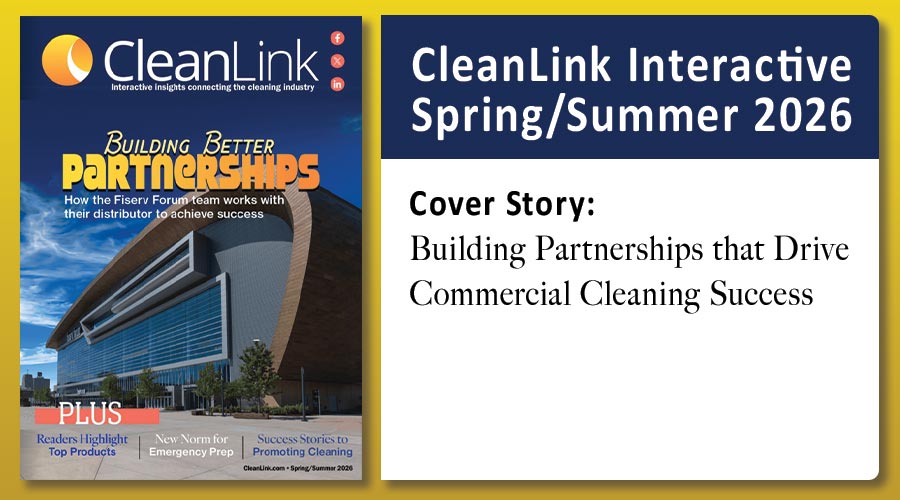
 CleanLink Interactive Spring/Summer 2026 Issue
 Recognizing the 2026 Reader Choice Award Winners
 2026 Emerging Leader Award
 How Surfactant Use is Expanding in Commercial Cleaning

Key Takeaways:
• Consumables and aftermarket services drive recurring revenue, strong margins, and customer retention.
• Sales calls for replenishment are valuable opportunities to uncover needs and strengthen relationships.
• E-commerce should make reordering easy, while salespeople remain essential as trusted advisors.
Closing a sale on a five-figure piece of equipment is great. But for successful jan/san distributors, that’s just the beginning. It’s what happens beyond the deal that consistently helps the bottom line. Equipment consumables, like floor pads, brushes, chemicals, and even non-tangible “consumables,” like training and preventative maintenance programs, keep revenue flowing long after that initial purchase.
Consumable sales offer benefits beyond profits, too. Every replaced hose and squeegee gives a sales team an opportunity to connect with customers. Highly successful salespeople use these touchpoints to deepen relationships and position themselves as experts and problem solvers.
But does this approach still make sense in the age of click-and-ship e-commerce? Sanitary Maintenance spoke to sales leaders and consultants to determine the best approach to consumable sales in 2026 and beyond.
Why Consumables are King
Consumable sales remain critical to a jan/san distributor’s bottom line, according to Paul Niffenegger, Consultant to the education, healthcare, and building service contractor (BSC) communities. That’s because these purchases often generate a large portion of a company’s profits.
“Because the initial product (hardware) is often sold at lower-to-mid margins to acquire customers, distributors rely on high-margin, recurring consumable sales to drive long-term profitability and customer lock-in,” Niffenegger explains. He also points to the value of machines that use proprietary consumables as they can create a recurring revenue stream.
Niffenegger estimates that because of their high gross margins—much higher than for durable goods—aftermarket services and supplies make up less than a third of some distributors’ revenues but drive over 50 percent of profits. He likens this to the razor and blades model, a business strategy that relies on selling the primary product (the razor) at a cheaper price, understanding that greater profits will come from the continuous sale of the consumable product (the blade) at a higher margin.
This famous sale strategy makes sense, but there is more to consider when applying it to jan/san equipment consumables.
“The reality is using an outside sales professional, who makes between $80,000 and $100,000 a year, is the most expensive way for an organization to accept and process an order,” says Paul Reilly, President of Tom Reilly Training and author of Value-Added Selling.
However, there is intrinsic value in the encounter itself. The call is one more opportunity to have a conversation with the customer. It’s during that extra conversation that a good salesperson can ask leading questions, like “What are you working on?” or “What big project is coming up?” The answers to these questions can reveal new, grander opportunities for sales or services.
Dr. Jessica Ogilvie, Associate Professor of Marketing and Executive Director at the Center for Professional Selling at Marquette University, sees other advantages to the consumable sales call.
“Re-ordering supplies takes effort and causes mental stress and strain. All of the choices out there can be overwhelming,” she says. “A good salesperson takes that worry and risk off their customers’ plates. A sales call like this positions the salesperson as an expert. It helps build a partnership."
Consumable sales can also expand beyond floor equipment to provide a unique look into how end users are cleaning throughout the facility—and offer insight to correct mistakes. Using proprietary touchless dispensing technology paired with a cloud-based inventory system that tracks usage is one example.
“I regularly track the usage of a disinfectant in a specific location in a school or office building,” Niffenegger shares. His knowledge of how many restrooms, sinks, fixtures, and high-touch surfaces exist in that space allows him to estimate how much product should be used. He then compares that number to how much product is actually used.
“Rarely would I find they overused the product, but more often I saw how dramatically underused the product was,” he says. “This means those surfaces are not properly sanitized, leading to consequences. A follow-up meeting with the management team turns this into a great training opportunity and increases our consumable sales.”
When Jan/San Distributors Should Sell Consumables