
 CleanLink Interactive Spring/Summer 2026 Issue
 Recognizing the 2026 Reader Choice Award Winners
 2026 Emerging Leader Award
 How Surfactant Use is Expanding in Commercial Cleaning
There is a reason why most cleaning professionals look down when evaluating the cleanliness of a facility. Whether it is a prime walking thoroughfare in a large commercial office or retail space, or a more compact hallway in a school or hospital, clean floors play an oversized role in the impression a visitor or building occupant will have of the overall cleanliness of a facility.
While distributors can agree there is typically a keen focus on the cleanliness and appearance of the floors their customers work on, they can also question whether those customers are devoting enough attention to the safety of floors. This is challenged by hazards that lead to slips, trips, and falls.
To help end users focus on health and safety, distributors should help clients develop floor safety programs that consider site-specific risks.
For example, slip-and-fall accidents are a leading cause of injuries in workplaces and public facilities. It is estimated that slips and falls result in over 1 million emergency room visits annually. Distributors should educate clients on how to institute safety programs that reduce the risk of these incidents.
Injuries related to floor hazards often result in workers’ compensation claims, lawsuits, insurance premium increases, and reputational damage—all risks that can be mitigated by a good safety program. Distributors can also help customers understand how unsafe floor conditions violate regulations outlined by the Department of Labor’s Occupational Safety and Health Administration or local building codes, as well as techniques that aid in compliance. That’s why a strong floor care program that incorporates safety is great insurance to protect against these risks.
Accidents cause downtime, not just for the injured workers but also for the entire workflow. An incident in a key area—such as a hospital entrance, production floor, or school cafeteria—can disrupt operations and require costly emergency cleaning or repairs. Floor safety education should include tips on how to reduce the likelihood of these disruptions occurring.
Aspects of Safety Plans
Cleaning professionals are on the frontlines of floor safety. Their daily routines, equipment choices, chemical usage, and response protocols significantly influence how safe all floor surfaces are in a facility. That’s why the floor safety plans jan/san distributors help customers create must include certain details.
For example, regular inspection and ongoing maintenance of floors allows cleaning professionals the opportunity to identify potential safety hazards early. Inspections should include looking for worn-out mats, wet or greasy spots, cracked tiles, or uneven thresholds.
Visual inspections are essential, but routine floor cleaning and safety protocols aren't only about appearances; end users should also be educated on preventive maintenance that helps mitigate floor safety hazards.
Routine maintenance and inspections must start from the top. Distributors should work with the management team to commit to an ongoing training program. Cleaning staff should be trained in the proper use of cleaning chemicals, the impact of pH levels on floor coatings, using the right equipment and pads for the floor type, and recognizing conditions that increase slip risks, such as humidity, snow, and rain.
Distributors can educate customers on how to properly execute these strategies. For example, distributors should demonstrate how to use the right cleaning agents and methods. This involves matching the agent to the floor type—neutral pH cleaners should be used on vinyl or linoleum, and degreasers should be administered to industrial floors. Customers should also be trained to apply the correct amount of the appropriate chemical to a floor.
Proper training programs should also include the use of equipment. For example, autoscrubbers or microfiber mops are important to consider. These tools can reduce water usage and improve drying times.
Entryway matting systems are another great tool. Help customers identify high-quality mats they can place at entrances to trap dirt and moisture before it’s tracked further into the facility. Encourage them to use scraper mats outside, wiper mats inside, and transition mats in high-traffic areas.
Training end users on the proper maintenance of these entryway matting systems is also essential. Provide an outline on how and when to clean the mats so that they remain effective and free from curling or movement hazards.
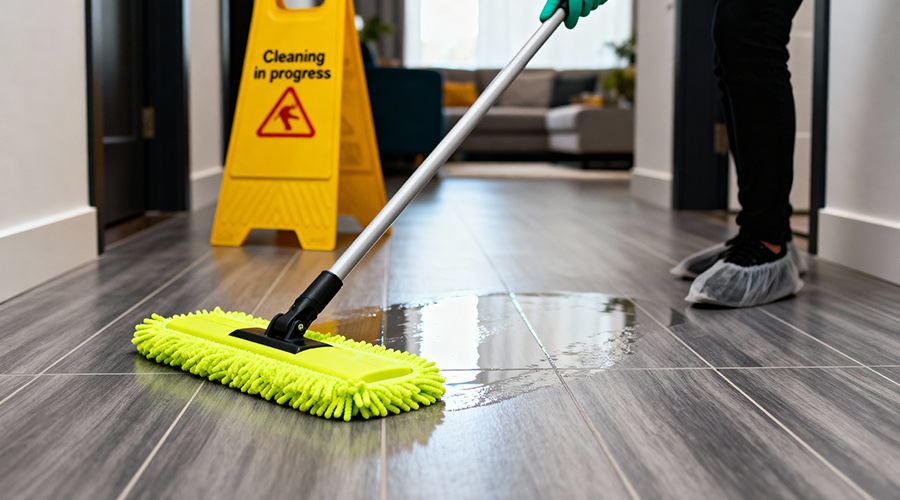
Matting systems will help trap moisture before it hits the floors, but for situations where wet flooring is a problem, jan/san distributors can offer their services. Encourage regular mop-ups of wet zones, such as restrooms and kitchens. When mopping during spills, customers should know to use wet floor signage. Additionally, weather-related procedures, such as deploying extra mats or absorbent floor runners during rain or snow, should be understood and followed.
Working with end users to create floor safety programs sometimes stretches beyond cleaning to include restoration. Customers will need to know how and when to properly strip and refinish floors to maintain slip resistance. They should also be trained in applying non-slip coatings or floor sealants designed for high-traffic areas. Finally, help them learn to conduct Static Coefficient of Friction (SCOF) testing to evaluate slip resistance, especially in high-risk zones.
Distributors should train clients on how to look for hazards during scheduled walkthroughs and document repairs when they are identified. Encourage clients to engage safety officers and supervisors in ongoing documented reviews to help provide liability protection in case of claims, showing reasonable efforts were taken to maintain safety.
Identifying Safety Issues on Different Floor Types