
 CleanLink Interactive Spring/Summer 2026 Issue
 Recognizing the 2026 Reader Choice Award Winners
 2026 Emerging Leader Award
 How Surfactant Use is Expanding in Commercial Cleaning
Floor care is undergoing a fundamental shift, and jan/san distributors are on the front lines of that change. What was once a standardized category—defined, routine stripping and refinishing, and familiar equipment—has evolved into a complex ecosystem of new surfaces, specialized tools, regulatory pressures, and emerging technologies.
Changes in flooring materials, equipment design, labor availability, sustainability requirements, and technology—from robotics to automation—are forcing facility managers to rethink how floors are specified, cleaned, and maintained. At the same time, staffing shortages and tighter budgets mean customers rely heavily on distributors for guidance, training, and problem-solving.
“There really isn’t anything that isn’t changing in floor care,” says Bill Griffin, Owner and CEO of Cleaning Consultant Services, Inc., Seattle. “It’s not just the equipment. It’s the surfaces, the expectations, the costs, the labor, and the technology all moving at once.”
To best serve customers, jan/san distributors must keep pace. Their recommendations can affect customer outcomes related to warranty protection, labor efficiency, safety, and long-term floor performance.
Beneath Your Feet
Flooring itself is among the biggest industry shifts, so distributors should start customer education there.
Vinyl composition tile (VCT) is being replaced by polished concrete, laminates, luxury vinyl tile (LVT), and luxury vinyl plank (LVP). Renovations and design trends have led to widespread use of these surfaces in healthcare, education, hospitality, retail, and office buildings.
Keith Schneringer, Senior Director of Marketing JanSan + Sustainability for Las Vegas-based BradyPlus, notes that this transition is driven by aesthetics and changing expectations around maintenance. He stresses that there is a growing preference for low-maintenance flooring that can withstand heavy use while reducing ongoing upkeep.
Customers may struggle if they assume new floors need minimal maintenance or keep their processes the same. For example, many modern surfaces are factory-coated and specifically engineered to perform without floor finish. Applying traditional finishes to these floors may cause permanent damage and void warranties.
“The real problem isn’t the finish,” Griffin explains. “It’s the removal of the finish. Strippers are caustic, water gets into seams, and over time you will see curling edges, delamination, and even mold below the floor.”
Failures like this are expensive, disruptive, and often blamed on cleaning teams, even when the root cause is a lack of understanding about how the floor was designed to perform.
Alfredo Burgos, Equipment Specialist for Imperial Dade’s Orlando, Florida branch, says he often sees this disconnect when customers transition to LVT.
“When these floors first came out, many users applied finish to them,” he says. “But that type of floor is not meant to have floor finish applied to it.”
In fact, he claims that once finish is applied, problems cascade. The finish will start coming off the floor, leading to appearance issues, surface damage, and warranty claims.
When customers are unsure how to proceed, his advice is conservative by design.
“If you’re not sure what to use on your floors, just use water for now until you figure it out,” he suggests.
When consulting with end-user customers, distributors should always ask what type of flooring is in use, when it was installed, and whether they have manufacturer care and maintenance documentation. Knowing this information in advance can prevent costly mistakes before they happen. Many times, distributors are the first, and sometimes only, resource customers turn to for clarity.
Equipment Evolution
As flooring materials diversify, equipment strategies and recommendations must evolve as well. Large rotary machines and aggressive stripping processes that once defined floor care programs are being replaced by smaller, lighter, and more specialized equipment designed for specific surfaces and spaces.
Textured and grained LVT, for example, often responds better to cylindrical brushes than traditional flat pads, which may not reach surface grooves. Water control has also become more important, as many modern floors are water-resistant but not waterproof. Excess moisture remains one of the fastest ways to damage seams and edges.
Griffin believes distributors should help customers avoid one-size-fits-all mindsets for floor care equipment, attachments, and chemicals. Matching equipment to the function, traffic patterns, and risk profile of each unique area allows facilities to clean more effectively while reducing labor strain and chemical usage.
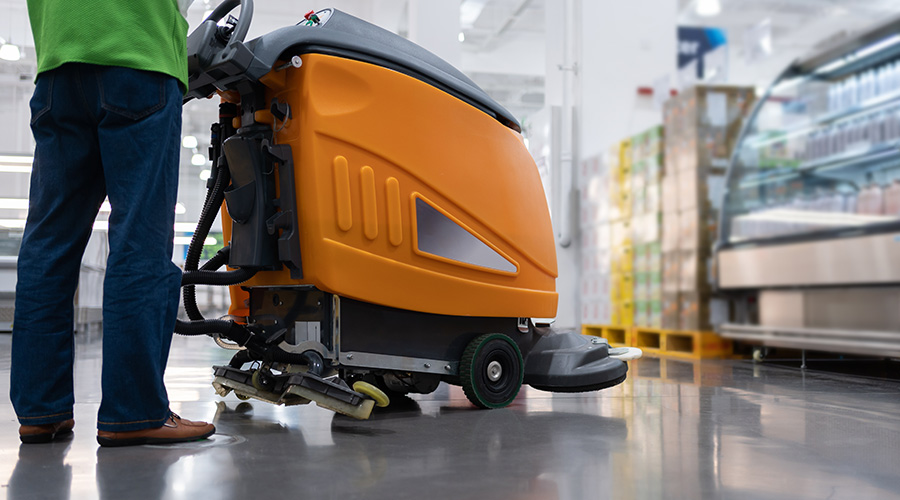
It’s also critical to consider accessories and tools that would work best. For instance, make sure customers use the right brush on the bottom of an autoscrubber or a squeegee is used to remove water.
Understanding Robotic Floor Care Equipment