
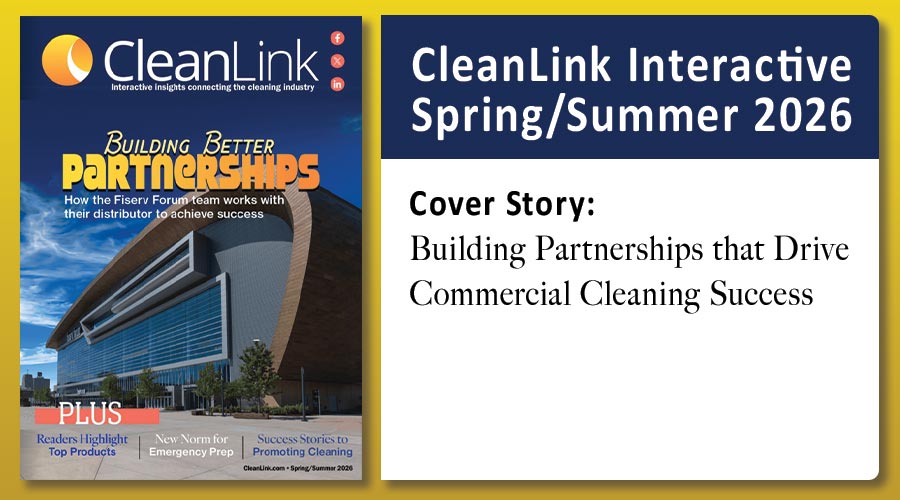
 CleanLink Interactive Spring/Summer 2026 Issue
 Recognizing the 2026 Reader Choice Award Winners
 2026 Emerging Leader Award
 How Surfactant Use is Expanding in Commercial Cleaning

Like the misconceptions on cost, many end user customers might be concerned that developing a more sustainable cleaning program will cause more training headaches—at a time when many teams are already understaffed. Fortunately, distributors are well-versed to explain that training might in fact be simpler, especially when compared to inefficient programs of old.
For example, complex chemical programs, such as those that include a cornucopia of brands, require extensive training. Each product has its own dilution ratio, safety requirements, and application method. This complexity increases the risk of errors, inconsistent cleaning results, and safety incidents.
Sustainable programs, on the other hand, simplify operations. That’s because fewer products mean faster onboarding, greater consistency, reduced error rates, and improved compliance.
Easier training is particularly important in industries with high turnover, such as hospitality and environmental services. When systems are simple for the end user, performance becomes reliable. This is especially the case for cleaning teams where staff retention is strong.
A contributing factor to high turnover in the cleaning industry is that employees don’t feel supported. Yes, cleaning professionals are the foundation of every housekeeping and environmental services program, but historically, their safety and long-term health risks have not always been fully considered. By helping customers provide safe, sustainable cleaning processes, jan/san distributors also help them send a clear message: leadership values the well-being of employees. This improves morale, engagement, and retention.
Employees who feel valued take greater pride in their work. Pride leads to higher standards. Higher standards lead to better outcomes. Sustainability is not just about protecting the environment—it’s about protecting people.
Like employee retention rates, it’s important that jan/san distributors communicate to end users that true sustainability is measurable. It’s not defined by labels or slogans; it’s defined by outcomes. Effective sustainable cleaning programs should demonstrate improvements in key operational areas such as reduced chemical consumption, lower supply costs, improved employee safety, reduced workplace injuries, improved IAQ, and increased employee, guest, and patient satisfaction.
These outcomes create both operational and financial value. Sustainability should be viewed as an operational strategy, not a branding exercise. When done correctly, this will improve efficiencies for end user customers.
In fact, sustainability aligns perfectly with an operational philosophy, which focuses on removing waste and improving efficiency. Every unnecessary chemical, step, or expense is a form of waste. By simplifying processes, reducing inventory, and eliminating inefficiencies, sustainable programs improve workflow and performance.
This is similar to how NASCAR pit crews continuously refine their process. They don’t remove steps that matter—they remove waste. The result is faster, safer, and more consistent performance.
Steps to Sustainable Cleaning
Distributors should stress that organizations don’t need to overhaul everything overnight. With the help of the supplier, sustainability can be implemented through five practical, phased steps:
Step 1: Evaluate Current Chemical Usage. Work with customers to identify how many products are currently being used and where redundancies exist.
Step 2: Simplify and Standardize. Recommend that clients reduce the number of products to essential, safe, multi-purpose solutions.
Step 3: Introduce Safer Alternatives. Encourage customers to adopt low-toxicity, green certified, or on-site generated solutions where appropriate.
Step 4: Improve Training and Communications. Work with purchasers to schedule training and maintain ongoing communication. Distributors should ensure that the staff understands the benefits and proper use of sustainable systems.
Step 5: Measure and Monitor Results. Train customers on how to properly track safety improvements, cost reductions, and performance outcomes.
Taking this approach with end user customers ensures that becoming more sustainable will enhance operations rather than disrupt them.
Future of Cleaning Leadership
The most successful organizations understand that sustainability is not separate from performance—it supports performance. Sustainable cleaning methods create safer workplaces, reduce costs, improve efficiency, and enhance the experience for guests, patients, and staff.
This is especially important in luxury hospitality and healthcare environments, where expectations are high and every detail matters.
True leadership means building systems that are effective, efficient, and responsible. Sustainability that actually works is not about doing more—it’s about doing better. It’s about creating environments that are safe for employees, comfortable for guests, efficient for organizations, and responsible for the future.
And when implemented correctly, sustainability becomes more than an initiative. It becomes a competitive advantage. This is the message distributors should leave with customers.
SIDEBAR: Green vs. Sustainability
Explaining the difference between green and sustainable to end users can sometimes be challenging. Here are few things distributor sales representatives can remember:
Sustainability is often explained as a three-legged stool with equal emphasis on the environment, social equity, and the economy. Each of the three components must be maintained equally, or the stool will fall.
Meanwhile, the UN World Commission on Environment and Development dives a bit deeper, defining sustainable development as: "development that meets the needs of the present without compromising the ability of future generations to meet their own needs."
Many experts stress that sustainability is a process, not a product. A product can add to sustainable efforts if the manufacturer of that product produces it in a sustainable way. For example, is the product made from renewable resources and in a way that reduces emissions? Is the product packaged with minimal plastics and/or paper? Does it have a small footprint in delivery trucks? What is the lifespan of the product? Does it produce minimal waste? What’s the end life—can it be recycled or repurposed?
Sustainability evaluates the overall process from development to end of life.
The term green is often used when referring to a product. If that product was created in a sustainable way, it is often considered “green.” Also, this term is used for products that are tested and certified by a third party. Chemicals often carry a certification, as illustrated on their labeling and safety data sheets. Green Seal and Design for the Environment are just a few examples of these certifications.
There are also certifications for vetting equipment, which often includes an analysis of emissions, chemical usage, or filtration. One example of this is the Carpet and Rug Institute’s Green Label program.
End user customers who want to “go green” are often referring to the increased use of these certified products and equipment. That is one way cleaning teams can contribute to larger sustainability initiatives outlined by facilities.
David Green is the Founder and CEO of Rediscover Clean, a consulting and leadership development company focused on luxury hotel housekeeping, healthcare EVS, and operational performance improvement. With nearly 40 years of experience in hospitality and healthcare operations, David has led teams for organizations including Cleveland Clinic and The Ritz-Carlton Hotel Company.
David specializes in leadership development, workforce engagement, operational assessments, labor optimization, sustainability initiatives, and service excellence strategies for hospitals, hotels, and facility service organizations. Through Rediscover Clean and the Yer A Rockstar Leadership Academy, he works closely with frontline leaders and executive teams to create practical systems that improve quality, accountability, employee engagement, and operational consistency.
Known for his “Leading with Kindness is the New Cool” philosophy and his Kindness Metric Driven Leadership approach, David combines operational expertise with entertaining and engaging teaching methods designed specifically for frontline service industries. He is a frequent speaker on topics including leadership, employee engagement, cleaning for health, sustainability, and operational efficiency. David is also a contributing industry writer for Cleanlink as well as other publications and podcast host who enjoys blending leadership development with music, storytelling, and real-world operational experience.
Follow David on LinkedIn here.
Creating More Sustainable Cleaning Systems