
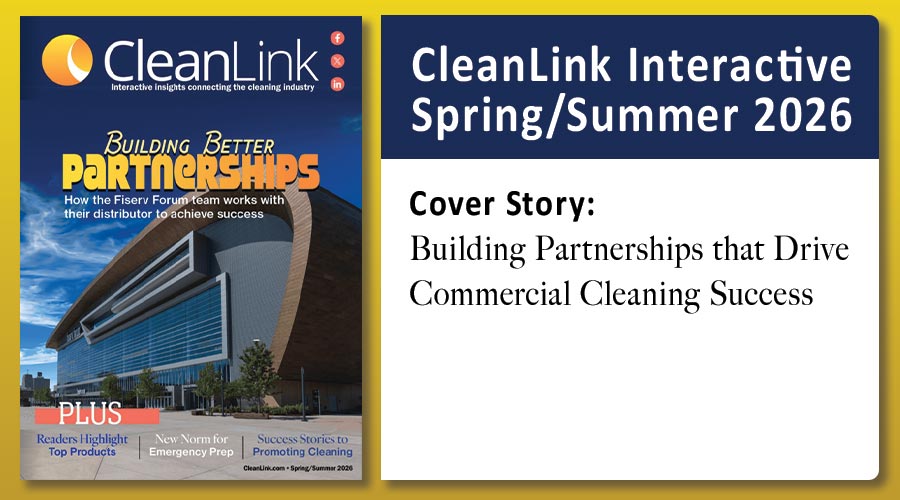
 CleanLink Interactive Spring/Summer 2026 Issue
 Recognizing the 2026 Reader Choice Award Winners
 2026 Emerging Leader Award
 How Surfactant Use is Expanding in Commercial Cleaning

Networking is a multiplying force for professional growth. The opportunity to build connections within the industry can support productive partnerships and drive operational innovation. Upcoming November events, such as ISSA Show North America, BSCAI's (Building Service Contractors Association International) Contracting Success Conference, and WFBSC's (World Federation of Building Service Contractors) Global Executive Congress, will bring the commercial cleaning industry together to develop relationships, learn new strategies, and strengthen cleaning solutions.
To better assess how jan/san distributors and manufacturers, in-house facility cleaning managers, and building service contractors are approaching networking events, CleanLink asked its audience to share their preferences by answering the following questions:
1) Which elements enhance networking experiences?
Facilitated speed-networking
Interactive workshops
Unstructured social hours
Targeted breakout sessions
2) How do you prefer to exchange professional contact information?
Digital business card
Physical business card
Social media
Other method (please specify)
3) What is your primary, most reliable channel for ongoing professional communication?
Phone call
Email
Social media messaging
Video conferencing
4) What would deter you from forming a new professional partnership?
Delayed feedback/responses
Misaligned expectations
Excessive contact points
Communication fatigue
5) What is the biggest drive encouraging you to follow up after a networking opportunity?
Workload bandwidth
Desired deliverable
Business need
Social confidence
Communication Considerations
When engaging in networking opportunities, most professional cleaning members prefer structured events. Half of those surveyed say facilitated speed-networking sessions can enhance networking experiences. These time-efficient experiences introduce individuals to multiple people and center conversations on topical industry trends, helping overcome everyday obstacles from supply chain disruptions to staff retention. Other networking elements—interactive workshops, unstructured social hours, and targeted breakout sessions—are valued by 17 percent of respondents.
Though the digital age has bridged the gap between businesses and clients, an abundance of technological tools can fragment communication. Factor in generational needs, and these communication methods further dilute. For instance, baby boomers appreciate face-to-face conversations, whereas Gen Z resonates with digital mediums.
Perhaps this is why 86 percent of CleanLink's audience share they prefer exchanging professional contact information the old-fashioned way: a physical business card. Although digital business cards and social media handles are established communication channels, they don't always leave the same impression as a tangible interchange. And while tactile may be favored, digital tools still have their place at events.
According to 71 percent of commercial cleaning industry professionals, email is their primary, most reliable channel for ongoing communication. This aligns with the remaining 14 percent of industry members who prefer to use email to exchange their personal details and build connections outside of an event. Personalized emails may provide a competitive advantage by supporting engagement and soliciting positive responses. Individuals should ensure their emails do not use certain keywords that would cause them to be considered spam messages.
While not included in this survey, QR codes have also become commonplace, multifunctional tools. From reducing check-in times from 12 to 3 seconds to increasing attendee satisfaction to 30 percent, Open QR shares that QR adoption is advantageous. These scannable tools can also enhance communication by sharing information instantaneously, making them a staple to be used in tandem with other preferred communication methods.
After the Event
When deciding to follow up after networking, the biggest driver for 57 percent of CleanLink readers is a business need. Whether connecting with an individual who works within the same industry or with a professional in the same locale, professional cleaning members are more likely to reach out if they trust that the conversation will lead to a business solution, professional growth, or opportunity for innovation. Just over a quarter of respondents share that the likelihood of them reaching out after an event depends on their workload bandwidth, with just 14 percent saying it depends on the desired deliverable they wish to attain.
On the other hand, the biggest holdback from pursuing a professional partnership is delayed feedback or responses, as affirmed by 57 percent of those surveyed. Response times can represent an individual's availability and reliability. When a bid for communication goes unnoticed or receives a delayed response, trust and confidence are lost, along with the chance for a fruitful relationship. Misaligned expectations, say 43 percent of respondents, can also affect interpersonal connections. When the goal is not a shared outcome by both representatives, professional rapport is reduced, which can lead to a relationship breakdown.
Avoiding these communication pitfalls can benefit the development of interpersonal professional partnerships that leverage communication mediums and preferences to strengthen operations and industry growth.