
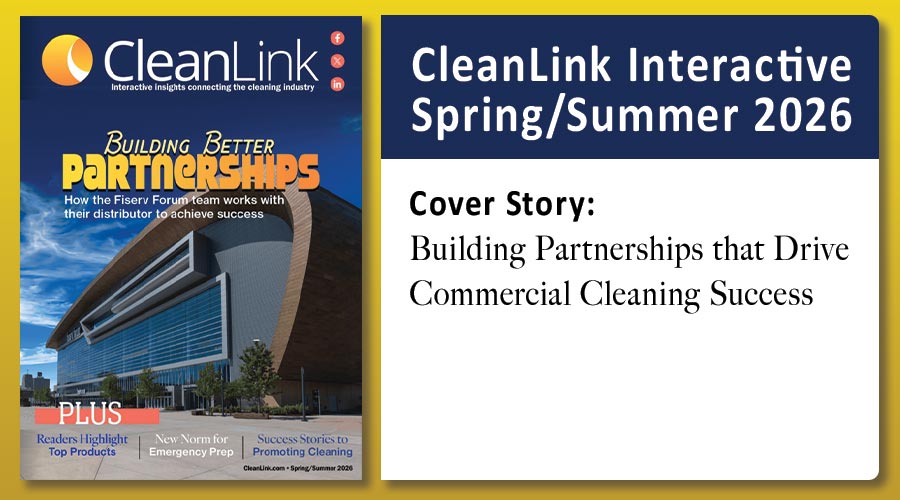
 CleanLink Interactive Spring/Summer 2026 Issue
 Recognizing the 2026 Reader Choice Award Winners
 2026 Emerging Leader Award
 How Surfactant Use is Expanding in Commercial Cleaning
In 1990, the Americans with Disabilities Act (ADA) was signed into law to protect the rights of individuals with disabilities through accessible measures. In a recent Facility Cleaning Decisions article, Uma Srivastava, Executive Director of KultureCity, shared that while this legislation was evolutionary, it only laid out a foundation. The commercial cleaning industry continues to build on this groundwork to promote accessibility not only for facility occupants and end users, but also for the frontline staff who create and maintain these inclusive environments.
To determine how commercial cleaning has prioritized and highlighted accessibility, the following questions and answer options were asked in the July monthly poll.
1) Where has the industry made the most progress regarding accessibility in recent years?
Inclusive infrastructure
Workforce diversity
Product innovation
Corporate culture
2) What operational challenge presents the biggest hurdle to maintaining accessible spaces?
Budget constraints
Staff execution
Aging architecture
Regulatory compliance
3) Which product category holds the greatest potential for inclusive innovation?
Chemical dispensing systems
Restroom fixtures and dispensers
Floor equipment
Smart machinery and technology
4) In what ways are staff insights incorporated into standard operations?
Legal mandates
Automation trends
Cultural and client demands
Evolving product designs
Innovation Drives Inclusivity
Product innovation is the top driver of industry inclusivity. All survey respondents agree that new tools and technology address constantly shifting workplace, regulatory, and client demands. These improvements in equipment and systems minimize barriers through user-friendly techniques. For example, dilution-controlled chemical dispensing systems are simplifying chemical mixing and refilling processes, resulting in improved compliance and ease of use.
Companies are increasingly adopting an accessible philosophy, according to a third of industry members. In fact, Tork, an Essity brand, launched an Inclusive Hygiene Playbook to provide a frame to view facility accessibility needs as it aligns with hygiene initiatives. Aside from professional cleaning companies’ efforts to address accessibility through facility design, many organizations have also bolstered their own diversity, equity, and inclusion (DEI) internal programs. For instance, Prestige Maintenance USA works with diverse suppliers to ensure equity in the work environment as well as in the services it provides.
Although the commercial cleaning industry is actively working to reduce barriers to hygiene, an inhibitor to their own success is cost. Nearly 67 percent of industry respondents shared that budget constraints are the biggest hurdle to maintaining accessible spaces. This is shown through restroom renovations, where the addition of a single-user restroom—supportive for individuals with disabilities and their caretakers—is two to three times more expensive to build than multi-stall restrooms.
Another caveat to accessible additions is a facility’s condition. Aging infrastructure creates implementation issues, as agreed by 33 percent of CleanLink readers. Older buildings have structural challenges and outdated systems that make retrofitting complicated. Many of these buildings require renovation plans that prioritize inclusive infrastructure, which comes with its own cost.
Yet, some of these additions are becoming more mandatory. In 2024, the Federal Aviation Administration (FAA) stipulated that airports seeking grant funding will need to install and maintain a universal changing station in restrooms by 2030. Regulatory compliance is the minimum standard to achieve when considering accessibility needs in the commercial cleaning industry, and staff will need to be trained on these updated tools and systems to ensure a seamless transition.
The Future of Clean
Looking to the future, 67 percent of professional cleaning industry members believe that floor equipment has the greatest potential for inclusive innovation. Floor care technology is advancing at a rapid rate, with new tools designed to increase staff productivity and reduce slip-and-fall and ergonomic injury risks. Some floor equipment, such as autonomous floor scrubbers, can limit environmental obstacles and reallocate cleaning assignments to ensure that each area is targeted efficiently.
Additional smart machinery and technology are also believed to be (by 33 percent of survey respondents) potential product categories strengthening the industry. The innovation of Internet of Things (IoT) technology and data-driven systems transforms commercial cleaning enterprises from reactive responses to sustainable processes. These digital tools are capable of creating an adaptable environment that can offer solutions in real-time, enhancing the hygiene experience for all individuals.
Inclusivity also necessitates staff insights that are incorporated into standard operations. According to 33 percent of industry members, automation trends are one way this can take effect. As frontline staff are most impacted by automation adoption, commercial cleaning executives should communicate why these changes are needed and how their integration will improve operations. Frontline staff should have an accessible forum to provide feedback on where automation may be beneficial in their daily operations and how the systems contribute to the overall cleaning program.
Above all, the majority of CleanLink’s audience says cultural and client demands directly impact standard operations. Customer feedback can influence the success of facility cleaning operations, as this perspective pinpoints areas of improvement that lead toward the ultimate goal of facilitating a clean and equitable experience for all.
To learn more about the benefits of inclusion, click here.