
 CleanLink Interactive Spring/Summer 2026 Issue
 Recognizing the 2026 Reader Choice Award Winners
 2026 Emerging Leader Award
 How Surfactant Use is Expanding in Commercial Cleaning
Key Takeaways:
• Public restrooms often fail to meet the needs of people with disabilities, limiting their dignity, independence, and ability to participate fully in everyday life.
• While the ADA established a foundation for accessibility, evolving needs and modern mobility equipment have exposed gaps that require more inclusive restroom standards and stronger enforcement.
• New legislation, updated building codes, and grassroots advocacy are driving the adoption of universal changing stations and more inclusive restroom designs that better serve people with visible and invisible disabilities.
Emily Flores just wanted to get coffee with a friend, but things got tricky when she needed to relieve herself. She knew the coffee shop’s restroom was small, with no grab bars or adult changing station, so the teenager, who happens to be a wheelchair user, faced a stark choice.
“My friend could help me transfer to the toilet, or I can pee right on my wheelchair,” she writes in Teen Vogue.
Flores chose to urinate on her wheelchair.
The experience left her feeling humiliated, degraded, and vulnerable. Unsurprisingly, Flores is not alone. From a scholarly analysis of op-eds and news articles exploring how individuals with disabilities access public restrooms to an eye-popping Reddit post painting a blunt picture of what it’s like to live with a lack of adult changing tables, it’s increasingly clear that today’s public restrooms are not fully inclusive.
The problem goes beyond a lack of universal/adult-sized changing stations. People with all kinds of disabilities and sensitivities, from post-traumatic stress disorder (PTSD) to paruresis (also known as Shy Bladder Syndrome), avoid public restrooms. This ultimately can lead to avoiding public spaces altogether, sidelining people and their caregivers from public life.
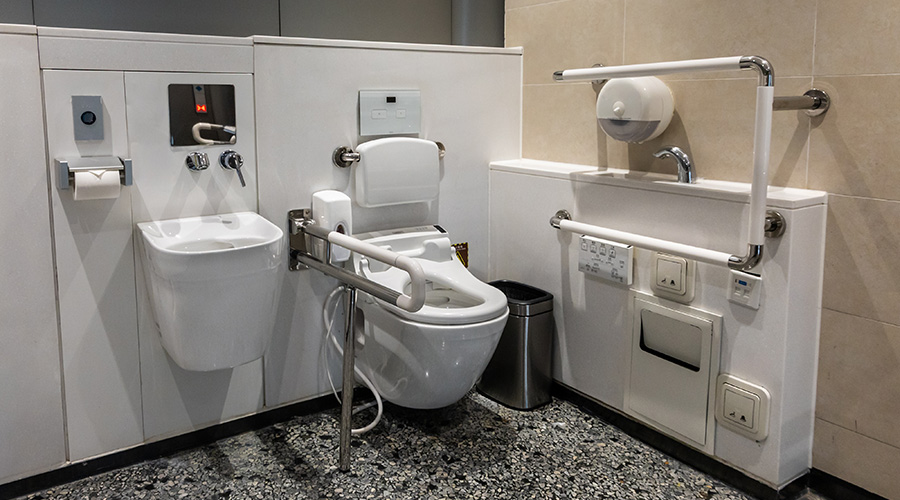
Change, however, is coming. The next frontier of inclusive restroom design seeks to serve the vast and diverse needs of the disability community. The movement starts with universal/adult changing stations, but also incorporates better lighting, privacy, reduced noise, and more.
Beyond the ADA
The Americans with Disabilities Act (ADA), signed into law in 1990, was a groundbreaking milestone for the disability community. The law, among other things, imposes accessibility requirements on public accommodations, including restrooms. However, holes in the legislation have grown increasingly evident over the last 36 years.
“The ADA was a transformative milestone, but it established a baseline, not a finish line,” says Uma Srivastava, Executive Director, KultureCity. “Since 1990, our understanding of accessibility and inclusion has evolved significantly. Today, we recognize the needs of individuals with sensory processing differences, autism, dementia, PTSD, and other invisible disabilities.”
But, as evidenced by Flores and others, the ruling has not always served the visibly disabled community well.
“ADA standards have not been enforced nearly enough, or at all,” notes Jonathan Katz-Ouziel, Accessibility Consultant, American Restroom Association.
He laments that the ADA has also not kept up with advancements in mobility equipment. For example, door width mandates under the ADA aren’t wide enough to accommodate modern powered chairs.
Luckily, a new code and standard are coming to some spaces. Under the 2024 FAA Reauthorization Act, all medium and large airports seeking federal airport development project grants must have at least one private universal/adult changing station per terminal by 2030. Meanwhile, the International Code Council has approved Code E142-21 for the 2024 International Building Code. This will require universal changing stations in certain establishments, like colleges, highway rest stops, arenas, and more.
This is a welcomed step forward. Without universal changing stations, the only other option is leaving the venue to change in the car, or worse, on the restroom floor.
“That was a non-starter for me,” shares Jacqueline Scali, whose son has global developmental delays and uses a wheelchair.
A height-adjustable universal changing table allows Scali to easily transfer her child from his wheelchair. She can raise the table to comfortably change him, then lower it to transfer him back. This robust equipment has high weight limits to accommodate most people. It also allows Scali and her family to access and attend events and travel.
While these positive changes are good news for disability advocates, many realize that national change and building code adoption move slowly.
“We see greater impact at the state level,” says Scali, who is a member of the New York Chapter of the Changing Spaces Campaign.
A map highlighting states where universal changing table mandates have passed or were proposed can be viewed at choosesova.com/pages/legislation. Judging by the map, there is a lot of progress to be made.
“The accessibility code, ANSI 117.1, which is separate from the ADA, has changed over the years to address the needs of the disability community in places of public service and public accommodation,” says Sarah St. Louis of the Minnesota Chapter of Changing Spaces.“Unfortunately, the majority of people that sit on the board that develops ANSI 117.1 are not people with disabilities.”
Strong advocacy is changing that narrative.
“Disability advocates, usually within states, help drive their state accessibility code—if their state has one—to meet the needs of the disability community within their state,” notes St. Louis. “In Minnesota, those with disabilities and disability advocates work with our Department of Labor and Industry to help craft accessibility codes that reflect our needs.”
As a result, the North Star State has the most comprehensive adult-sized changing table code in the United States.
Amy Milshtein is a freelance writer with over 20 years of experience writing for various publications and blogs. Amy has been a frequent contributor to CleanLink and its family of brands—Facility Cleaning Decisions magazine, Sanitary Maintenance magazine, and Contracting Profits magazine.
Popularizing Inclusivity in American Public Restrooms