
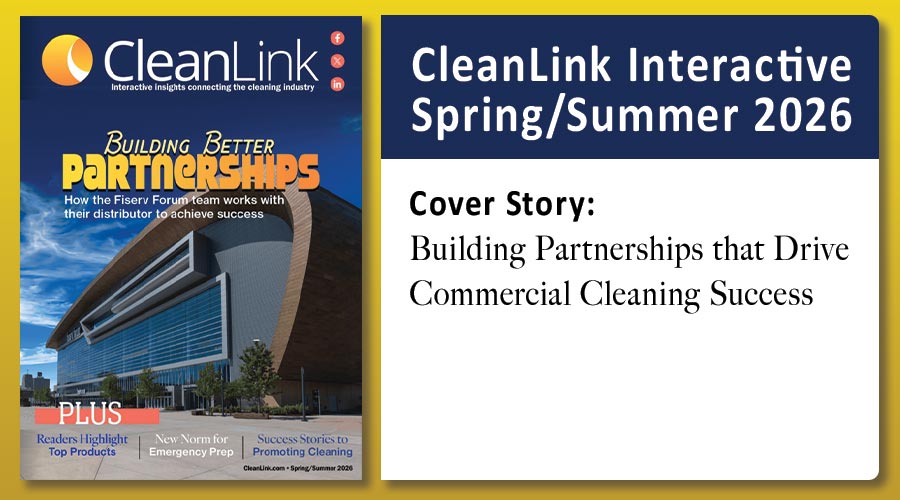
 CleanLink Interactive Spring/Summer 2026 Issue
 Recognizing the 2026 Reader Choice Award Winners
 2026 Emerging Leader Award
 How Surfactant Use is Expanding in Commercial Cleaning
Cleaning Specialists of America published a detailed set of janitorial standards developed specifically for Manhattan office environments, but can also be applied to high-traffic, commercial spaces nationwide.
The newly released standards cover disinfection frequency, surface treatment protocols, and hygiene procedures directly relevant to city-wide commercial cleaning operations. This publication serves as a resource for building service contractors (BSCs) and facility cleaning managers, reflecting the operational complexity involved in maintaining commercial environments within densely occupied urban centers.
Disinfection Benchmarks
The standards established by Cleaning Specialists of America offer clear guidelines on disinfection intervals for high-contact surfaces—including door handles, elevator buttons, shared workstations, and restroom fixtures—within high-occupancy office buildings. The protocols distinguish between routine maintenance schedules and more intensive cleaning cycles, providing commercial cleaning executives with a structured framework for day-to-day operations.
These benchmarks support cleaning program evaluation and revision by providing a point of comparison for determining whether current service schedules and product usage align with recognized hygiene expectations for office cleaning environments.
Surface-specific protocols form a central component of the benchmarks, with guidance on appropriate cleaning agents, application methods, and dwell times necessary for effective disinfection. These distinctions carry particular weight in office cleaning environments that feature shared spaces, substantial daily foot traffic, and heightened cross-contamination risks.
Air quality considerations, waste management procedures, and floor care routines are included as essential elements of a complete office hygiene program. Rather than treating each as an isolated concern, these aspects become a unified approach designed to reduce pathogen transmission and sustain consistent cleanliness across commercial floor plans.
These components are especially critical as the United States experiences various disease outbreaks. Since the start of August, 2,465 measles cases were confirmed by the Centers for Disease Control and Prevention (CDC). Alongside rising measles cases is the ongoing cyclosporiasis and E. coli outbreaks.
Staff training and documentation are integral components of a complete janitorial program. Maintaining logs of completed cleaning tasks and product application records supports accountability and aids compliance verification in regulated commercial environments. These practices align with the broader expectations of city commercial cleaning operations serving high-occupancy properties.
Facility cleaning teams are encouraged to use the standards as a review tool when onboarding new jan/san vendors or renegotiating service contracts. The documentation specifies which tasks should occur daily, which are suited to weekly cycles, and which require periodic deep-cleaning attention. This gives procurement teams concrete criteria to incorporate into service-level agreements.