
 CleanLink Women of Clean - 2026 Honorees Announced
 CleanLink Interactive Spring/Summer 2026 Issue
 2026 Emerging Leader Award
 Recognizing the 2026 Reader Choice Award Winners

Key Takeaways:
• LA Metro added nearly 150 custodians to maintain cleanliness and safety during World Cup matches.
• Staff quickly adapted to unexpectedly high ridership by doubling custodians at the busiest station.
• Extra trash bins, frequent pickups, and proactive planning helped prevent waste buildup and maintain clean stations.
At 471 square miles, Los Angeles is larger than the “Big Apple,” with New York City topping out at 301 square miles, according to World Popular Review. That famous urban sprawl makes Los Angeles an interesting city to traverse. It’s common knowledge that its residents drive more than in many major cities, which contributes to its brutal traffic. Luckily, the Los Angeles Metro (LA Metro) provides a practical solution for the more than 1 million locals navigating daily life, as well as visitors exploring the City of Angels.
Earlier this year, those additional visitors made an impact. Los Angeles attracted more than 560,000 tourists when it hosted eight matches of the 2026 FIFA World Cup. Fans flocked from all over the city to SoFi Stadium, a $5.5 billion ode to engineering genius that became the most expensive stadium ever when it opened in 2020. People had no issue getting to and from these matches using the LA Metro, which is impressive considering the significant amount of foot traffic.
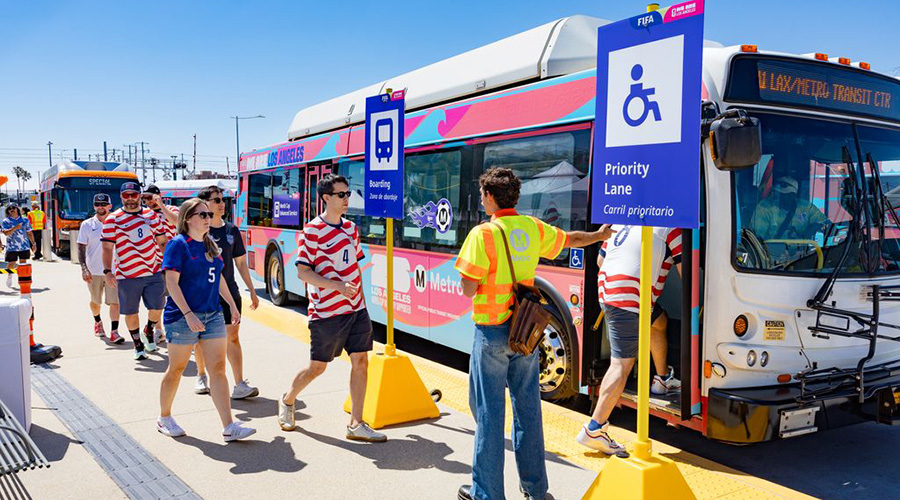
That estimated spike in rider volume resulted in a reevaluation of staff as executives prioritized cleanliness and safety. On each game day, they assigned three custodians per shift at each stop routed for SoFi—one on the station platform and the other two working in the queuing lines and the Games Enhanced Transit Service (GETS— a temporary bus/shuttle program) area. Nearly 150 additional custodians would ultimately work across the 15 stops that route directly to SoFi Stadium via GETS.
Each game day had two shifts. The first shift kept the dust pans and mops active, and the evening shift busted out the autoscrubbers and pressure washers. Touch points, such as ticket machines, handrails, fair gates, and elevator buttons, were disinfected at least once per shift, or roughly every eight hours. A plan was in place, and plenty of work and riders were expected, but what wasn’t anticipated was how the riders dispersed. This caused the largest cleaning headache of the World Cup.
Change of Plans
Despite careful planning and the expectation of 100-150 riders per match from the Pierce College station, the LA Metro team was unprepared when even more riders showed up for transportation to the first match at SoFi Stadium. Once that match concluded, facility maintenance and cleaning staff were unsure if that rider volume was an aberration or a sign of things to come. Then, an even larger number of riders took that same route for match two. LA Metro staff knew what to expect moving forward—roughly double the riders would be hopping on at Pierce College to get to SoFi Stadium than originally anticipated.
Since the first two matches were played in quick succession, the only lull for LA Metro staff occurred between the second and third games. Leadership found that pause the perfect time to tweak their game plan so that the mounting cleaning needs at the Pierce College stop—spills, debris, and waste management—could be resolved before the next 75 percent of matches were played.
Leaders went over the reports across all LA Metro stops routed to World Cup matches. Using that information, they reassigned reserve cleaning staff from stations that could spare workers to the Pierce College location.
Christopher Limon, LA Metro’s Executive Officer, Facilities Maintenance Infrastructure, Maintenance and Engineering, says that once the call was made to double the custodians working per shift at the Pierce location, the change was implemented in less than an hour.
“We brought in more riders from the [San Fernando Valley] than we originally planned, which was a great thing,” recalls Limon. “But the way our people were able to pivot and make it happen...we were prepared; we were on it."
Despite a slightly off start, things could have been harder on LA Metro staff during those first two games had leaders not done their research in advance. Previous major-event experiences, and the fact that the World Cup would be taking place from mid-June to mid-July, suggested riders would be carrying plastic-bottled beverages to not only beat the Southern California heat, but also to avoid the exorbitant costs of in-stadium concessions.
To match the waste output, extra cardboard receptacles were placed about every 50 feet of the queuing line. LA Metro also added a special trash pickup at the end of every World Cup match. If those changes to the normal procedure had not been made, receptacles would have overflowed, causing an unsanitary and unsightly issue.
“We had to be active, making sure that the areas were clean—free of trash, spills, and debris. We had to make sure our stations looked their best,” shares Limon. “I think we had a total of 18-hour coverage at each location, so that’s why we needed the extra people.”
Those roughly 12 dozen custodians assigned to GETS stops for the World Cup exclude the 130 other stops LA Metro has in its system, demonstrating the magnificent size of this transit network that supports hundreds of millions of annual boardings. That’s an important consideration, as regular, day-to-day cleaning still had to be carried out to meet high standards at LA Metro’s bus and light rail stations, bus rapid transit stops, and bus and rail operating facilities.
LA Metro Strategizes Cleaning for Upcoming Sporting Events