
 Celebrating BSCAI's 60th Anniversary eBook
 The Down and Dirty on Cleaning in Virus Season
 Industry Report Reveals Burnout Prevalence Among Cleaning Professionals
 How Surfactant Use is Expanding in Commercial Cleaning
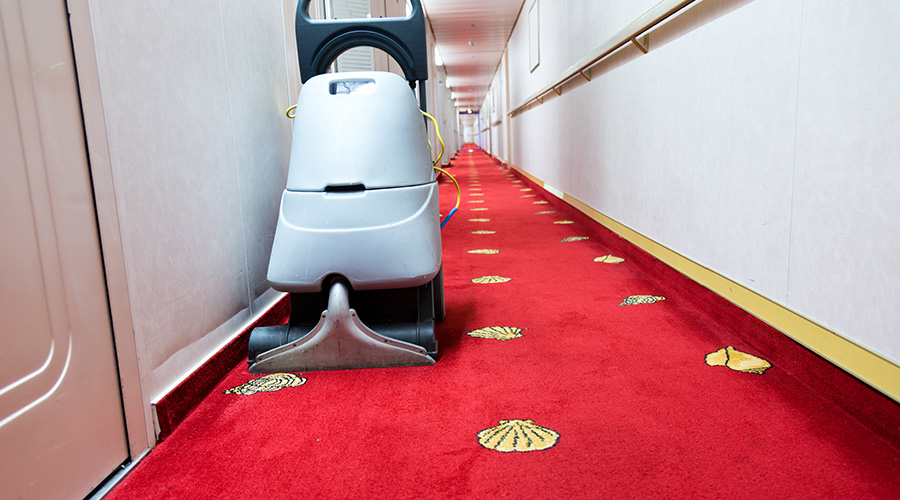
While the ultimate carpet care performance depends on many factors, there are expected cleaning times associated with large and small carpet equipment.
According to Schneringer, a 12-inch upright vacuum will typically clean 2,200 square feet an hour. A 30-inch upright could cover 10,000 to-15,000 square feet in an hour. In comparison, if handled by an experienced operator in an ideal space, a backpack vacuum can cover a 7,200 square foot space in an hour.
For carpet cleaning equipment, such as extractors, Franke suggests the following:
“Assuming the employee is a trained operator, and the soil load is average, small carpet equipment cleans 300-to-600 square feet an hour. In practice, that means it takes two to three hours to clean 1,000 square feet. Five thousand square feet will take between eight and 15 hours, so the work is often spread across multiple shifts. Expected drying time is between six and 12 hours and often requires additional air movers.”
If departments implement larger extractors, they can expect higher production rates.
“Typical productivity is between 1,000 and 2,000 square feet per hour with only two to four hours of drying time,” he says. “In practice, that means it only takes between 30 and 60 minutes to clean 1,000 square feet.”
Don’t forget the fatigue factor. While larger equipment is heavier and somewhat intimidating, if an operator is well trained, bigger machines often reduce exhaustion.
“It’s counterintuitive but larger machines require fewer passes, are often self-propelled, and lead to less bending, lifting, and stopping,” says Franke. “Smaller equipment can tire workers out leading to a slower pace, shortcuts, and inconsistent results.”
When it comes to vacuums and carpet cleaning equipment, clearly one size does not fit all. That’s why the most successful operations rely on a mix of small and large machines in their carpet care arsenal. Adding in autonomous vacuums can also help.
“There are no real autonomous extractors yet, but I would love to see it,” says Bowlby. “Still, the vacuums do a good job and are becoming more widely accepted."
Another trend to look for is the switch from corded machines to battery-operated models. Batteries increase productivity as there’s no cord to manage. But not all batteries are created equally. Bowlby suggests equipment with lithium batteries.
“I try to steer people away from lead-acid batteries, especially for carpet equipment,” he says. “If you don’t maintain the batteries properly, you can damage the machine and the carpet. That would be a disaster.”
Another aspect to keep in mind is the carpet’s place in commercial settings. For a long time, broadloom carpet was king. Warm, luxurious, and sound dampening; it was the obvious choice for commercial spaces. Carpet tile, which has all of the benefits of broadloom while allowing users to replace worn or stained sections, was also a popular option.
Today, both choices are being surpassed by hard surface flooring, like Luxury Vinyl Tile (LVT).
“Carpet is just not as popular as it used to be,” admits Griffin.
Still, there will always be a place for carpet in commercial settings. And that means investing in its care and the people who do the work.
Amy Milshtein is a freelancer based in Portland, Oregon. She is a frequent contributor to Facility Cleaning Decisions.
Comparing Large and Small Carpet Care Equipment