
 CleanLink Interactive Spring/Summer 2026 Issue
 Recognizing the 2026 Reader Choice Award Winners
 2026 Emerging Leader Award
 How Surfactant Use is Expanding in Commercial Cleaning
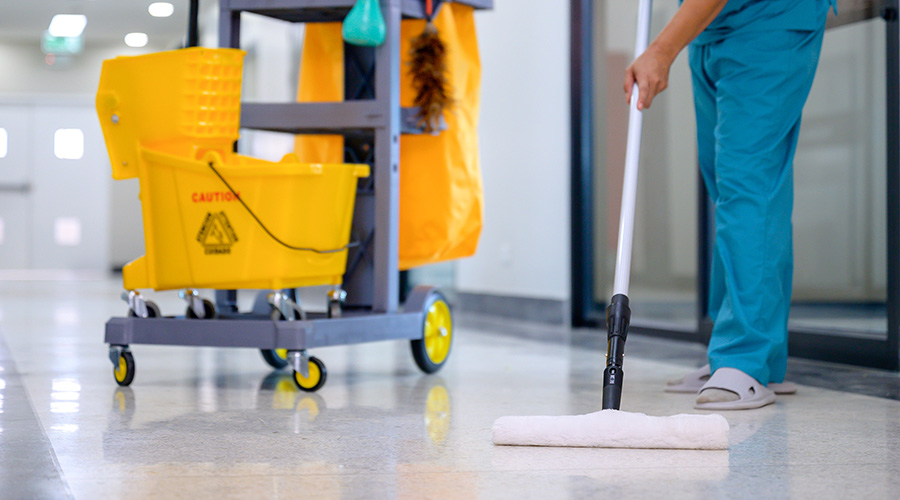
Splitting a mop bucket system into two sides is easy enough. What’s difficult, evidently, is maintaining the parts on the bucket system. Buckets are used a lot, so they go through normal wear and tear, just like a car.
One important aspect of the mop bucket system that jan/san distributors say can cause trouble is the wringer used to squeeze water out of the mophead and into the bucket. There are two common types of wringers: side press and down press.
When using the side press wringer, one of its four walls squeezes against the mop, pushing it against the opposite side, releasing the liquid. The side press can cost a little less, immediately giving it advocates in an industry that faces tight margins.
The down press also has four walls to contain water during wringing, but none move. Instead, it has two additional moving parts shaped like the letter “C.” When the operator pulls down on the wringer handle, the two parts, which face each other, grab the mop at the top and move downward, causing water to release.
Josephs finds more of his customers prefer the down press. Charlie Moody, President, Solutex, Sterling, Virginia, also favors the down press wringer because he thinks it results in a dryer mop.
The mop buckets themselves are much more durable than the wringer, so it’s common for a customer to want to replace the broken part when the rest of the tool is perfectly fine. However, Moody, who has been in the industry since 1986, says the proliferation of many manufacturers over the years makes this difficult because they don’t make it easy to replace parts—especially those outside of the United States. When manufacturers do make parts available, some make buying new more prudent because the wringer alone is almost as expensive as a new bucket.
Josephs says poor wringer durability is the No. 1 complaint customers give about mop buckets and their parts, no matter the manufacturer. However, it’s not the only part that often has issues.
Casters, the swivel wheel on mop buckets, are an important component because a good one will allow the user to roll the bucket on uneven floors or at a threshold where the floor surface changes without causing turbulence. Instability is what can cause the water to rise in a wave and spill out. Bad wheels also make the bucket harder to move. Like a bicycle tire, casters wear with use, so it’s nice when they are easy to replace.
Color Coded
Color coding is favored in commercial cleaning because it helps prevent frontline staff from using tools across different areas of a facility, which can cause significant cross-contamination issues.
For example, when a mop and mop bucket are used in a restroom, the tools should be red—the color widely used across the industry to signify something meant only to be used in high-risk spaces. Items used in the restroom are among the most important to color code because they encounter fecal matter and other materials that can make people sick. Green is often used in areas where food is prepped or eaten; blue is used for objects that clean general areas; and yellow is used for isolation or caution-based tasks.
Different settings require different cleaning, so the scale of color coding depends on the venue. In schools or airports, three colors could get the job done. In food processing, six or seven different color combinations might be necessary. For a major facility that requires impeccable cleanliness, like a big hospital, 10 or more colors could be used for different cleaning tasks.
“The important thing is to choose a standard and train on it so staff can identify the right tool instantly and avoid using the same equipment in the wrong place,” says Attman.
Questions to Ask
With so many options, shopping for a mop bucket might seem like an exhausting endeavor. However, decision makers can be more confident in mop bucket purchases if they follow a few practical steps.
Since wringers and wheels are very susceptible to wear, it’s a good idea to buy a bucket from a manufacturer who provides good customer service and has a robust offering of replacement parts. That way, if something as small as a spring is needed, the BSC can place a quick order that’ll be delivered soon.
The fragility of mop systems due to heavy use is also why it can be good to buy from a manufacturer who offers a product warranty.
“The first question any of these people should ask of a distributor is what’s the warranty policy on these buckets,” says Josephs. “It’s a very easy question, and as a distributor, if I don’t know because we deal with several manufacturers and with different warranties, I’m going to find out for them because that’s important.”
Many commercial cleaning operations employ people with varying physical capabilities. The uniqueness of each employee is why it’s important for companies to ask about the weight of the mop and bucket, the length of the mop, and whether the bucket must be lifted to drain.
“Many of our customers will order a variety of mop sizes, like 16 ounces and 24 ounces, to fit the comfort levels of their different team members,” says Moody.
Attman says it’s also important to consider the type of soil being removed, laundering requirements for the mop head, the expected lifespan of the mop and bucket, the cost of replacement parts, and how the bucket system fits the workflow of a specific building.
“The best choice is usually the one that improves consistency, protects the worker, and lowers the total cost to clean over time,” says Attman. “It’s not simply the one with the lowest purchase price.”
Jake Meister is the Managing Editor for Trade Press Media Group's Cleaning Group of brands. He works on three magazines: Sanitary Maintenance, Contracting Profits, and Facility Cleaning Decisions, as well as on Cleanlink.com, the home of all three publications. Jake has over five years of experience covering the commercial cleaning industry as an employee of Trade Press Media Group, but also spent time as a freelance journalist for the company.
Jake has attended many commercial cleaning events where he enjoys connecting and networking with representatives from all corners of the industry. This often lays the groundwork for profile articles featured across the group. He excels at identifying outstanding individuals and/or programs that showcase the great things the commercial cleaning industry represents.
In addition to writing, Jake moderates many of CleanLink's educational webcasts, and he is the voice behind much of the social posts.
Follow Jake on LinkedIn here.
Buyer's Guide to Mop Buckets