
 CleanLink Interactive Spring/Summer 2026 Issue
 Recognizing the 2026 Reader Choice Award Winners
 2026 Emerging Leader Award
 How Surfactant Use is Expanding in Commercial Cleaning
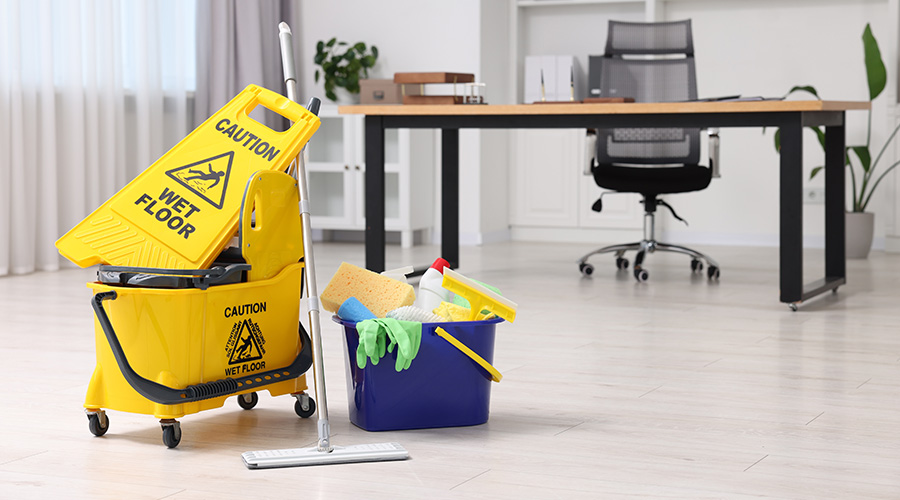
Robotic floor scrubbers, internet of things-enabled fixtures, and other technology might be the provocative eye candy on trade show floors, but traditional cleaning tools still dominate janitors’ closets. The trouble is that brooms, brushes, mops, and similar hand tools are so entrenched in the profession that it’s easy for building service contractors (BSCs) to simply click “purchase” the moment they need to buy another one. However, one should make a habit of researching a product before buying it. That adage holds true for mop buckets.
Many BSCs, especially those who grew up in commercial cleaning, might wax poetic about decades-old memories of swinging a mop around a dirty floor. The fruit of their labor was clearly displayed in the murky waters of their single-bucket system. However, these days, industry experts stress that mop bucket shopping must begin with a more modern dual-bucket system.
While some janitors might not mind using a single-bucket system, especially when cleaning up small spills, the single-bucket system means a mop is more soiled with every repetition because the water used is becoming dirtier by the dip and squeeze.
Jan/san distributors push the dual-bucket system because it separates good water from bad. One side holds clean water with a solution. That’s the side that goes on the floor for every swipe. The other side is where the mop is rung out.
There are two types of dual-bucket systems. One has a permanent divider that separates the two sides, and another makes the divider removable.
“The biggest pro that I see to being able to pull out the divider is a lot of these buckets only have one drain on what's called the ‘back end’ of the dirty water. If they don't have a removable divider, if there's still water left in it after cleaning, you have to dump it if the drain isn’t placed in a certain spot,” says Dan Josephs, Executive Vice President and Chief Operating Officer at Spruce Industries, Rahway, New Jersey. “That's the biggest thing for drainage, and that's why it's such a big conversation piece, because a lot of these people don't want to lift it. It's a work hazard. It’s heavy.”
Even without a removable divider, a dual bucket is still favored more by jan/san distributors than a single bucket. A non-removable bucket divider may not always be ideal, but a single bucket seems antithetical to a cleaning profession that prioritizes cleaning for health more than ever.
“In practice, the dual-bucket system can improve soil removal, support better cleaning consistency, and reduce cross-contamination risk,” says Scott Attman, Vice President at Acme Paper & Supply Co., Inc., Savage, Maryland. “For operators focused on results, this is the best solution because it helps ensure you are cleaning with a clean solution instead of redistributing dirty water.”
Mop Replacement Part Issues