
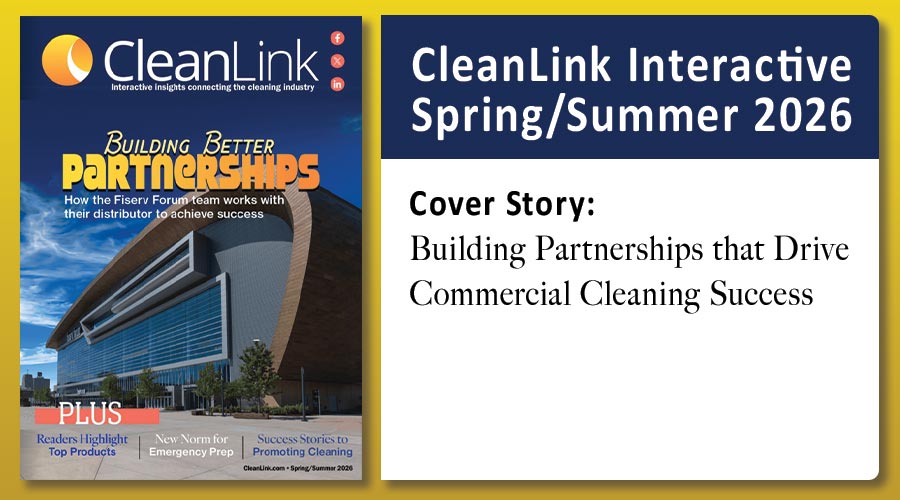
 CleanLink Interactive Spring/Summer 2026 Issue
 Recognizing the 2026 Reader Choice Award Winners
 2026 Emerging Leader Award
 How Surfactant Use is Expanding in Commercial Cleaning

Key Takeaways:
Jan/san distributors can build customer loyalty through value-added services that go beyond cleaning product sales.
Hands-on commercial cleaning training improves safety, compliance, and cleaning performance.
Training can be turned into a customer-retention strategy with practical, repeatable learning resources.
In an industry of sameness, value-added services can turn transactions into lasting customer relationships.
With just a few clicks, building service contractors or facility cleaning managers can purchase cleaning chemicals and equipment from any number of suppliers—a convenience for buyers but a growing challenge for many jan/san distributors. As products and equipment become more accessible, availability alone is no longer a competitive advantage. To differentiate themselves, distributors must increasingly focus on the value they provide post-sale: delivering expertise, service, and ongoing support that help customers achieve better results.
Research suggests that this approach pays off. According to a study in the International Journal of Logistics Management, as products become more alike, customer service becomes a critical factor in strengthening the relationships jan/san distributors have with their end-user customers, giving them a competitive edge.
For Bradley Payne, Sales Consultant at Kenway Distributors Inc., that evolution has been central to the company’s success.
“We’ve gone from simple product suppliers to strategic partners with our customers,” he notes. “In order to differentiate ourselves, we’re leveraging value-added services, like training and in-house equipment repair that reduces downtime.”
Today’s jan/san distributors provide far more than cleaning chemicals and equipment—they educate customers about the products they purchase, train the frontline custodial staff, troubleshoot problems, and repair equipment to keep operations running smoothly.
For customers, those services mean fewer disruptions, lower equipment downtime, and confidence that cleaning programs are carried out safely and effectively. By solving operational challenges—not just filling orders—distributors create partnerships that extend well beyond the initial sale.
Knowledge Pays
A consultative approach to training can pay big dividends—not only for end-user customers but for distributors. Joshua Davis, Founder of JanSan, discovered this when a client sought his advice about implementing a formal staff certification program.
After researching programs, Davis enrolled JanSan in the ISSA Cleaning Management Institute (CMI) Train the Trainer workshop to become a certified training center for his client. The investment paid off in unexpected ways: Not only did it strengthen JanSan’s credibility, but it also equipped Davis’ team with a better understanding of the industry. The customer also benefited from more consistent training that aligned with industry standards.
“We learned a lot about the industry and best practices, as well as how to better communicate with our building service contractor clients,” says Davis. “As a result, we strengthened our relationship with our client, added extra value, and improved the quality of our training. That’s a powerful combination.”
Davis acknowledges that not every customer is in a position to outsource employee training—and not every distributor can invest in a formal certification program. Even so, he believes distributors can add value by offering practical, hands-on education at no additional cost. That kind of instruction can reduce mistakes, improve safety, and increase productivity.
Kenway Distributors Inc. offers on-site equipment and tool demonstrations, including mopping and vacuuming techniques. The distributor also trains custodians on fundamentals, such as reading safety data sheets, operating dilution control systems, and wearing personal protective equipment—practices that promote safety and support compliance with Occupational Safety and Health Administration (OSHA) and Environmental Protection Agency (EPA) regulations.
“We simplify training as much as we can and never assume people know the basics because there’s so much turnover in our sector of business,” Payne says.
Train to Retain
One of the most effective training methods jan/san distributors can offer is hands-on demonstrations. This allows participants to practice using the equipment and implementing procedures while receiving immediate feedback.
When setting up training, Payne often starts with a walkthrough of the customer’s facility. For example, in a hospital, he inventories all chemicals and equipment needed to clean a patient’s room and provides environmental services (EVS) workers with a checklist to organize their cart. Next, he walks EVS staff through the mechanics of cleaning the patient room, demonstrating each step of the process.
In facilities with over 100 employees, Payne recommends dividing participants into smaller groups for breakout sessions. In a hospital setting, he organizes three stations focused on key topics: proper disinfection techniques, bloodborne pathogen safety, and cleaning cart preparation. Rotating through these topics provides individualized instruction while helping trainers identify knowledge gaps before employees return to work.
While hands-on training is one of the most effective ways to teach custodial skills, Payne and Davis share that the following approaches can supplement in-person sessions to improve learning outcomes and build long-term loyalty.
Quick reference tools: Most learning materials have moved online, but end-user customers and their frontline custodians still appreciate printed resources for quick reference on the job. Davis provides laminated cart cards that serve as guides for cleaning chemicals while custodians are mobile. These cards help ensure custodians use products correctly, reducing the risk of mistakes or injury.
Peer learning sessions: Payne schedules quarterly Q&A sessions with healthcare customers to fill in knowledge gaps and address their pain points. This is also a prime time to share personal experiences. “We ask staff to share their success stories because it’s a great opportunity for people to learn from others—and it creates team bonding,” he says.
Customized certification programs: In addition to helping customers pursue industry certifications, distributors can develop their own certification programs tailored to each client’s needs. Kenway Distributors Inc., for example, hosts annual continuing education days for clients who oversee schools and hospitals, providing new training opportunities and awarding certifications at various competency levels. This approach not only builds a stronger customer/distributor relationship, it recognizes employee achievement and helps customers build a more knowledgeable, engaged workforce.
Why Details Make the Difference