
 CleanLink Interactive Spring/Summer 2026 Issue
 Recognizing the 2026 Reader Choice Award Winners
 2026 Emerging Leader Award
 How Surfactant Use is Expanding in Commercial Cleaning

Key Takeaways:
• Accelerated jan/san distributor consolidation is reshaping the market, forcing building service contractors and facility cleaning managers to adapt to larger, more centralized competitors.
• The traditional commercial cleaning supply chain is dissolving as non-traditional MRO and digital procurement giants like Grainger, Amazon Business, and Uline capture massive market share in cleaning category volume.
• To maintain a defensible position, jan/san distributors and manufacturers must evolve beyond traditional facility cleaning products and integrate into broader digital procurement networks, packaging, and facility maintenance ecosystems.
For more than a decade, mergers and acquisitions (M&A) have steadily reshaped the jan/san industry. The accelerating pace of consolidation has created larger competitors, concentrated purchasing power, and left many manufacturers and distributors uncertain about where they fit. But consolidation is only part of the story. The future of jan/san will also be shaped by the convergence of janitorial, packaging, MRO (Maintenance, Repair, and Operations), and digital procurement. The essential question is whether manufacturers and distributors can establish a defensible position within that broader market.
Much of the industry's attention is focused on the merger of Imperial Dade and BradyPLUS, now operating as Imperial Brady. The combined organization's approximately $10 billion in annual revenue, more than 13,000 employees, and a broad North American distribution network create unprecedented scale within the traditional jan/san market.
But focusing exclusively on Imperial Brady risks overlooking the more consequential change taking place.
When the largest commercial sellers of janitorial and cleaning supplies are assessed using estimated category volume, national-account reach, product and digital scale, and customer or distribution footprint, Imperial Brady is followed by companies such as Grainger, Amazon Business, and Uline.
None are a traditional jan/san distributor.
That is powerful evidence that the jan/san channel is not merely consolidating. Its boundaries are disappearing.
A Broader Competitive Market
Imperial Brady illustrates this convergence. Although it is commonly viewed as a jan/san distributor, the company defines its business across cleaning and facility care, foodservice, and packaging.
Similarly, nontraditional competitors are expanding into jan/san:
Grainger offers a large commercial cleaning and janitorial assortment supported by its broader MRO infrastructure, national account relationships, digital platform, and branch network.
Uline combines janitorial products with packaging, shipping, and industrial supplies, using direct marketing, proprietary products, and rapid fulfillment to reach customers nationwide.
Amazon Business operates under an entirely different model. On July 21, 2026, it reported reaching $60 billion in annualized gross merchandise value (GMV) and serving more than 11 million organizations worldwide. While GMV is not directly comparable to distributor revenue, the scale demonstrates Amazon's growing influence over organizational purchasing.
The crucial point is not simply that these companies sell cleaning products. It is that three of the most powerful competitors in the category never needed jan/san to own the customer relationship.
Beyond Consolidation
Knowledgeworx drafted a white paper that divided the market into three primary distribution tiers: mega-distributors, regional distributors, and specialized local companies. That framework remains useful because it captures the growing concentration of purchasing power at the top of the market and the increasing importance of service specialization at the local level.
But the competitive landscape has evolved beyond that three-tier model. A fourth and fifth force now need to be recognized: nontraditional integrated and digital suppliers.
These companies may not have originated in jan/san. Still, they are increasingly important competitors because they sell the same products through different business models, customer relationships, and procurement systems. (See chart)
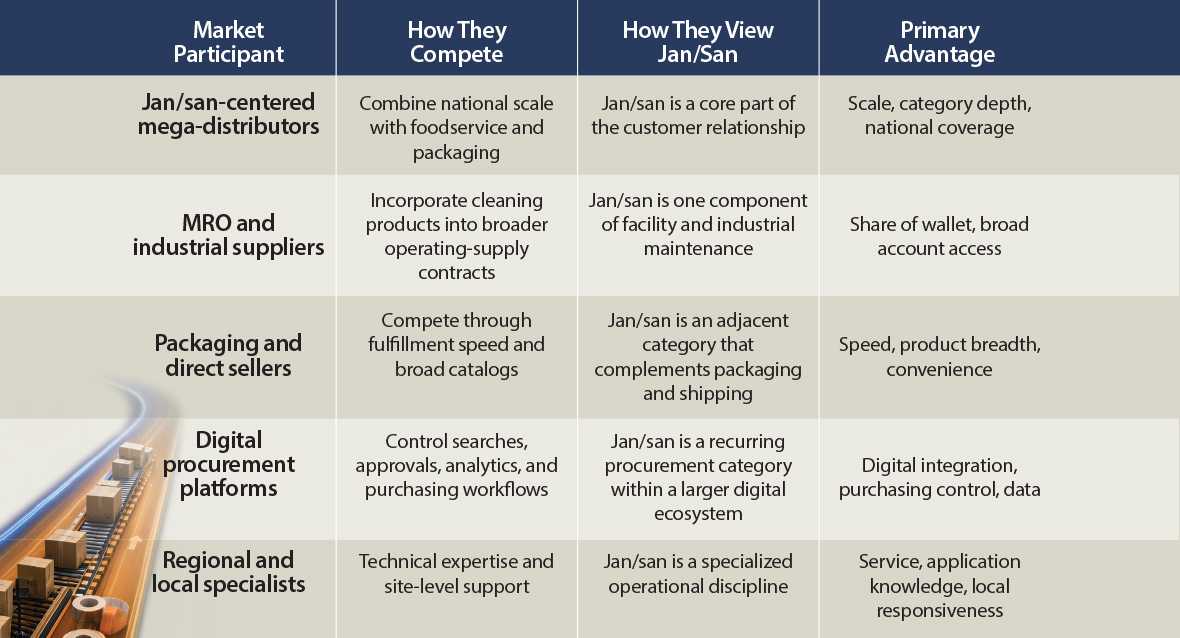
The significance of this shift is that these competitors define the market differently, even when they are selling many of the same products.
A traditional jan/san distributor may view chemicals, equipment, paper, and liners as the foundation of the customer relationship.
An MRO supplier, such as Grainger, may view those same products as one part of a much broader facility and industrial maintenance program. Uline can combine jan/san with packaging and shipping supplies.
Amazon Business can position those purchases as recurring transactions within a broader digital procurement ecosystem that also manages searches, approvals, spend visibility, and purchasing workflows.
From the customer's perspective, those channel distinctions are often irrelevant. Customers are focused on whether a supplier can simplify purchasing, provide needed products, deliver reliably, integrate with existing procurement processes, and ultimately improve operating performance.
That is why the competitive issue is larger than distributor consolidation alone. The jan/san channel is not simply becoming more concentrated; it is being redefined by companies with different business models, different sources of competitive advantage, and different ways of controlling the customer relationship.
Jan/San Distributors Use Strategy to Pave the Path for Future Sales