
 CleanLink Interactive Spring/Summer 2026 Issue
 Recognizing the 2026 Reader Choice Award Winners
 2026 Emerging Leader Award
 How Surfactant Use is Expanding in Commercial Cleaning
Key takeaways:
• AI chatbots can improve jan/san customer convenience by providing real-time product availability and purchase support, provided they are easy to find, connected to current inventory data, and able to transfer customers to staff when needed.
• Jan/san distributors can increase warehouse accuracy and productivity with technologies such as computer vision, IoT, voice picking, pick-to-light, AMRs, RFID, and route optimization.
• Successful technology adoption depends on change management—especially clear communication, employee training, and demonstrating how new tools support rather than replace frontline workers.
AI agents, also known as chatbots, are becoming an increasingly valuable tool for jan/san distributor websites. The key, according to experts, is focusing on customer convenience.
“Make the chatbot easy to find and easy to use—and make sure it’s tied to a database that is kept up to date,” says Streeter. “Most people will go to a website before they call, so distributors need to make it easy to find and buy stuff.”
Modern AI-powered chatbots can connect directly to inventory systems and answer product availability questions in real time. A customer looking for a specific cleaning chemical can ask whether the item is available and receive an immediate response.
“I need 10 units of XYZ chemical—do you have that in stock?” Streeter says, describing a common scenario. “It’s going to say, ‘Yes, and would you like to buy it now?’”
While chatbots are a natural extension of customer service operations, Streeter emphasizes that they should complement—not replace—human interaction.
“There has to be the ability to talk to somebody, otherwise customers get into these recursive loops that are frustrating,” says Streeter “Make sure you have the ability to hand off to a person at the right time.”
Measuring chatbot performance is equally important. Tracking common questions, customer drop-off points, and unresolved issues can provide valuable insights for continuous improvement.
Smarter Warehouses
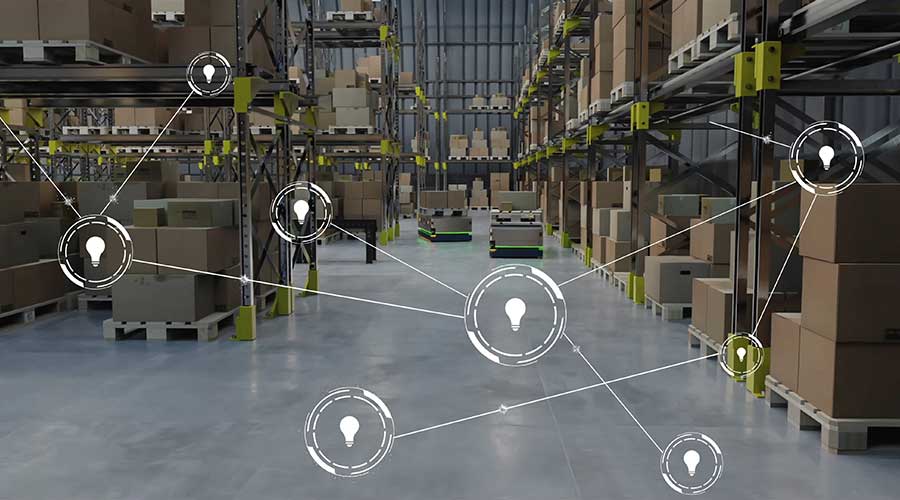
Warehouse operations are another area where technology is delivering measurable gains. Streeter believes AI’s ability to “see, hear, and speak” is opening new possibilities for inventory management. Using computer vision technologies, distributors can automatically analyze images and videos to track inventory levels. For example, AI can identify pallet quantities, monitor inventory movement, and update records with minimal manual intervention.
The technology becomes even more powerful when combined with Internet of Things (IoT) devices.
“The Internet of Things allows the warehouse to have a pulse,” Streeter explains. “AI has the ability to take these massive datasets and make decisions based on those datasets.”
Quinn shares several warehouse technologies that are becoming increasingly accessible. For instance, voice-picking systems provide workers with hands-free instructions through headsets, improving both efficiency and accuracy. And pick-to-light systems guide workers directly to storage locations using illuminated indicators, reducing search time and errors. Autonomous mobile robots (AMRs) are also gaining traction.
“If there’s a lot of driving around the warehouse with pallets, AMRs allow you to move pallets from one place to another without a person, which is both a labor and time savings,” says Quinn.
For higher-volume operations, goods-to-person systems bring inventory directly to workers rather than requiring them to travel throughout the warehouse. Quinn also highlights radio frequency identification (RFID) technology, which has become more affordable and practical in recent years and is a great tool for tracking high-value stock-keeping units (SKUs).
Once a truck leaves the facility, fleet management software allows distributors to monitor vehicles and drivers in real time. Route optimization tools extend benefits beyond simple vehicle tracking, allowing distributors to identify the most efficient delivery sequences, which helps reduce fuel consumption and increases driver productivity.
As AI capabilities expand, transportation data can increasingly be integrated with warehouse and customer information to create more connected distribution operations.
The Human Side of Change
Despite the potential benefits, technology adoption often faces one significant obstacle: employee resistance.
“Most of the fear that happens is from frontline workers who are worried about losing jobs,” Streeter says. “So there has to be a champion, and you have to have a change management plan.”
Streeter isn’t alone in thinking this.
“Don’t underestimate the depth of change management required when updating systems and processes,” Quinn says. “You’re dealing with people, so it’s important that they are trained and prepared to use the new technology.”
Likewise, communication plays a critical role.
“The second you think you’re communicating too much, you’re still not communicating enough,” Quinn adds. “Employees need to understand not only what is changing, but why the change is occurring and how it benefits them personally.”
Indeed, with the right training, support, and communication, employees are likely to see technology not as a threat but as a tool that empowers them to work more efficiently and productively.
Kassandra Kania is a freelance writer based in Charlotte, North Carolina, and is a frequent contributor to Sanitary Maintenance.
Jan/San Distributors Explore Business Growth Using AI