
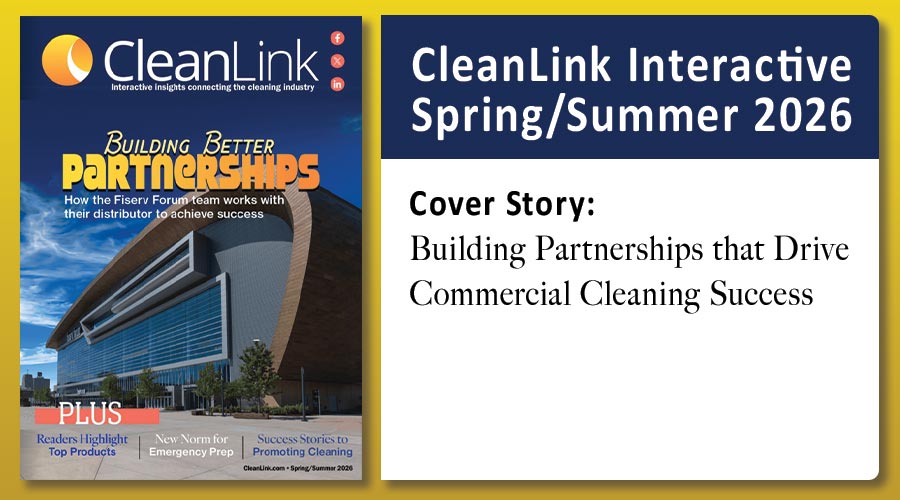
 CleanLink Interactive Spring/Summer 2026 Issue
 Recognizing the 2026 Reader Choice Award Winners
 2026 Emerging Leader Award
 How Surfactant Use is Expanding in Commercial Cleaning

Key Takeaways:
• A facility-specific sanitary survey can help jan/san distributors map how germs move before specifying cleaning solutions.
• Prioritizing high-touch surface cleaning can interrupt pathogen transmission.
• Cleaning chemistry should be matched to soil type and risk level for better cleaning outcomes.
Germs don’t stay put. They move from hands to high-touch surfaces, from one area to another, and, when cleaning practices fall short, to the very tools meant to remove them.
Research shows just how quickly this can happen. Charles Gerba, PhD, Professor of Virology at the University of Arizona, and his research team placed a virus on a push plate in an office building occupied by 80 people. The results were discomforting.
“Within four hours, 50 percent of the office surfaces had the virus on them,” Gerba says. “Workers picked up the virus on their hands and transferred it to computers and other surfaces as they moved through the building.”
How to Start
When jan/san distributors better comprehend how germs travel, they can help end-user customers stop them—no matter the facility type. Before spec’ing chemicals, equipment, or cleaning processes, distributors must understand building use, occupancy, traffic patterns, surfaces, and seasonal conditions. Robert Powitz, a formally trained Institutional Sanitarian and Owner of R.W. Powitz & Associates, P.C., starts with what he calls a “sanitary survey.”
“I look at the environment,” Powitz explains. “What is it about the environment that I must worry about? What is it about the environment that I don’t have to worry about?”
He then matches chemicals, equipment, and cleaning processes to actual conditions.
“Too often somebody says, ‘Oh, my building’s dirty,’ and then they bring in a distributor who recommends a magic juice that’ll clean everything. And later, they still have a problem,” Powitz says. “It should be a systemic approach based on science, not fiction.”
That means considering everything from the amount and type of soil entering the building to how traffic changes throughout the day and year. For example, heavily used touchpoints, such as elevator buttons, doorknobs, push plates, and banisters, may require more frequent attention than other surfaces.
Keith Schneringer, Senior Director of Marketing and Sustainability for Imperial Brady, echoes that approach.
“Start with the facility and the facility team’s challenges rather than the specific product recommendations,” he advises. “That assessment should consider current products and procedures, traffic patterns, surfaces, high-risk areas, staffing, training, equipment, chemical usage, and safety concerns.”
Once jan/san distributors develop a greater understanding of a customer’s facility, they can begin matching that space to the proper chemistry for the job.
The type of soil determines which chemical to use, so it’s important to know what soils the customer encounters. Alkaline cleaners, for example, are better suited for removing proteins and fats, while acidic cleaners are needed for scale, according to Ethan Solomon, Head of Global Technology and Applications at LANXESS Material Protection. When disinfectants are applied to dirty surfaces, they can reduce their effectiveness, so it’s important that the customer understands a surface must be cleaned before disinfectant is applied.
There are also environments where stronger interventions are warranted. Hospitals, foodservice and food manufacturing, pharmaceutical manufacturing, and other critical areas may require sanitizers or disinfectants. But that does not mean the same products belong everywhere.
“Do I really need a disinfectant in the rotunda of Grand Central Station, New York?” Powitz asks. “The answer is no. I need to remove dirt because I’ve got several thousand people walking through there in an hour.”
No Dilution Control and Other Chemical Mishaps