
 CleanLink Interactive Spring/Summer 2026 Issue
 Recognizing the 2026 Reader Choice Award Winners
 2026 Emerging Leader Award
 How Surfactant Use is Expanding in Commercial Cleaning
Key takeaways:
• Public facilities are recommended to have hand hygiene programs that include skin-friendly, fragrance-free, dye-free, or hypoallergenic soaps where appropriate to improve comfort, support frequent use, and accommodate sensitive building occupants.
• Hand sanitizer should complement handwashing, with ADA-compliant dispensers placed near restroom exits or other convenient locations to improve access and usage.
• Distributors can strengthen customers’ infection-prevention programs by favoring effective drying options, providing visual hand-hygiene signage, and preparing adequate soap, sanitizer, wipes, and towels ahead of illness peaks.
Ultimately, Schneringer believes end user customers should spend less time debating foam or liquid soap and more time evaluating the ingredients. Products formulated to be gentle on skin can improve comfort, which would in turn encourage regular use.
“When people complain that the soap is drying their skin, look at the ingredients of the soap,” he advises. “Usually, the products contain ingredients that dry the skin.”
Fragrance is another consideration distributors should be prepared to discuss.
“People are becoming sensitive to various ingredients and fragrances,” Fellows notes. “You’ve got people who love a little fragrance, but there may be other people in that same building who can’t tolerate it.”
Fragrance-free, dye-free, and hypoallergenic products are a great alternative for healthcare, education, and public-facing facilities. Fellows compares those accommodations to accessibility requirements.
“Not everybody has a problem with fragrances, but for the ones that do, it’s really important that something be done to help them,” he says.
Like soap, hand sanitizer adds value to hand hygiene programs.
“Building occupants should be encouraged to wash their hands and then use a hand sanitizer on the way out,” Gerba says, noting that research shows that handwashing alone may not remove enough viral particles to eliminate infection risks from highly contagious pathogens, such as norovirus.
Fellows views hand sanitizer as an important supplement when soap and water are not readily available.
Despite its benefits, sanitizer usage rates are affected by dispenser placement. Distributors should work with end user customers to position dispensers near restroom exits, while also considering accessibility. Dispensers set more than 48 inches above the ground are in violation of the Americans with Disabilities Act (ADA).
Handwashing and sanitizing are major components of hand hygiene, but the final step is just as important. If hands aren’t properly dried, everything that took place prior matters much less. And when it comes to drying hands, the core question revolves around using paper towels or air dryers.
Gerba, Schneringer, and Fellows all prefer paper towels over machine drying options. These experts stress that paper towels do a better job of drying hands and don’t spray the germs into the air.
But distributors should remain open minded to end user preferences. Hand dryers do appeal to some facilities focused on reducing paper consumption. However, jan/san distributors can help customers evaluate broader implications, including maintenance requirements, moisture accumulation, and infection-prevention priorities.
Final Steps
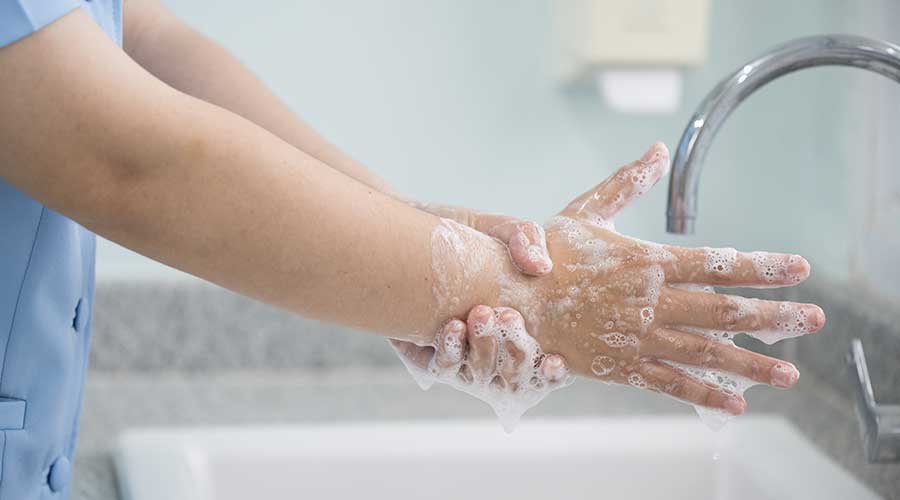
Education must be a key part of every hand hygiene program. One way to spread information is to provide signage in restrooms, reminding people of hand hygiene’s importance and how it is done correctly. When supplying signage, jan/san distributors should ensure it includes images, as restroom users are more likely to scan signage that has more than just words.
Jan/san distributors can also help customers take hand hygiene programs to the next level by preparing them for seasons where illnesses spike.
“We’re seeing two spikes per year,” says Schneringer. “There’s a spike in the winter and a spike that happens August through September as students go back to school.”
Gerba’s research found that providing employees with disinfecting wipes and hand sanitizer at their desks during these peak times can reduce transmission by as much as 70 percent.
Distributors can also help customers prepare for cold and flu seasons by reviewing their product inventories, evaluating dispenser capacity, and ensuring they have adequate supplies of soap, sanitizer, and drying options.
By marrying scientific research with facility experience and advice, distributors can help customers create hand hygiene programs that improve compliance, reduce germs, and keep occupants healthier throughout the year.
Ronnie Wendt is a freelance writer and owner of In Good Company Communications in Waukesha, Wisconsin.
Helping Jan/San Customers Build Hand Hygiene Programs