
 CleanLink Women of Clean - 2026 Honorees Announced
 CleanLink Interactive Spring/Summer 2026 Issue
 2026 Emerging Leader Award
 Recognizing the 2026 Reader Choice Award Winners
Key Takeaways:
• Conducting on-site janitorial closet and dispenser audits empowers jan/san distributors to act as efficiency consultants.
• Customizing restroom supply bundles across facility foot traffic, industry standards, and sustainability goals help cleaning managers streamline procurement.
• Jan/san distributors must proactively mitigate supply chain concentration risks and position themselves as strategic growth partners.
Helping an end-user customer understand their needs is vital to building the right restroom bundle.
“It requires shifting from a product-pusher mindset to acting as an efficiency consultant who reduces labor costs, increases productivity, and provides solutions,” theorizes Niffenegger.
To start, he proposes asking to conduct an on-site audit to check janitorial closets and activate dispensers. Niffenegger strongly suggests documenting current brands, core sizes, and dispenser compatibility, while also noting exact specs like paper-ply count and soap dispensing type. After the walkthrough, jan/san distributors should build a presentation that demonstrates the total cost optimization that bundles can provide.
“Show how high-capacity jumbo rolls cut labor time by reducing changeouts. Demonstrate how proprietary or controlled-use dispensers reduce product waste and increase customer satisfaction. Simulate a switch moving an industrial account from multifold towels to high-capacity rolls, typically saving 20–30 percent in annual consumption,” Niffenegger recommends.
Of course, individual customers have individual needs. Customized bundling should match supplies directly to those specified needs, such as foot traffic rate, industry standards, and budget constraints.
For clients with sustainability goals, offering green restroom solutions shows a distributor shares their customers’ values.
“Key offerings include coreless toilet paper, biodegradable soaps, energy-efficient hand dryers, and recycled paper products,” Niffenegger notes. “With your relationship, you help your clients hit their own Corporate Social Responsibility (CSR) goals, making your partnership indispensable.”
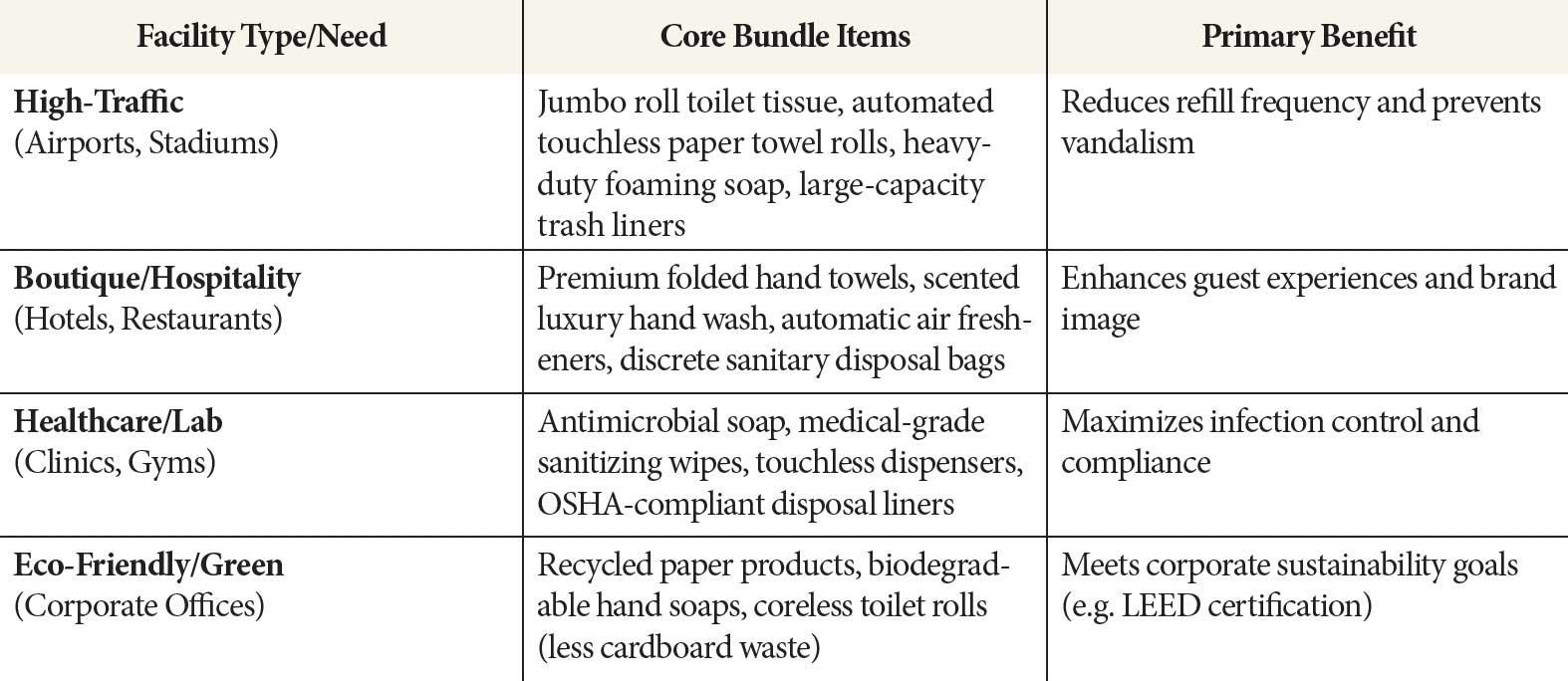
The same goes for other specialty end users, like those managing luxury hotels, high-traffic locations, and healthcare facilities. (See chart for Niffenegger's recommendation of possible bundles and their benefits.)
How to Group Bundles by Specific Needs
A Win/Win Strategy
Selling restroom bundles offers benefits for all parties. Businesses and property managers generally use bundling to lower their Total Cost of Ownership (TCO), streamline procurement, and ensure design consistency across facilities. On the other hand, jan/san distributors can anticipate value-driven revenue.
“Bundling janitorial products and services creates convenience for clients while driving predictable, higher-margin revenue for your business,” Niffenegger explains. “Value is created for the client with a single point of contact, guaranteed readiness, and time savings—streamlining ordering, receiving, and invoice processing. Profitability is maintained with volume supplier discounts, reduced overhead, consolidating deliveries, regular, consistent orders, and lower fulfillment costs.”
And, of course, for the customer, there will be discounts. Niffenegger reports bundled restroom packages typically offer a “10 to 30 percent discount compared to purchasing items individually, à la carte.”
End users can also enjoy price stability, which is an element that offers them peace of mind during turbulent times.
“In the past, it was not uncommon for some price contracts to go for two to three years,” Davis reveals. “Of course, things are more volatile today, so price terms go for about six months. Still, that price stability is key.”
Other bundling positives, aside from price stability and access to discounts, include simplified shipping, guaranteed matching finishes and fit, and simplified maintenance and warranty.
“With a single point of contract, end users never have to manage separate warranties and multiple manufacturer contacts,” says Niffenegger.
However, not all customers will be on board to purchase restroom supplies this way. Supply chain disruptions—from factory fires, labor strikes, or even natural disasters—may instantly halt production. Without competitors to benchmark against and no pricing to leverage, the ability to counter price hikes or downgraded quality is removed. Leverage also disappears if a supplier goes bankrupt or is acquired. Also, a single vendor might not be able to keep up with sudden growth or a rapid increase in demand.
“Customers don’t always like bundled product groups and single-source suppliers because these approaches limit their freedom, increase financial risk, and can feel manipulative or fragile,” says Niffenegger. “Purchasing from just one supplier creates a high concentration of risk that can lead to severe operational halts or financial strain if that single source fails.”
Still, the bundling strategy offers so many advantages to both parties that it’s difficult not to see the win/win reality. Consistency, continuity, and simplification translate into a strong, long-lasting partnership—if jan/san distributors approach sales with the right mindset.
“If you are selling these products, don't just sell soap and paper towels. Sell peace of mind, wellness, and user experience. Help your clients understand that a clean, well-stocked restroom increases their customers' satisfaction,” says Niffenegger. “The relationship impact you have positions you as a strategic growth partner rather than a line-item expense.”
Amy Milshtein is a freelancer based in Portland, Oregon. She is a frequent contributor to Sanitary Maintenance.
How Product/Service Bundles Improve Restroom Care