
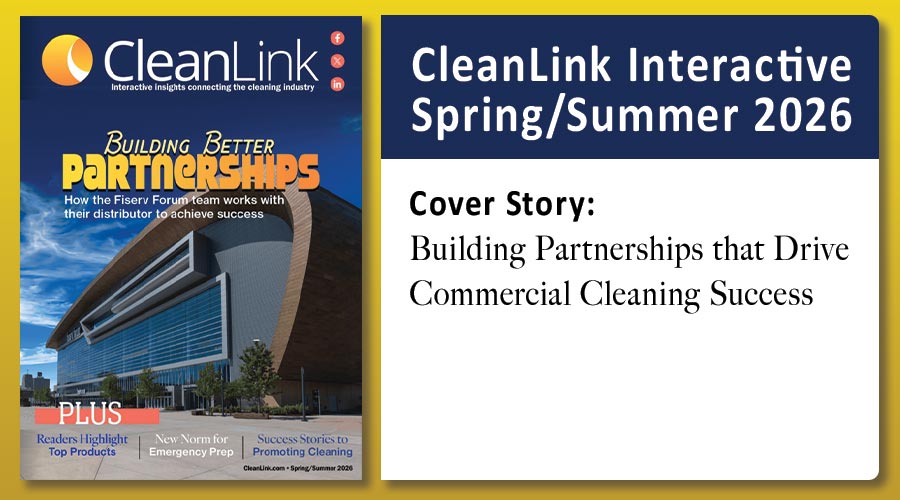
 CleanLink Interactive Spring/Summer 2026 Issue
 Recognizing the 2026 Reader Choice Award Winners
 2026 Emerging Leader Award
 How Surfactant Use is Expanding in Commercial Cleaning
The American Cleaning Institute (ACI) led a coalition of 26 attendees representing 15 member companies in a Congressional fly-in to build momentum around proposed legislation to amend the Toxic Substances Control Act (TSCA). The visits focused on members of the House Energy and Commerce and Senate Environment and Public Works Committees.
ACI worked with industry organizations to share the real-world impact of challenges imposed by the current TSCA statute. Currently, the chemical review process can create bottlenecks, leading to delays in getting safer, more sustainable chemistries and products to the commercial cleaning market.
“ACI and its member companies support targeted, bipartisan refinements that preserve TSCA’s health protections while ensuring EPA decisions reflect real-world conditions of use, focused on credible risks and are implemented through predictable, timely processes,” says Blake Nanney, ACI’s Director of Government Affairs.
Nanney called out five specific areas where proposed bills by both the U.S. House of Representatives and the U.S. Senate would streamline new chemistry review under the Environmental Protection Agency (EPA):
1) Focus evaluations on credible risks: Prioritize exposure pathways that are more likely than not to occur, so EPA resources target the highest-risk situations.
2) Clarify “conditions of use”: Ensure reviews reflect intended and credibly foreseeable uses and appropriately recognize effective exposure controls that protect workers and communities.
3) Create priority review pathways: Accelerate review for innovations—safer substitutes and Safer Choice-aligned chemistries—that demonstrably reduce hazards and exposure compared with legacy substances.
4) Strengthen risk management: Emphasize measures that reduce risk to the extent reasonably feasible to drive real-world protections while minimizing unintended consequences.
5) Allow appropriate treatment of chemically equivalent substances: Avoid duplicative reviews where EPA has already assessed equivalent substances, while preserving EPA oversight.
6) Reinforce coordination and scientific rigor: Improve predictability through clearer timelines, earlier engagement, stronger interagency coordination, and fit-for-purpose peer review.
“These changes would better align implementation with Congress’s intent—strong protections, science-based decisions, and a system that encourages safer innovation rather than delaying it—allowing EPA to deliver measurable risk reduction on the highest-priority chemicals,” Nanney shares. “These targeted clarifications would strengthen TSCA implementation and uplift U.S. innovation while maintaining the bipartisan balance Congress established in the 2016 reforms.”