
 CleanLink Women of Clean - 2026 Honorees Announced
 CleanLink Interactive Spring/Summer 2026 Issue
 2026 Emerging Leader Award
 Recognizing the 2026 Reader Choice Award Winners

Key Takeaways:
• Implementing continuous, multimodal infection-prevention training to integrate life-saving disinfection protocols into the daily janitorial services workflow.
• Frontline staff must receive comprehensive education on the technical distinction between soil removal and pathogen eradication to effectively break the chain of transmission.
• Professional cleaning teams are operational defenders of building occupant health rather than clinical infection preventionists.
Ideally, infection-prevention training for janitorial staff should combine classroom instruction, hands-on practice, written procedures, and ongoing evaluation and reinforcement. This approach makes infection prevention part of the normal workflow rather than a once-a-year training exercise. Frontline staff should understand not only what procedure to follow, but also why it matters and how their actions protect building occupants, co-workers, and themselves.
“I don’t think we give cleaning staff enough credit for the impact they have on infection prevention. They literally save lives,” shares Warren. “Cleaning and disinfection are one of the ways we break that chain of transmission. Training gives staff not only the 'what' and 'how,' but also the 'why,' which I think is incredibly important.”
The “why” should include training on the difference between cleaning and disinfection.
“That distinction really matters. You can remove visible dirt and still leave pathogens behind. Disinfectants may not work as intended if a surface isn’t properly cleaned first. Staff need to understand what each step is actually accomplishing, and why both matter,” Warren adds.
Walker clarifies that custodial workers are themselves “not infection preventionists, nor should they be expected to perform that role.” He explains that although “infection preventionist” isn’t necessarily a universally degree-protected title, credible clinical practice generally requires relevant postsecondary education, supervised experience, and, often, professional certification. Custodial work can be—and often is—an essential part of an organization’s infection prevention program, he notes.
“Training should translate infection prevention requirements into clear, job-specific practices: PPE use, hand hygiene, chemical use and dilution, required contact time, cleaning process, prevention of cross-contamination, equipment handling and maintenance, and procedures for higher-risk situations such as bodily fluid spills,” adds Walker.
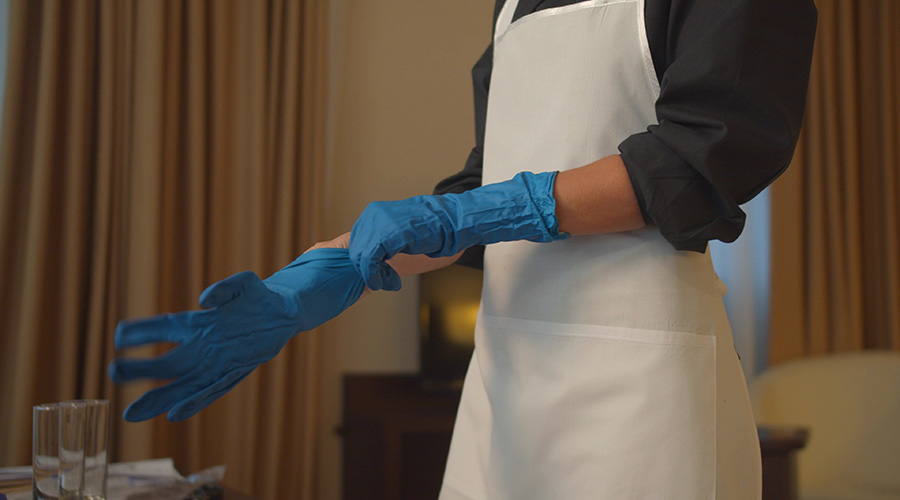
Experts agree that the most effective IPC training is hands-on, job-specific, and competency-based rather than lecture-only instruction. Topics covered in training should include compliant handwashing protocols, correct use (donning and doffing) of PPE, proper application of disinfectants, standard cleaning techniques, and consistent handling and transporting of contaminated materials. Worker competency can be verified through observation checklists to confirm that employees are performing critical procedures correctly.
The best custodial training programs don’t treat training as a one-time event. The most effective departments are those that make continuous learning a feature of their operation.
“The best programs I’ve seen combine in-person classes, interactive content support, guided hands-on practice, proficiency demonstrations, and certificates of completion throughout all phases of employment,” Walker says.
With the industry’s ever-evolving practices, products, and technologies, it’s imperative for facility cleaning managers to break the natural habits people form over time.
“Regular refresher training is important, but I also think some of the best training happens in real time,” Warren shares. “If you identify a problem, see something that could be improved, or learn something new, that’s an opportunity to teach, not just correct.”
Warren calls himself a big fan of objective feedback. Fluorescent markers are a great example of this in practice.
“You can put an invisible marker on a surface before cleaning and then use ultraviolet (UV) light afterward to see whether it was actually removed,” he says. “It gives staff immediate, visual feedback, and gives you an objective way to measure cleaning performance over time."
Not to be overlooked is the need for bilingual or multilingual training for custodial staff. If a procedure is expected to be followed, frontline staff need to have full access to comprehend the training.
“Our blessing in the cleaning profession is a multilingual, multicultural, and multi-able workforce,” says Walker, who has personally trained rooms of custodians where two or three different languages were spoken. “One thing I’ve found is that almost everyone understands color and numbers. The simpler the training is, the more it relies on color-coding and numbers to reinforce the learning objectives, and the more consistently the operation maintains that color-coding in practice, the easier it is for workers to understand and succeed.”
When asked what common mistakes they've seen custodial staff make, Warren identifies incorrect disinfectant dwell times. He also sees high-touch surfaces missed, surfaces wiped too quickly, or the same cloth used across too many surfaces. These errors usually aren’t people intentionally doing something wrong, he shares; they are signs that the process or training needs to be improved.
Similarly, Walker finds that workers don’t understand or haven’t yet been adequately trained on how to use daily cleaning chemicals.
“I try to get the daily cleaning chemical inventory down to three to four color-coded chemicals and make sure each cleaning function relies on only one. It’s much easier on the worker, and it’s much safer for the organization,” he says.
Custodial workers are an integral component of IPC in the facilities they clean, and it’s important they understand why their work matters. After initial training and orientation for new employees, managers should provide periodic refresher training, regular safety meetings, retraining when procedures or products change, and reviews after an infection-control incident or identified error. Simplify chemicals, tools, procedures, and visual cues that frontline teams are expected to use, and train them with those same materials in the environment where they’ll perform the work.
Infection prevention succeeds when the process is clear, repeatable, and reinforced as part of everyday cleaning.
Shannon O’Connor is a freelance writer from Mason, Ohio
Top Tools and Training Improving Infection Prevention