
 CleanLink Women of Clean - 2026 Honorees Announced
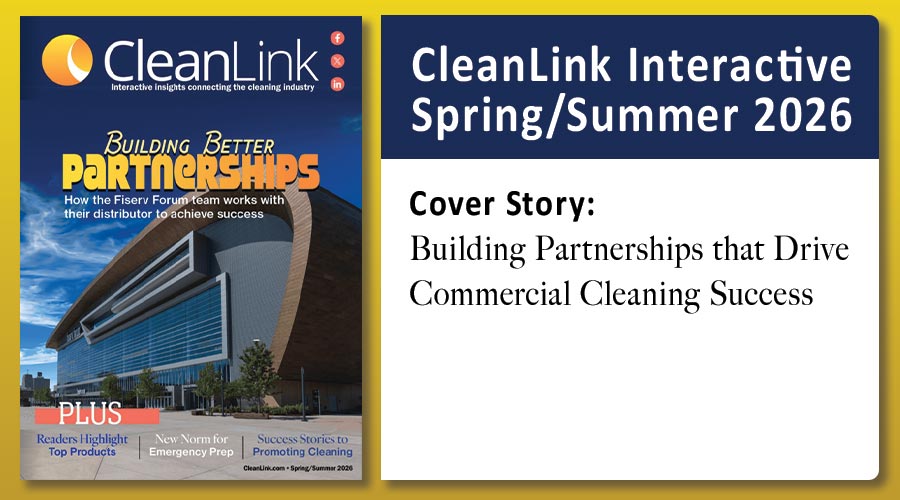 CleanLink Interactive Spring/Summer 2026 Issue
 2026 Emerging Leader Award
 Recognizing the 2026 Reader Choice Award Winners


Key Takeaways:
• Advanced floor pads improve productivity and reduce labor.
• Proper pad selection protects floors and ensures consistent results.
• Innovative pads reduce resource use and extend floor life.
When it comes to technological advancements in the professional cleaning industry, most of the attention is placed on artificial intelligence and robotics. While those advancements are exciting, breakthroughs in floor pad technology can’t be ignored.
To get a better idea of where floor pad technology stands, Facility Cleaning Decisions spoke with Dale Franke, Vice President of Sales and Marketing at Acme Paper & Supply Co., Inc.
Q: How can new floor pad technologies help improve productivity?
FRANKE: Labor remains one of the biggest challenges cleaning teams face. Many facilities are being asked to maintain the same amount of space, and in some cases even more, with fewer people. That makes productivity extremely important.
Advances in floor pad technology can help cleaning teams accomplish more in fewer steps. Improved mechanical action can mean fewer passes over a floor, less rework, and, depending on the application, fewer separate maintenance procedures. If we can help a frontline team achieve the desired result faster and more consistently, we're giving valuable time back to an already understaffed operation.
That's why I don't think the conversation should focus on the cost of a floor pad alone. We should be looking at the total cost of maintaining that floor, and labor is a major part of that equation.
Q: How might floor pad improvements result in easier work?
FRANKE: Floor care can be physically demanding work. Employees may spend hours walking behind equipment, maneuvering machines, and repeatedly covering the same areas.
When the pad, machine, and application are properly matched, the equipment can do more work than the operator. Improvements in pad construction and performance can reduce unnecessary resistance, improve contact with the floor, and potentially reduce the number of passes needed to achieve the desired result.
From an ergonomic standpoint, anything we can do to reduce repetitive motion, pushing, pulling, machine time, and overall physical effort can make a meaningful difference for frontline employees.
Q: How is improved floor pad technology helping create consistent results?
FRANKE: Consistency is a major challenge in facility cleaning, particularly when customers deal with staffing shortages across multiple shifts. Improved pad technology can deliver more predictable performance, but I think there's another important part of this conversation: simplifying the employee’s process.
Distributors should be helping their customers clearly identify which pad is used for each floor, machine, and application. The more complicated we make the process, the greater the opportunity for mistakes. When employees understand what to use, where to use it, and why, results become much more consistent.
Q: What types of pads do you recommend for each flooring type?
FRANKE: There isn't a single pad that works for every floor. The first thing we need to understand is the floor type, its condition, the customer's desired appearance, the level of soil, the equipment being used, and what the team is trying to accomplish.
For resilient floors such as Vinyl Composition Tile (VCT), we generally consider the maintenance objective and select the appropriate level of aggressiveness—routine cleaning and polishing require a very different pad than deep scrubbing or finish removal.
With Luxury Vinyl Tile (LVT) and Luxury Vinyl Plank (LVP), we typically prefer a less aggressive approach that cleans effectively without unnecessarily damaging or abrading the wear layer.
Stone, terrazzo, and polished concrete can benefit from specialized abrasive pad technologies that mechanically clean and refine the surface while helping maintain its appearance.
Ceramic and porcelain tile flooring pose another challenge, especially when the surface is textured. In those cases, we may need additional mechanical action to remove embedded soils.
The point is that the floor and desired outcome should determine the pad selection. We shouldn't start with a pad and then try to make it fit the application.
Q: How can pads reduce chemical and water use?
FRANKE: One of the more interesting developments in floor care is the growing ability to rely on mechanical action rather than chemistry alone.
Advances in abrasive and surface-engineered pad technologies can help remove soil, marks, and surface imperfections through controlled mechanical action. Depending on the floor and application, this may allow a facility to reduce the amount or concentration of chemistry used and, in some processes, operate primarily with water. Reducing chemical and water use can also simplify training and reduce some of the handling and dilution issues facilities encounter. However, that doesn't mean chemistry is no longer important. The objective should be to use the right combination of chemistry, water, and mechanical action to achieve the desired result without using more resources than necessary.
Q: How and why does new floor pad technology help extend floor life?
FRANKE: Using a pad that is more aggressive than necessary can remove finish or unnecessarily wear the floor surface. Newer pad technologies provide more options for controlled mechanical action—enough to remove soil and restore appearance without being unnecessarily aggressive.
That can help facilities extend the time between major restorative procedures such as stripping, refinishing, or heavy abrasion.
I like to think of it as maintaining rather than restoring whenever possible. The longer we can keep a floor looking good through routine maintenance, the more we can reduce labor, material costs, and disruption, all while protecting the facility's investment.
Q: How do floor pads support newer equipment and cleaning methods?
FRANKE: I think it's important to view the equipment, pad, chemistry, and cleaning process as a complete system rather than individual products.
Floor care equipment has evolved significantly. We now have orbital and oscillating machines, advanced autoscrubbers, improved pressure and water-management systems, and increasingly sophisticated autonomous equipment.
Pad technology has evolved alongside those machines. The pad needs to complement the equipment's speed, pressure, motion, water usage, and intended application.
Autonomous equipment makes consistency even more important. If we're going to automate part of the cleaning process, we need predictable results. The machine, pad, chemistry, and process must all work together.
Ultimately, I think that's where the jan/san distributor brings tremendous value. Our job isn't simply to sell a customer a floor pad or a piece of equipment. It's to understand their facility, floors, labor challenges, equipment, and expectations, and then help them build a floorcare program that delivers the desired result as efficiently and consistently as possible.
Jake Meister is the Managing Editor for Trade Press Media Group's Cleaning Group of brands. He works on three magazines: Sanitary Maintenance, Contracting Profits, and Facility Cleaning Decisions, as well as on Cleanlink.com, the home of all three publications. Jake has over five years of experience covering the commercial cleaning industry as an employee of Trade Press Media Group but also spent time as a freelance journalist for the company.
Jake has attended many commercial cleaning events where he enjoys connecting and networking with representatives from all corners of the industry. This often lays the groundwork for profile articles featured across the group. He excels at identifying outstanding individuals and/or programs that showcase the great things the commercial cleaning industry represents.
In addition to writing, Jake moderates many of CleanLink's educational webcasts, and he is the voice behind much of the social posts.
Follow Jake on LinkedIn here.