
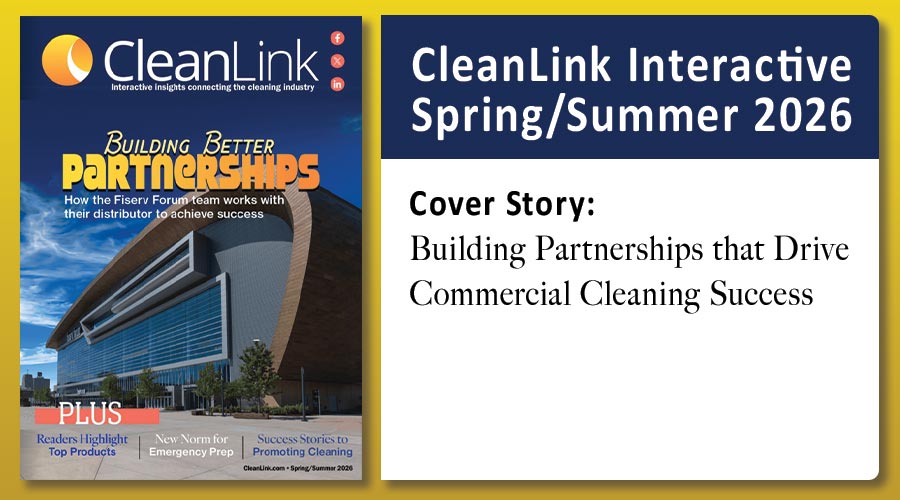
 CleanLink Interactive Spring/Summer 2026 Issue
 Recognizing the 2026 Reader Choice Award Winners
 2026 Emerging Leader Award
 How Surfactant Use is Expanding in Commercial Cleaning
Key Takeaways:
• Optimizing floor pad and brush selection improves commercial cleaning efficiency while reducing total cost of ownership.
• Proper maintenance, employee training, and high-quality consumables deliver greater long-term value than choosing the lowest-cost products.
• Mechanical cleaning technologies are helping facility cleaning management teams reduce chemical use without sacrificing cleaning performance.
Q: Which pad works best with autoscrubbers versus swing machines?
Louis—It’s typically going to be easier to see the pad while using a swing machine, which helps with any pad that wears quickly—like melamine—or needs frequent changes—like a stripping pad, as well as those you would normally only use on a lower speed. However, different applications call for many different processes, so it’s best to research before selecting at random.
Gallagher—The best product selection depends on the floor type, soil conditions, and desired cleaning result. In general, brushes and bristled floor pads outperform traditional pads by delivering better agitation, deeper cleaning, and more consistent results.
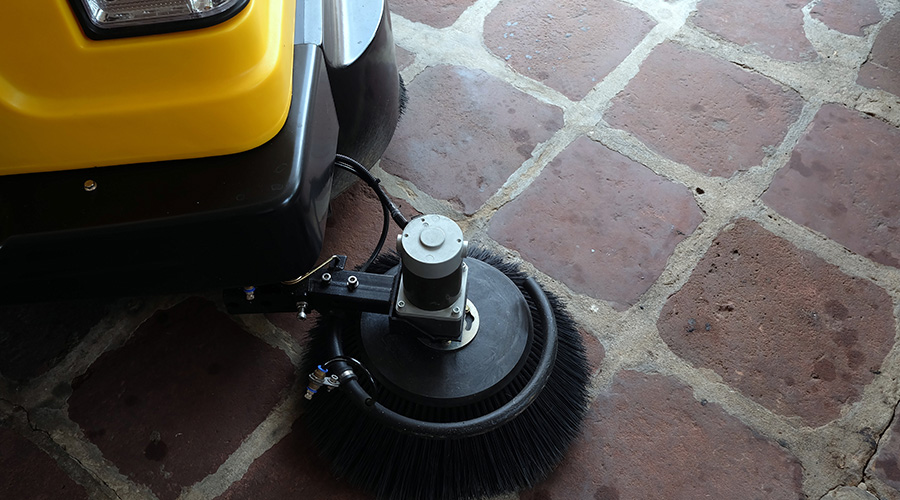
For both autoscrubbers and swing machines, a rotary grit brush or bristled floor pad will typically deliver the best cleaning performance compared to traditional floor pads.
For autoscrubbers, rotary grit brushes and bristled floor pads help maintain consistent cleaning performance over long cleaning cycles because they are self-cleaning and resist loading with dirt and debris.
For swing machines, the bristle action increases floor contact and scrubbing effectiveness, making them ideal for applications that require more aggressive cleaning, restoration, or maintenance of heavily trafficked areas.
Rotary grit brushes and bristled floor pads are designed to provide a deeper level of clean by maintaining more consistent contact with the floor surface. The bristles reach into grout lines, textured surfaces, and floor imperfections where traditional pads may only clean the top surface.
Brushes and bristled floor pads create greater mechanical agitation of water and cleaning chemicals, helping maximize cleaning performance and improve soil removal efficiency. This increased agitation allows cleaning solutions to work more effectively, often reducing the number of passes required to achieve the desired result.
VanBruggen—Personally, I prefer the swing machine for project pads, but the use of a swing machine in vast open spaces such as airports or lobbies can be impractical. In general, I would say that most slow-speed wet pads are going to be somewhat interchangeable between the two technologies. Thin pads should have a thick backer pad placed behind them if used on an autoscrubber. This helps them access low points in the flooring better since they have limited loft.
Q: How often should pads and brushes be changed? Are there signs that indicate a change is needed?
VanBruggen—Knowing when to change a traditional pad can be a challenge. For slow-speed, wet-use pads, I highly recommend inspecting the pad daily. Checking the pad is more than just ensuring it still has life—it ensures that it is going to do the job that day without damaging the floor. If a red pad is clogged with sand particles and has picked up a paper clip along the way, instead of scrubbing with optimized abrasive technology, it'll be scrubbing with sand and a paper clip that day. Checking the pads and rinsing/cleaning them if needed will give the best value of that pad.
For traditional cleaning pads, I generally recommend replacing them once they have reached about half the thickness they were out of the box—usually around a half inch.
Louis—Some pad/brush systems have wear indicators—especially diamond pads or diamond-impregnated pads.However, the best indicator is a trained operator who can visibly see when the performance declines and can either clean or change the pad/brush.
Q: Can pad life be extended without sacrificing performance?
Louis—Absolutely—proper maintenance, rinsing, storage, and equipment selection/operation can significantly extend the life of floor pads and brushes. The true measure of value is not how long a pad lasts, but how much productive cleaning it performs throughout its lifespan. This is one reason many facilities evaluate pads based on total cost of ownership rather than initial purchase price alone, especially when reviewing more expensive pad/brush systems.
Q: How can a cleaning manager lower their annual floor pad and brush costs?
Louis—The greatest cost in floor maintenance is labor, not consumables. By far, the most overlooked question when evaluating a facility is pad selection. In today’s age, a facility cleaning manager cannot just use a red or black pad because it’s what’s been used for the last 40 years. Times are changing, and it’s important to make sure frontline teams are using the correct product and process to reduce labor costs and improve productivity.
VanBruggen—Three things come to mind that will really help reduce the cost of consumables. Hint: None of the three involves purchasing budget products. First, purchase quality products. A quality cleaning pad that also restores gloss is going to last longer, reduce burnishing needs, and extend floor life. Minimizing burnishing, top scrubbing, and stripping will also have a much bigger impact on a facility cleaning manager's bottom line than saving 10-15 percent on floor pads. Second, train employees on proper pad use. Ensure machine settings are optimized, and the appropriate pads are used in the correct places on the correct machines. Third, maximize value by cleaning the pads between uses and know when it is time to flip or pitch them.
Gallagher—Cleaning managers can significantly lower their annual floor care costs by switching from traditional floor pads to bristled floor pads or rotary grit brushes. Replacing disposable floor pads with longer-lasting bristled solutions enables facility cleaning managers to reduce recurring costs while creating a more efficient, repeatable, and productive floor care program. Beyond the consumable spend, labor savings are achieved through less downtime.
Traditional floor pads wear quickly; accumulate dirt, debris, and contaminants; and lose effectiveness over time. As they become saturated, operators must frequently stop to flip, wash out, replace, or change pads to maintain cleaning performance. These interruptions increase labor costs, create downtime, and reduce overall cleaning productivity. Bristled floor pads and rotary grit brushes are self-cleaning, so they continue to perform throughout the cleaning cycle without becoming ineffective—thus allowing teams to clean more square footage in less time.
By comparison, bristled floor pads outlast traditional floor pads by up to 50:1, helping reduce material costs while maintaining consistent cleaning performance. Rotary grit brushes outlast traditional floor pads up to 200:1, delivering even greater longevity and reducing replacement frequency.
The overall operational and financial impact includes:
• Lower annual spending on pads and brushes
• Fewer pad changes and less downtime
• Reduced labor interruption and improved productivity
• Lower inventory requirements and simplified purchasing
• Standardized cleaning processes across facilities
• More predictable and consistent cleaning results
• Improved floor appearance and cleaning performance
• Lower total cost of ownership
Q: Are premium pads worth the higher purchasing price?
Louis—This can vary depending on the customer’s needs/wants. Premium products are going to create a lower cost of ownership despite the higher initial purchase price as long as the proper equipment and training have been provided to the end user. Far too often, I see cutting-edge technology sitting in closets and collecting dust because nobody showed the customer how to use the system properly.
VanBruggen—Yes! The price of the consumable is less than 5 percent of the total cost to maintain a floor.
Q: Can a cleaning manager improve cleaning results without increasing chemical usage?
Gallagher—Yes, cleaning managers can improve cleaning results without increasing chemical usage by switching from traditional floor pads to bristled floor pads or rotary grit brushes. Rather than relying on stronger chemicals or higher chemical concentrations to compensate for cleaning performance, bristled floor pads and grit brushes deliver true mechanical cleaning action. Thousands of bristles maintain consistent contact with the floor surface and reach deeper into grout lines, textured surfaces, and the high and low points of the floor where soil, grease, and debris accumulate.
The bristles also agitate cleaning chemicals more effectively, helping maximize chemical performance and improve soil removal. Since the mechanical action is doing more of the work, facilities can often reduce dependence on aggressive chemicals and use more neutral, lower-toxicity cleaning solutions while still achieving superior cleaning results. This creates measurable operational and cost benefits, including:
• Improved cleaning performance without increasing chemical concentration
• Reduced chemical consumption and overall spend
• Ability to use more neutral, less aggressive cleaning chemicals
• Lower exposure to harsh chemicals for cleaning staff
• More consistent cleaning results across floor types
• Cleaner grout lines and improved floor appearance
• Lower total cost of ownership
By combining mechanical cleaning action with optimized chemical performance, bristled floor pads and rotary grit brushes help facilities clean more effectively while using less chemicals and reducing ongoing operating costs.
Louis—The industry as a whole is looking to do this for many different reasons. The majority of new flooring is a "no-wax” or “low maintenance" floor type, which is drastically reducing floor finish/stripper sales. However, this is opening other avenues that require less chemistry and more mechanical action to clean and maintain those new types of floors.
Q: Are there environmentally preferable or chemical-free floor pad options? How beneficial are they to cleaning managers?
Louis—There are a variety of environmentally preferable floor pads available that can significantly reducethe need for aggressive cleaning chemicals. Technologies such as melamine and diamond-impregnated pads allow facilities to clean effectively using little more than water or a neutral cleaner.
That said, no floor pad completely replaces chemistry in every situation. There will always be applications where chemicals remain an important part of the process. The goal is to use the least amount of chemistry necessary while maximizing the effectiveness of the pad/brush. For many facilities, environmentally preferable floor pads have become less about being "green" and more about improving efficiency, reducing complexity, and lowering the overall cost of maintaining their floors.
Gallagher—Yes—there are chemical-free and environmentally preferable solutions available for maintaining highly polished concrete and cementitious terrazzo floors using only water, eliminating the need for chemical dependency in both restoration and ongoing maintenance. By removing the need for coatings, burnishing, compounds, and recurring stripping and waxing cycles, this system significantly reduces chemical spend and dependency, annual maintenance costs, and labor associated with repeated restoration cycles.
Because the system is chemical-free, it also helps improve facility safety and indoor environmental quality. Eliminating harsh chemicals reduces VOC emissions, which contributes to better indoor air quality, and helps reduce slip-and-fall risks associated with residue buildup from chemical-based floor finishes. The result is a sustainable, cost-efficient floor care approach that delivers long-lasting shine, reduced environmental impact, and simplified day-to-day maintenance.
VanBruggen—In terms of chemical-free or pads that clean with water, yes, there are a few options. Cleaning chemistries have always been intended to aid in the removal of soil. When thinking of a red pad that has limited soil-removing capabilities, cleaning chemistry is intended to provide a boost. With higher-performing cleaning pads that effectively utilize abrasion and the mechanical removal of soil particles, there is less reliance on chemicals. However, be careful when thinking of cleaning versus disinfecting. There is nothing magical about any floor pad that allows it to be more or less effective on a microbiological level. Better floor pads simply do a better job of mechanical removal of soil particles, requiring less use of cleaning chemistries.
Taylor Vraney is the Assistant Editor working on Facility Cleaning Decisions, Sanitary Maintenance, and Contracting Profits magazines. She's also very active in contributing to CleanLink.com. Prior to her time in media, Taylor served as a Special Education teacher, which gives her a strong perspective on custodial operations and its role in creating healthy environments for building occupants.
Taylor currently oversees Sanitary Maintenance's Sales Leaders Award program, which gave her a quick introduction to some of the many outstanding personalities that make up this great industry. At industry events, Taylor got first-hand experience with products and equipment, and even recorded the experience to demonstrate what frontline workers experience daily.
Taylor handles the collection of content for the Cleaning Insider newsletter and facilitates CleanLink's monthly polling questions.
Follow Taylor on LinkedIn here.
Industry Q&A Explores Floor Care Equipment Accessories