
 CleanLink Women of Clean - 2026 Honorees Announced
 CleanLink Interactive Spring/Summer 2026 Issue
 2026 Emerging Leader Award
 Recognizing the 2026 Reader Choice Award Winners

Key Takeaways:
• Using drone technology to clean windows can cut commercial exterior-cleaning costs.
• Drone cleaning technology can improve safety, efficiency, and sustainability in high-rise cleaning.
• Facility cleaning managers considering drone technology should plan for permits, performance metrics, and a hybrid service model.
Since 1910, Kent State University has welcomed over 285,000 students to its campus to support their studies as they grow to become worldwide changemakers. Stepping onto campus can be a celebratory time. Undergraduate students are one step closer to achieving degrees, graduate students are nearing scholarship success, and college faculty can continue developing academic welfare.
For facility cleaning managers, being on campus is less about future accomplishments and more about meeting present needs. The university's facilities team is tasked with creating and maintaining safe and healthy environments for eight Ohio-based campuses, containing 128 buildings, stretched across 953 acres. Like most educational institutions, facility leaders at Kent State University compete with aging infrastructure, varied foot traffic volumes, and constricted budgets.
When challenges arise, opportunities for innovation appear. Such was the case for Doug Pearson, Associate Vice President of Facilities Planning and Operations at Kent State University, who came across a cost-effective solution for exterior maintenance on campus, specifically window cleaning.
"We have a College of Aeronautics and Engineering that is involved in drone research and education," Pearson says. "Drone cleaning was a less expensive method and tied to our academic program. We were eager to demonstrate advanced technology on building maintenance tasks."
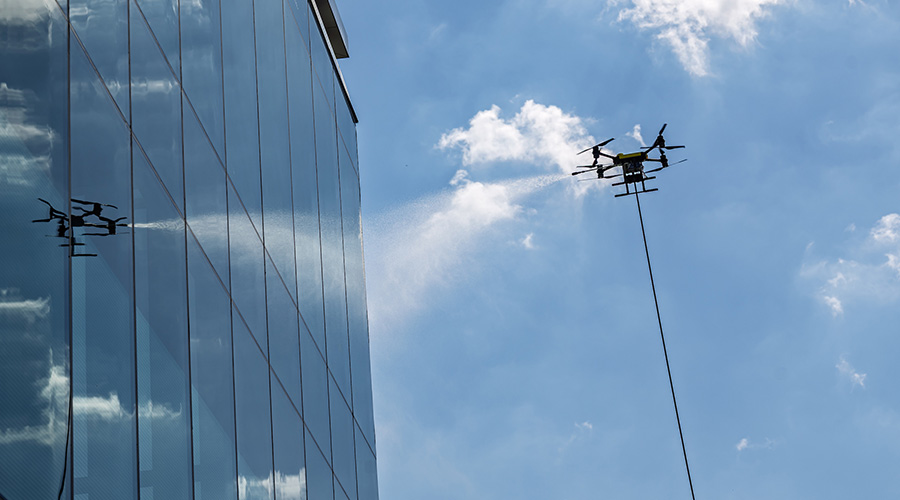
Using drones to clean windows and exterior facades is a technological trend that enhances operational safety and sustainability. Not only does it provide services at high elevations, reducing staff risk and equipment scaffolding, but it can also use fewer chemicals, minimizing runoff and subsequent stormwater system concerns. Rather than replacing workforce needs, drone cleaning can augment traditional exterior and window washing operations.
"Drone cleaning isn't a full replacement for boots-on-the-ground crews; it's a force multiplier for parts of a building that are slow, risky, or expensive to reach with lifts, scaffolding, or rope access," shares David Wheeler, President and CEO of Drone Clean USA. When working with facility management clients, he highlights the value of safety and liability reduction, elevation access, minimal disruptions, and predictable program cadence.
"Cost matters, but it's rarely the only driver," he notes. "Facility managers care that the work gets done without creating a second problem for operations or insurance."
Before contracting drone window cleaning services, Kent State University's in-house staff utilized lifts and ladders to manually clean windows no further than 6 feet off the ground. Pearson outsourced window cleaners for other facility exterior areas, requesting services over the summer when most students were off campus to avoid tenant traffic. Adopting drone cleaning technology not only cut the cost of its window cleaning operations in half, but it also increased operational efficiency, leaving a great first impression.
"With a much lower cost, we were able to clean more windows to improve the campus image and student and staff recruitment," says Pearson. With the time saved on window cleaning, the university's frontline team could address higher-value priority cleaning tasks. As a result, more campus buildings can be cleaned without compromising exterior facility needs.
Kent State University already had a local vendor in mind when it began to evaluate drone cleaning service providers. However, Pearson advises other facility cleaning managers to search extensively for companies that provide drone cleaning services, especially as the demand for drone cleaning grows. Wheeler echoes this sentiment, pointing out the metrics that actually move in-house managers.
"When we pitch, the numbers that stick are hours on-site versus traditional access methods for the same elevation, the amount of permit costs avoided, the reduction of incidents and/or near-miss exposure, closing occupant disruption windows, and recurrence intervals," Wheeler shares. "A hybrid model is our default recommendation for most commercial sites."
Kent State University identified a drone cleaning service provider, but that was only the first step in adopting this service. Next, the university needed to provide permission for the contracted company to operate a drone in its airspace. This is an important consideration for facility cleaning managers, as commercial drone cleaning systems must comply with the Federal Aviation Administration's (FAA) airspace and local permit requirements.
Pearson encourages facility cleaning managers to investigate federal, state, and local ordinances and permissions before employing drone cleaning services. Some states are more permissive with drones than others, meaning drone cleaning technology in one state may be more restricted in another. Property owners and local authorities that have jurisdiction must also provide authorization before a drone can be used in their airspace, requiring facility cleaning managers to seek permissions prior to adopting these services.
Ensuring staff are on board is also key to successful drone cleaning implementation. For Pearson, he received no pushback on contracting the services from his cleaning crew, as drone cleaning didn't disrupt ongoing operations. For other facility cleaning teams, management may need to emphasize how drone cleaning technology makes service delivery safer, reduces chemical exposure and fall risks, and improves worker productivity.
In any case, facility cleaning leaders should consider the industry's rapid adoption of drone cleaning technology and consider how it might supplement their window and exterior cleaning operations. Wheeler predicts the technology will become standard in the same way soft wash and pure-water systems have become common components in commercial exterior cleaning programs.
"Platforms will get better at precision dosing, mapping, and repeatable flight paths; water and chemistry delivery will get more building-specific; and facility managers will start writing drone access into specs the way they write rope access today," he says.
By adapting to changing operational needs and evolving technologies, facility teams, like that of Kent State University, can engage in cleaning that makes the grade.
Taylor Vraney is the Assistant Editor working on Facility Cleaning Decisions, Sanitary Maintenance, and Contracting Profits magazines. She's also very active in contributing to CleanLink.com. Prior to her time in media, Taylor served as a Special Education teacher, which gives her a strong perspective on custodial operations and its role in creating healthy environments for building occupants.
Taylor currently oversees Sanitary Maintenance's Sales Leaders Award program, which gave her a quick introduction to some of the many outstanding personalities that make up this great industry.
Taylor handles the collection of content for the Cleaning Insider newsletter and facilitates CleanLink's monthly polling questions.
Follow Taylor on LinkedIn here.