
 Celebrating BSCAI's 60th Anniversary eBook
 The Down and Dirty on Cleaning in Virus Season
 Industry Report Reveals Burnout Prevalence Among Cleaning Professionals
 How Surfactant Use is Expanding in Commercial Cleaning
 Boost Cleaning Efficiency and Sustainability in Just 40 Minutes


Disinfection in public/commercial facilities is an important component of a complete cleaning and hygiene program. However, it is also one of the murkier concepts to undertake in the commercial cleaning industry. Disinfection requires its own specialized chemistry, tools, and procedures. This can be especially challenging as professional cleaning workers are often asked to do more and do it quicker, often without proper instruction beyond the features and benefits of the chemical they are using.
What facility cleaning managers are seeing isn’t a lack of effort on the part of frontline workers. It’s a lack of clarity. Custodians are often expected to use disinfectants without a clear understanding of when they’re needed, where they should be used, how they work, or what can go wrong when they’re misused or misapplied.
Over time, that can create real problems, like inconsistent results, excessive chemical use, and frustration for everyone involved. Strong cleaning and disinfection programs don’t start with better products. They start with clear expectations, practical training, and a process that supports the people doing the work.
Cleaning and disinfecting are often used interchangeably, but they are not the same task. Cleaning is the process of removing soil, organic matter, and microbes from a surface. Disinfection is a chemical process designed to kill certain pathogens under very specific conditions.
Disinfecting chemicals are regulated products under the U.S. Environmental Protection Agency (EPA) and are considered pesticides under the Federal Insecticide, Rodenticide, and Fungicide Act (FIFRA). For a product to be certified and marketed as a disinfectant, it must be tested in an EPA-approved lab and certified to kill pathogens when used according to the exact directions for dilution, application, and contact time. That registration is reflected on the label as an EPA Registration Number (EPA Reg. No.).
To make this concept practical for a cleaning manager, the objective of a good disinfection program shouldn't be to disinfect everything, everywhere, all the time. The goal should be to match chemistry to the areas of the building with the highest risk of exposure. This means areas where bodily fluids such as vomit, saliva, blood, mucus, urine, and feces are most likely to be present.
In most facilities, that means restrooms and high-touch points. Healthcare facilities, clinics, dental offices, and surgical suites each have their own procedures and requirements, so it’s important to perform due diligence when addressing those specific concerns. As counterintuitive as it may sound, offices, classrooms, and general areas usually don’t require routine disinfection under normal circumstances. This is because, in most cases, those areas deal with dirt, dust, and everyday soils.
Easy Education
One of the biggest challenges in frontline training is the complexity of disinfection science. Product labels are dense. Regulatory language is technical. Marketing tends to oversimplify things. Also, much of the conversation revolves too often around the effectiveness of the chemical.
That’s why simple teaching models are useful. An efficient way to explain disinfection is to make it a three-dimensional process that aligns with what professional cleaning workers experience in the field. A good disinfection process embraces three important elements: chemical, friction, and drying. Think of it as the triangle of kill, with each point of the triangle representing a concept individually.
This is not meant to replace label instructions. It’s meant to help workers understand how disinfection actually works in the real world, where surfaces tend to dry quickly and time is limited.
The first point of the triangle is the chemical.
Disinfectants kill pathogens. Every EPA-registered disinfectant has legally binding instructions for dilution, application, and contact time. EPA-registered labels carry legal weight. In practice, enforcement focuses on manufacturers, but the label still sets a good-faith expectation for facilities to train on and work toward. That contact time—whether it’s 30 seconds or 10 minutes—is how long the surface must stay visibly wet to kill.
In most daily cleaning situations, sprayed surfaces begin to dry within a couple of minutes. In fact, CloroxPro noted in a 2023 study of common disinfection practices that keeping a surface visibly wet for long contact times can be difficult in day-to-day conditions. It’s an important distinction because of the gap between how disinfectants are tested and how cleaning actually occurs. When surfaces dry early, chemistry can’t carry the entire load, and that’s where cleaning technique and friction become essential components, not optional.
When dealing with any chemicals in the workplace, safety data sheets (SDS) and label training matter. Instead of treating SDSs as paperwork, effective programs take the time to put them in workers' hands, so they understand their contents. At the bare minimum, workers should know where sheets are in the event of an emergency, and have a basic understanding of:
- What the product can do to their skin, eyes, or lungs.
- What PPE is required. (Most facilities have their own policies requiring hand and eye protection.)
- What happens if products are mixed—never mix.
- What to do if there’s an exposure.
Frontline workers don’t need to memorize these documents, nor should they be expected to. What they need to understand are the risks associated with products and how to protect themselves. It’s training that should be repeated, offered in the languages workers speak (if possible), and updated when products change in operation.
The second point of the triangle is friction.
Real surfaces aren’t clean when one gets to them. They’re covered in dust, oils, food residue, and invisible films that block disinfectants from doing their job. The Centers for Disease Control and Prevention (CDC) has been clear for years: removing soil is a critical step because organic matter interferes with disinfection.
Friction does more than prep the surface. The act of wiping and scrubbing creates a force that can damage bacteria and viruses on its own. Studies have shown that wiping with a disinfectant is more effective than spraying alone, and that abrasion can reduce microbes even before the chemical finishes its contact time.
Wiping also captures and removes what’s on the surface. Microbes don’t just get smeared around; they’re lifted onto the cloth, mop, or wipe, where residual chemistry often continues to neutralize them. In practice, friction works three ways:
1) Removal and Capture—Lifting soils and microbes off the surface and trapping them.
2) Direct Kill—The mechanical force of wiping and scrubbing can destroy some microbes outright.
3) Exposure—Disrupting soil and biofilm allows chemistry to make full contact with pathogens.
This is why friction matters. It doesn’t replace chemistry, it enhances its effect. Without friction, disinfectant could sit on top of dirt and biofilm, never reaching what it needs to kill. With friction, the surface is cleared, microbes are weakened or destroyed, and chemistry has a direct path to finish the job.
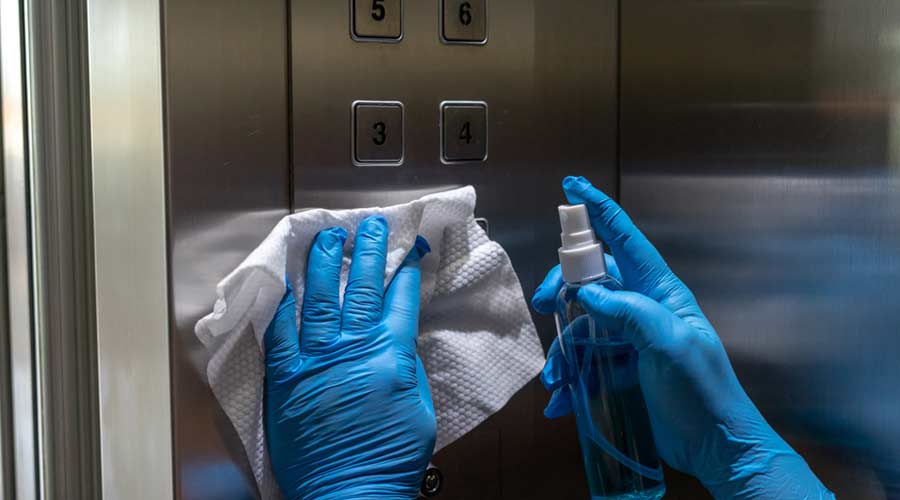
From a training standpoint, this is important. It’s why one should consider using heavy-duty microfiber or cotton cloths. When used properly, they create significant friction on the surface. Workers should know how much pressure to apply, how to fold cloths (don’t bunch) to expose clean sides, and how to avoid spreading soil around. A good friction technique may reduce the need for long dwell times and improve disinfection reliability.
The last point of the triangle is drying, and it’s often overlooked.
Once a surface has been cleaned and disinfected, it should be left to air dry. Dry surfaces are tough environments for microorganisms. Drying removes the moisture many pathogens need to transfer efficiently and reduces the opportunity for spreading, even though some pathogens can still persist on dry surfaces for extended periods. Drying also keeps residues from being picked up by hands or tools and spreading to the next surface. It’s the step that locks in the work that’s already been done. Skip it, and the process isn’t finished.
Teaching workers to let surfaces dry before re-wiping or layering products improves both safety and results.
The Power of Synergy
The strength of the triangle of kill lies in how chemical, friction, and drying amplify one another. Chemistry provides germicidal power; friction exposes and destroys microbes; and drying locks in the result, so nothing survives. Alone, each point helps. Together, they multiply each other’s impact. That’s why best practices matter. The right tools and methods are what make the triangle essential in daily operations. It’s recommended to:
- Use an EPA-registered disinfectant appropriate for the type of operation, and standardize to as few products as possible, to keep training consistent.
- Choose the right wiping tools. Disposable wipes, cotton cloths, or microfiber towels work well to create friction on surfaces. Fold them properly to create multiple clean surfaces.
- On floors, use microfiber flat mops with dual-chambered buckets. One side holds a fresh solution and the other holds a rinse, so dirty water isn’t redeposited.
- In toilets and urinals, stiff-bristle brushes create more friction than bowl swabs.
When chemical, friction, and drying are integrated into these practices, disinfection becomes reliable, repeatable, and defensible.
Safe, effective cleaning programs aren’t built on good chemistry alone. They’re built on good training and clear expectations. When workers understand the products they’re using, have the PPE they need, and know when and how to apply disinfection effectively, everyone benefits. The work becomes safer, more consistent, and easier to defend.
Disinfection doesn’t work because the surface was sprayed. It works when chemistry, friction, and drying come together in a system that respects both science and the people doing the work.
Ben Walker is President of Walker Foundry, a cleaning industry consultancy. A 20-year industry veteran, he writes regularly on the human element of cleaning, elevating custodial operations, and workforce innovation.