
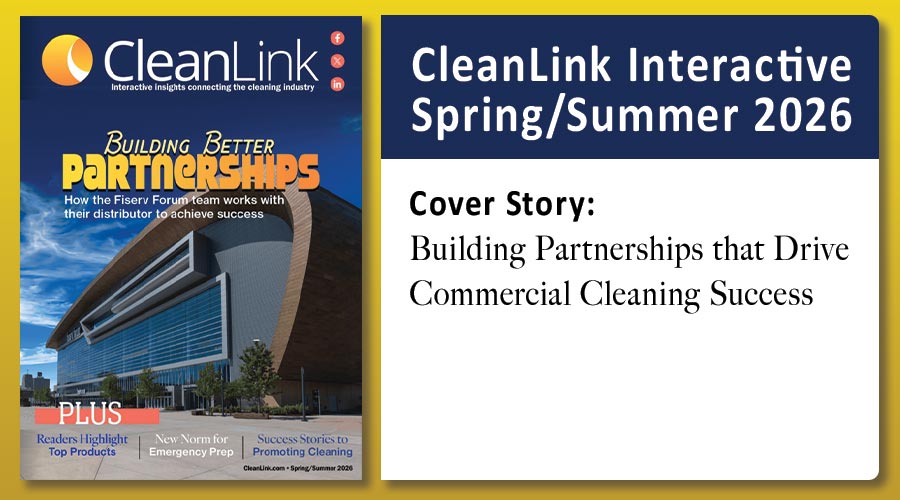
 CleanLink Interactive Spring/Summer 2026 Issue
 Recognizing the 2026 Reader Choice Award Winners
 2026 Emerging Leader Award
 How Surfactant Use is Expanding in Commercial Cleaning

No doubt, EVS staff operate under constant pressure. Patient rooms must be turned over quickly, yet every surface needs to be thoroughly cleaned and disinfected to reduce the risk of cross-contamination. Fortunately, products and technology are continually evolving to address this conundrum.
One advancement is the addition of whole-room UVC disinfection devices as part of an overall cleaning and disinfecting program. These systems use ultraviolet-C light to disinfect hard-to-reach areas and surfaces EVS staff may miss. Many devices can treat a room in 10 to 30 minutes, helping hospitals achieve faster room turnovers without compromising infection prevention efforts. However, experts stress that UVC should only be used as an adjunct to routine cleaning and disinfection, not as a replacement.
To further support the adoption of UVC devices, the Food and Drug Administration (FDA) recently established a new category for whole room microbial reduction devices, classifying them as Class II medical devices. As a result, manufacturers must substantiate microbial reduction claims, giving healthcare facilities professionals confidence in the safety and efficacy of these technologies.
Another product gaining traction in healthcare settings is hypochlorous acid (HOCl). According to Trinks, HOCl is essentially the end product of electrolyzed water and it serves as a powerful disinfectant.
“People are switching to hypochlorous acid because it is less expensive and non-toxic, yet very effective,” he says. “Anything over 500 parts per million is a hospital-grade disinfectant and can kill anything.”
The only downside, according to Trinks, is that the product degrades quickly, which is why he recommends hospitals buy a generator and make HOCl on site. He adds that this is an investment that will pay for itself in shipping costs alone within approximately six months.
Hospitals are also starting to incorporate products into their infection control arsenal that offer continual or long-lasting antimicrobial benefits. These cleaning or surface treatment products claim to kill microbes for extended periods of time.
Gerba conducted a study in which a transparent antimicrobial surface coating was applied to patient rooms and common areas in three units at two urban hospitals. Following the surface application, the total bacterial colony forming units (CFUs) at Hospitals A and B declined by 79 percent and 75 percent, respectively, indicating a significant reduction in HAIs and environmental bioburdens.
While cleaning and disinfecting practices have traditionally focused on high-touch surfaces and equipment, professionals inside healthcare settings are beginning to recognize the importance of airborne pathways in microbial transmission.
“We understand the role of contaminated air more and more,” notes Garrett. “EVS plays a role in that, too, because they’re in these environments for long periods of time. So those daily and terminal cleanings impact transmission, as well."
Trinks echoes this sentiment, emphasizing the importance of maintaining HVAC systems.
“Hospitals are finally catching on that fungus, bacteria, and mold travel through the HVAC system to other patients’ rooms,” he adds, stressing the use of proper filtration.
For most healthcare facilities, Trinks recommends MERV 13 filters, which capture 50 percent of particles between 0.3 and 1 microns. He shares that many hospitals have a filter rating of six or seven, which captures dust and debris but not bacteria.
Invest in EVS
Even the most advanced technologies and products are only effective when used properly and consistently, underscoring the importance of training and retaining qualified EVS staff.
“If I don’t have that person who understands their job, how to do it well, and the why behind it, it doesn’t matter what product I give them,” says Garrett. “I can give them the best disinfectant—one that’s effective against every organism—but if it’s misused, they’re not going to be successful.”
While EVS staff need not be pathogen experts, a basic knowledge of microorganisms and their transmission modes is crucial for choosing the appropriate disinfectant. This knowledge helps ensure cleaning and disinfection practices align with the specific risks in different environments.
Protecting frontline workers themselves also requires targeted education. Industry experts caution healthcare facilities not to overlook the importance of training EVS staff in the proper donning and doffing of personal protective equipment.
“Gloves are a beautiful thing—but you have to know how to put them on correctly, and that’s where training and education comes into play,” says Trinks.
No doubt, investing in EVS workers’ professional development, coupled with recognizing their expertise and fostering open communication, strengthens morale and retention, reinforcing EVS as a vital defense against HAIs.
Kassandra Kania is based out of Charlotte, North Carolina, and is a frequent contributor to Facility Cleaning Decisions
Smarter Cleaning, Better Training, and New Tech Help Fight HAIs