
 CleanLink Interactive Spring/Summer 2026 Issue
 Recognizing the 2026 Reader Choice Award Winners
 2026 Emerging Leader Award
 How Surfactant Use is Expanding in Commercial Cleaning
Key Takeaways:
• Successful facilities leaders build trust first by listening, engaging stakeholders, and understanding the organization's culture before driving change.
• Standardizing processes and communicating the "why" behind changes helps facilities teams become more proactive, equitable, and effective across the district.
• Long-term operational success depends on balancing urgency with relationship-building, increasing the visibility of facilities teams, and learning from a strong professional network.
When Lazell Ofield stepped into the Chief Operating Officer role at Columbia Public Schools, Missouri, a district serving more than 18,000 students across 43 schools, he inherited five major departments: transportation, custodial services, nutrition services, technology, and facilities and construction. He also inherited something that is a bit more difficult to quantify but typical to any existing organizational culture: years of entrenched habits and operational silos. Meanwhile, the district was in the middle of rapid growth, with two elementary school additions underway and a brand-new school on the horizon.
Ofield doesn't hesitate to sum up his first two years on the job succinctly: engaging, standards, and on the move.
Engagement and standards reflect core components of Ofield’s framework for what senior facilities leadership truly demands, especially in districts with many moving parts and exciting initiatives happening.
Lesson 1: Engagement
When Ofield first arrived at Columbia Public Schools, he knew his first charge was to understand how things worked to determine what needed to be fixed over time.
"I came in with an open mind, ready to know. I've got these five departments and I need to learn as much as I can, but still be that advocate and resource for them," Ofield says.
This orientation toward engagement and learning shaped Ofield’s initial months on the job. He facilitated a staff survey to assess how the operations department was perceived from a customer service perspective. He joined principals' meetings to hear directly about building concerns. He also held a leadership retreat with the operations directors to surface their insights and concerns, as well as learn from them.
"The leadership retreat was really like a team-building exercise," he explains. "I wanted to understand the expectations of their department, my expectations of them, and their expectations of me."
Ofield now runs the leadership retreat annually and expands it every other year to include frontline supervisors. This guarantees that the entire leadership team is aligned with the same vision.
“Resist the temptation to arrive with a fixed playbook. The culture, the systems, and the people will teach you what the district needs,” Ofield recommends.
Lesson 2: The Standardization Strategy
When Ofield started, every school within the district handled things in a different way. For example, some allocated a budget to refresh furniture annually, while others didn't. Painting was scheduled reactively, sometimes requiring teachers to vacate classrooms midday, with little continuity on process from building to building. Work orders were handled inconsistently, with no clear expectations for response times or follow-up.
"Is it really sustainable for the entire district if each school is doing something different? How do we standardize our processes so they are reliable, equitable, and consistent across all our facilities?" Ofield asks.
He now builds systems around these questions, from creating standard furniture procurement processes to developing a painting schedule that doesn't disrupt instruction and delivering a work-order process with defined response windows and visible tracking.
Standardization allows facilities teams to shift from being reactive to proactive, and from inequitable to sustainable and reliable.
Lesson 3: Expect Resistance
Every facilities leader knows the moment a change is proposed. The room becomes very quiet. Or someone says, politely but firmly, that they've been doing it this way for years, and it works just fine.
Ofield faces this regularly, and he’s developed a clear approach to handling it.
"I try to understand why they are currently doing what they're doing, whatever the process is, and then help them understand how a change will benefit and be more efficient in the long run," he says. "Those are personal conversations, sitting with them, not forcing my agenda on them, but allowing us to have dialogue so that we both can agree on a path forward."
Ofield's approach acknowledges that change management requires not only big-picture thinking and outlining the vision, but also the ability to engage others to commit to the changes through many small interactions over time.
Lesson 4: Slow Down to Speed Up
Ofield experienced a personal growth moment throughout his first two years on the job. He learned that not everyone moves at his pace, and that’s a good thing.
"I want things to happen yesterday," Ofield says. "But sometimes I get ahead of things, and then I have to take us back, make sure the team understands the goals, and make sure their input is heard. Then we can successfully execute the plan that we come together on."
This can be a common tension for high-energy leaders who step into senior positions within an existing system with its own structures and patterns. The instinct is to move quickly, fix obvious problems, and build momentum. But moving faster than the speed of trust can produce staff resistance, confusion, or disengagement.
Slowing down to build trust and alignment is an important leadership discipline that makes change possible and new ways of operating stick.
Lesson 5: Build Broader Visibility
Ofield describes operations with a phrase he uses often: "We are the hands and the feet of the school district."
Living this looks like being physically present in buildings, doing inspections, talking with principals, and following up in writing when issues are found. It also looks like making sure schools know a request didn't just disappear into a work order queue. Someone saw it, put it on a schedule, and will communicate when it's resolved.
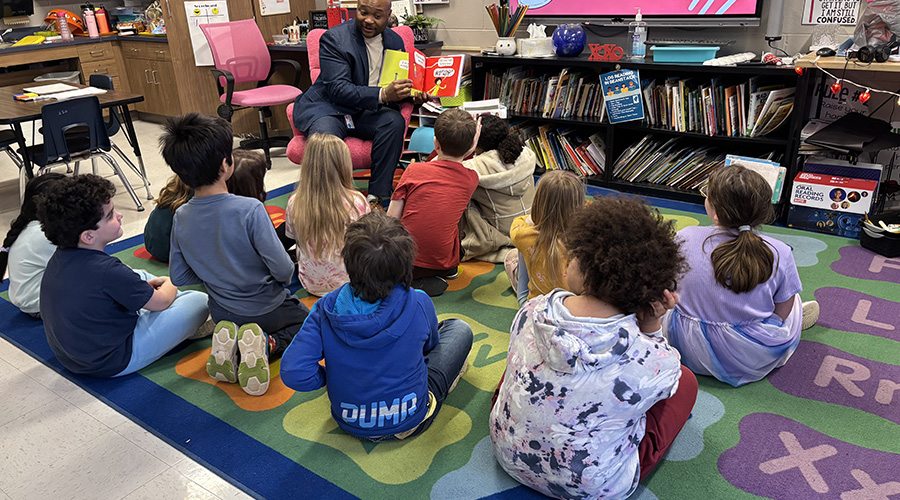
Being the hands and feet of the district also means advocating for Ofield’s departments in ways that build visibility and trust. His monthly read-alouds in elementary classrooms help students understand and appreciate the people who keep their schools running, reflecting a philosophy that the facilities team deserves visibility and respect across the whole community.
His upcoming K-12 Silent Heroes children's book series, Mr. Eli and the Quiet Shine, centered on custodial services, and it reflects Ofield’s creative and innovative approach to building visibility. His book started from the core belief that the people who clean the floors, fix the lights, and keep the buildings safe are educators, too. The least that can be done is to make sure the kids know their names.
Lesson 6: A Growing Network
When asked what he’d tell someone stepping into a senior facilities role in a new district for the first time, Ofield offered the importance of building a network.
“Connect with other industry leaders who have tenure and people you can call when you hit an unfamiliar situation—and who won't make you feel foolish for asking. Surround yourself with people who have been in the field," Ofield advises. "You can bounce questions off them and learn from them."
Two years into the role, Ofield has a new elementary school opening, a 10-year master plan in development, a bond on the horizon for 2027, and a children's book in the publishing pipeline. His feet have continued to be on the move throughout the district. The foundation underneath all of it has been built slowly, deliberately, and through genuine engagement with the people his department serves.
Sara Porter has worked with Healthy Schools Campaign for more than 15 years. She currently serves as director of Healthy Green Schools & Colleges, a program that helps K-12 and higher education institutions identify and implement low- and no-cost measures that improve indoor air quality, among other initiatives. She holds a bachelor’s degree in political science from DePaul University.