
 CleanLink Interactive Spring/Summer 2026 Issue
 Recognizing the 2026 Reader Choice Award Winners
 2026 Emerging Leader Award
 How Surfactant Use is Expanding in Commercial Cleaning
Key Takeaways:
• Commercial cleaning operations must establish rigorous, healthcare-specific training pipelines to equip specialized janitorial crews with critical infection-prevention and disinfection protocols.
• Mandating facility-specific competency assessments can mitigate hiring risks and maintain strict quality control.
• Implement transparent recruitment procedures that clearly communicate mandatory healthcare cleaning needs.
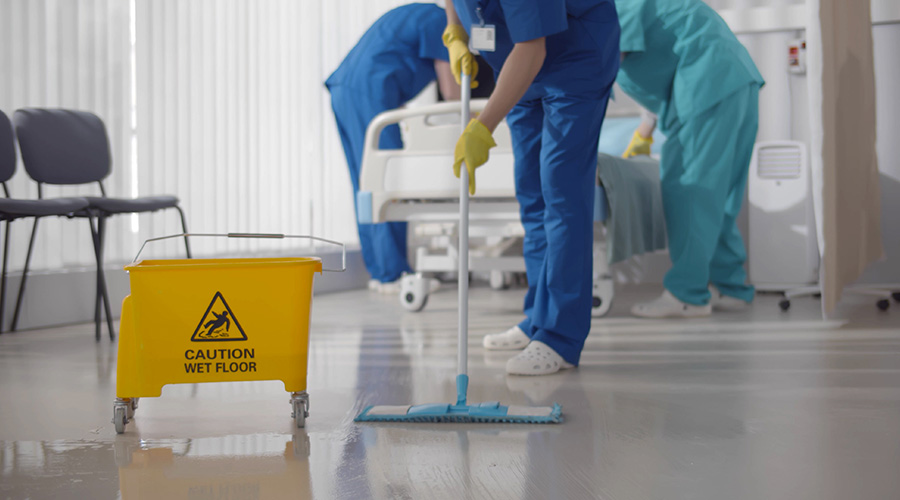
Before cleaning healthcare facilities, janitorial crews need specialized training that goes beyond the skills used in other commercial buildings, preparing them to meet stricter infection-prevention standards and to work alongside clinical staff.
“You can’t just take a cleaner who’s been cleaning offices and put them in a healthcare facility,” says Baran. “You also need to be very selective with who you hire. People need to be detail-oriented and focused on delivering exceptional quality service.”
At Helping Hands Commercial Cleaning, new janitors complete a two-week training program before working independently. During the first week, employees rotate throughout different commercial facilities to learn how cleaning requirements vary. The second week focuses on medical environments, where trainees learn healthcare-specific cleaning and disinfection protocols.
After training, employees must pass a competency test to be cleared for work. The company uses different assessments for different facility types, including one specifically for healthcare that includes bloodborne pathogen testing.
Preparing employees for healthcare work also means setting expectations before they are hired. Jamie Henry, CEO of Bee Line Support, recommends discussing vaccination requirements during the recruitment process so prospective employees understand that many healthcare facilities require immunizations for everyone working onsite. Being transparent about these expectations helps ensure BSCs have a workforce that is ready to serve healthcare clients when needed.
“There might be flu or COVID-19 shots required that people are sometimes resistant to,” Henry says. “Make sure you’re upfront with the people you’re hiring so you already have their willingness once cold and flu season arrive."
In addition to establishing clear hiring expectations, Henry has invested heavily in specialized training for frontline workers and supervisors. The company services ambulatory and non-acute clinics, as well as a 35-bed, critical-access hospital. Managers earn credentials through the Association for the Healthcare Environment (AHE), including the Certified Healthcare Environmental Services Technician (CHEST) designation.
But healthcare certifications do more than strengthen employee knowledge; they also help establish credibility with prospective clients. Henry’s investment in healthcare-specific certifications helped position the company as a medical cleaning specialist.
Bee Line Support has also developed an internal training program for team members who clean surgery centers. The program includes hands-on instruction in the company’s training center, where managers and technicians practice cleaning and disinfection protocols on real medical equipment.
“We built a state-of-the-art training center at our headquarters with a mock exam room, operating room, and restroom,” says Henry. “We thought that would be a great way to show our commitment and have our managers train in a real-life setting.”
The investment in training and certifications has paid off. Today, healthcare facilities account for 60 percent of Bee Line’s client base, and the company continues to expand its footprint nationally.
Small Beginnings
While Bee Line Support now specializes in EVS, the BSC’s first foray into healthcare began with a handful of medical sites in the 2000s. Henry advises other service providers who want to expand into healthcare to start small.
“Get your first office, whether it’s a med spa or an optometrist, just to get your foot in the door.”
As companies gain healthcare experience, new opportunities often follow through referrals and reputation. Bands says her company gradually expanded from medical suites within office buildings to larger medical pavilions as property managers and healthcare clients gained confidence in its capabilities. Likewise, Henry recommends using early healthcare successes to develop case studies and references that support future sales efforts.
BSCs with an established foothold in the medical market recommend leveraging industry associations, conferences, and networking events to build professional relationships and secure new healthcare accounts. Beyond participating in national and international organizations, such as Building Service Contractors Association International (BSCAI) and ISSA, Baran encourages BSCs to become active in local business and professional organizations. For example, she serves on the board of the Elmhurst Chamber of Commerce in Illinois and participates in several networking groups throughout the Chicago area.
Bands suggests attending healthcare-specific events—not only to build professional connections, but to gain a deeper understanding of the healthcare industry’s values and culture. This includes becoming familiar with the terminology commonly used in the field to build credibility and communicate with prospective clients.
“We’re around terms we don’t use in other markets at all,” Bands says. “What does acute mean? What’s ambulatory? Learning the lingo of healthcare is helpful so you can deliver presentations using their terms.”
As healthcare continues its shift from hospitals to outpatient clinics, medical offices, and ambulatory facilities, opportunities for BSCs are expected to grow alongside it. But success in this market requires more than adding healthcare to a company’s list of services. BSCs must build a workforce prepared for the unique demands of healthcare environments and earn clients’ trust through consistent performance and a commitment to infection prevention.
Beyond its growth potential, healthcare offers greater long-term stability than many traditional office accounts. As workplace occupancy continues to fluctuate, outpatient clinics, dental practices, surgery centers, and nursing homes still require routine cleaning and disinfection to protect patients and staff.
“People will always need healthcare,” says Baran. “Traditional office buildings can be affected by remote work, but healthcare facilities still need to be cleaned. That makes those client relationships much more consistent over the long term.”
Kassandra Kania is a freelance writer based in Charlotte, North Carolina, and is a frequent contributor to Contracting Profits.
BSCs are Turning to Healthcare Cleaning to Grow Business