
 CleanLink Interactive Spring/Summer 2026 Issue
 Recognizing the 2026 Reader Choice Award Winners
 2026 Emerging Leader Award
 How Surfactant Use is Expanding in Commercial Cleaning
Key Takeaways:
• Autonomous floor cleaning equipment helps commercial cleaning teams reduce labor, save time, and improve floor care efficiency.
• Battery-powered and IoT-connected cleaning equipment is transforming floor cleaning with greater mobility, smarter maintenance, and improved productivity.
• Adopting new cleaning technology requires management support, employee training, and the right equipment to overcome resistance and maximize ROI.
After restroom care, maintaining floors is probably a commercial cleaning operation’s greatest commitment. Big, busy, and full of mixed materials, floor care can be complicated. It takes time, effort, and multiple tools to get the job done, stretching perpetually understaffed cleaning crews even further.
Innovations do make the job easier. Just moving from mops to an autoscrubber, for example, takes a lot of the time and backbreaking effort out of floor care. Contemporary advancements—autonomous floor equipment, Internet of Things (IoT)-compatible tools, and advances in battery technology—promise to streamline floor care even further. But that’s only if building service contractors (BSCs) can get frontline teams’ buy-in to new technology—and get customers to accept the associated costs.
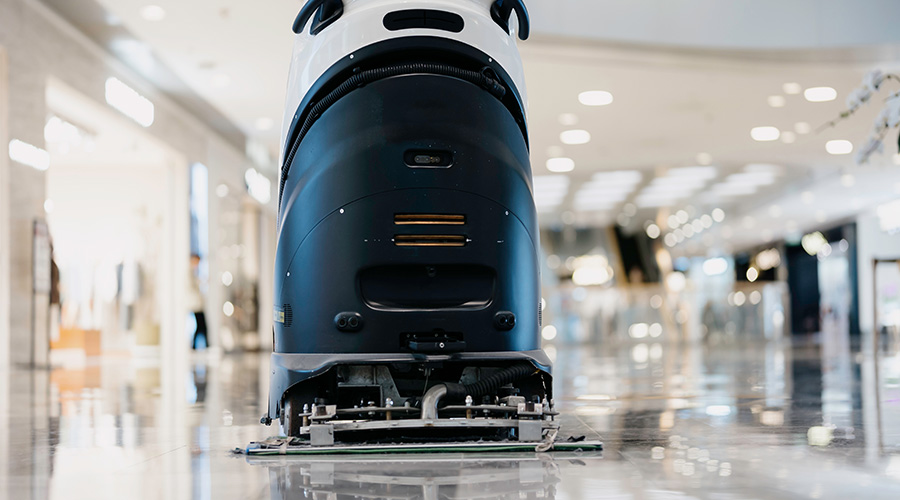
Like it or not, autonomous cleaning equipment is here to stay, with more changes on the way. How does a BSC decide what’s needed, what can stay the same, and when to make the purchase?
The Robot Revolution
The demand for data-driven cleaning systems has evolved alongside the development of artificial intelligence (AI) and autonomous equipment. In fact, 38 percent of BSCs believe that including technology in their contracts will grow in 2026, as affirmed by Contracting Profit's 2026 BSC Market Study. Despite the inevitability of its integration, adoption of autonomous equipment still faces resistance.
“These machines have been offered for nearly 30 years, yet the [commercial cleaning] industry is still debating whether contractors and facilities are ready to accept them,” argues Dave Thompson, Director of Education, Academy of Cleaning Excellence. “That illustrates how slowly the cleaning industry embraces change.”
Much of this pushback comes directly from workers who are afraid of losing their jobs to a machine. Even when the machines in question make the job easier.
“I had a challenge convincing a cleaning crew to give up their mops and wringers for a simple walk-behind autoscrubber,” recalls Keith Schneringer, Senior Director of Marketing Jan/San + Sustainability, Imperial Brady. “They thought the machine would cut their hours, so they resisted.”
That’s a lot of opposition to a now common tool. Yet pain points for the commercial cleaning industry—shrinking budgets, staff shortages, and high turnover—persist. At the same time, floor equipment that promises to ease these stressors continue to advance.
“I attended Interclean in both Shanghi and Amsterdam, and robots were the main focus at both events,” says Bill Griffin, CEO, Cleaning Consultant Services, Inc. “They had restroom cleaning robots with arms that could open a stall door and clean a toilet with a Johnny mop.”
Bleeding-edge innovations like these are a decade or more out from being used in the United States, theorizes Griffin. That makes sense. Look at the autonomous cleaning robots currently on the market. Those used commercially are essentially a simple upgrade to traditional equipment users have known and loved—not a whole lot more. Great technologies are out there and available for those BSCs willing to embrace their benefits.
“Manufacturers have taken cleaning technology that has existed for more than 100 years and adapted it so the machine can navigate without an operator,” says Thompson. “That makes the machine autonomous, but it does not necessarily make the cleaning process innovative.”
Even so, those autonomous cleaning robots make basic floor care less labor-dependent and time-consuming. They’re also becoming more affordable, which is something that has held back industry-wide adoption for a while.
“The first autonomous floor cleaner I saw in 1994 was priced at $100,000," recalls Schneringer. “Now they are between $20,000 to $40,000, while minimum wage continues to rise.”
The rising cost of employment, difficulties finding dependable workers, and increasing affordability of autonomous floor equipment is an interesting combination that has many BSCs asking, “What’s next?” One well-known organization believes autonomous vacuums might be the next big thing.
“Our goal is to stay ahead of industry trends rather than catch up later, which is why autonomous vacuums are the priority for 2027,” reports Darrell Hagan, Director of Technical and Programs, The Carpet and Rug Institute (CRI). “Autonomous vacuums perform differently than standard uprights, so we're building a dedicated protocol rather than reusing the existing standard. The new autonomous vacuum testing protocol will become a new category under our Seal of Approval program.”
When and Why to Buy Autonomous Floor Care Equipment