
 Celebrating BSCAI's 60th Anniversary eBook
 Recognizing the 2026 Reader Choice Award Winners
 2026 Emerging Leader Award
 How Surfactant Use is Expanding in Commercial Cleaning
 Boost Cleaning Efficiency and Sustainability in Just 40 Minutes

Key Takeaways:
-Commercial cleaning teams face unique safety risks because they often work alone in low-visibility areas and during off-hours.
-Traditional jan/san safety protocols do not deliver the quick response required for emergency situations faced in facility environments.
-Workplace safety compliance is becoming a strategic priority for commercial cleaning contractors and facility service providers.
By Kenny Kelley, Founder of Silent Beacon
In the commercial cleaning industry, safety conversations often focus on what guests can see: clean lobbies, well-lit entrances, secure access points, emergency exits, and visible staff presence.
But some of the most important safety risks happen out of sight.
For cleaning professionals, work often takes place behind closed doors, in isolated corridors, restrooms, storage areas, mechanical rooms, and during off-peak hours when fewer people are around. These workers are essential to the guest experience and facility operations, but they’re also often among the least visible employees.
This creates a safety blind spot. The issue isn’t only whether a risk exists; in many cases, it’s also how quickly someone realizes something has gone wrong.
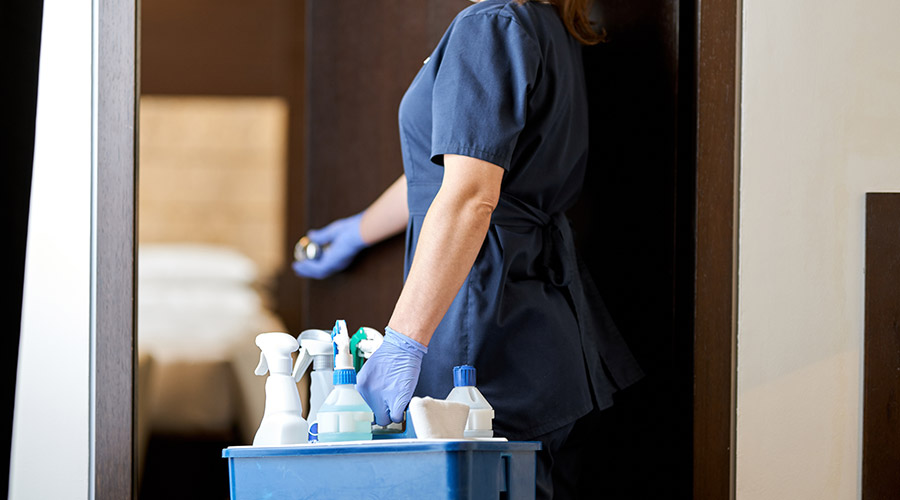
A housekeeper enters a guest’s room alone. A janitorial worker is cleaning a restroom after hours. A facilities employee checks a back-of-house area late at night. Any one of them could slip, become ill, or encounter a threatening individual where no one else is present.
In each of these scenarios, the danger isn’t limited to the incident itself. The real risk is the gap between when something happens and when help is alerted.
Traditional Safety Procedure Limits
Cleaning crews work in unique conditions. They move constantly throughout the property. They enter spaces that may be occupied, partially occupied, or recently vacated. They often work alone or in small teams. They may be on upper floors, in guest rooms, restrooms, parking areas, or back-of-house corridors where there’s limited visibility.
This is especially true for housekeeping staff, who may enter dozens of guest rooms per shift. While most interactions are routine, the nature of the job creates unavoidable uncertainty. A worker may not always know who is inside a room, whether a guest is present, or how a situation may unfold once the door closes.
Janitorial and environmental services teams face similar challenges across other facility types. In schools, hospitals, office buildings, retail centers, government buildings, and large commercial properties, cleaning often happens when buildings are less populated. Early mornings, evenings, overnight shifts, and weekends can increase isolation.
Most safety programs include training, reporting procedures, security protocols, radios, phones, and emergency plans. These are all important, but many of them still rely on one assumption: that an employee can call for help.
A worker may not be able to reach a phone. They might feel safe speaking out loud. They could be injured or disoriented. They may be unsure whether a situation has escalated enough to justify calling security or emergency services. Or they might be in a location where it’s difficult to explain exactly where they are.
Even when help is eventually contacted, the process can involve multiple steps. A worker calls a supervisor. The supervisor calls security. Security tries to determine the location. Someone then decides whether to escalate further.
In a real emergency, time is not a small detail. It is often the factor that determines whether a situation is contained quickly or becomes more serious.
Real-Time Responses
Across hospitality and facilities management, there is a growing shift from prevention-only safety models toward real-time responses. Prevention is still critical. Training, lighting, staffing procedures, guest policies, access control, and security awareness all matter.
But prevention cannot eliminate every risk.
When something goes wrong, cleaning professionals need a way to alert for help quickly, directly, and discreetly, without relying on chance, visibility, or a long chain of communication.
That’s why organizations are evaluating tools like wearable panic button devices, location-enabled emergency systems, and response platforms. These systems are designed to shorten the gap between an incident and a response by simplifying how workers call for help.
When evaluating these tools, employers should look for wearable solutions that are easily accessible and do more than send a basic alert. In an emergency, a worker shouldn’t have to unlock a phone, search for an app, or navigate multiple steps to call for help.
The strongest systems make key safety features available with one press, including the ability to simultaneously notify internal safety or management teams and 911, share the worker’s real-time location, support two-way communication as the situation unfolds, and offer discreet alert options for sensitive situations where drawing attention could heighten the risk.
The value is not just the alert itself—it is what happens after the alert is sent. Who needs help? Where are they? Who has been notified? Is help already on the way?
When safety systems aren’t built for real-time response, those questions consume critical minutes. The right tools help answer them faster, giving workers a clearer path to help and giving managers and responders the information they need to act.
A Proactive Future
In several jurisdictions, emergency response systems like panic buttons and personal security devices are already required to protect hotel employees, particularly housekeeping and room service staff working alone in guest rooms.
New Jersey requires hotel employers with 100 or more guest rooms to provide panic devices to all employees who are assigned to work alone in guest rooms. The law also requires employers to educate employees on how to use the devices, respond promptly when they are activated, maintain records of violent incidents, and protect employees from retaliation for using them.
Washington law requires hotel, motel, retail, security guard, and property services contractor employers with at least one isolated employee to provide those workers with a panic button. The law is especially relevant to cleaning and facility service providers because it covers isolated frontline employees.
California is also a leading state in this broader shift. Its statewide workplace violence prevention requirements now require most employers to establish, implement, and maintain written workplace violence prevention plans. At the local level, cities like Los Angeles have adopted worker protections requiring personal security devices for hotel workers assigned to work alone in guest rooms or restroom facilities.
Illinois has moved in a similar direction through its Hotel and Casino Employee Safety Act, which requires hotels and casinos to adopt anti-sexual harassment policies and provide panic buttons to certain employees.
For commercial cleaning leaders, the message is clear: emergency response is no longer just a best practice. It’s increasingly becoming part of how regulators, employees, unions, insurers, and facility operators define workplace safety.
The underlying issue is the same: when cleaning crews are alone, mobile, or working outside direct view, organizations need to equip them with a reliable way to get help. That makes worker safety more than a compliance concern—it becomes part of daily operations, employee trust, and workforce stability.
Closing the Emergency Response Gap
For hospitality and facility management, improving safety for cleaning teams and staff doesn’t have to involve complicated technology. It starts with a clear review of where response gaps exist.
Leaders should look closely at which employees work alone, where they work, and during what hours. Guest rooms, restrooms, stairwells, parking areas, storage rooms, laundry areas, kitchens, loading docks, and mechanical spaces should all be part of the conversation.
They should also evaluate how workers are expected to call for help. Is a phone always accessible? Is a radio practical in every situation? Can a worker discreetly alert someone without escalating a confrontation? Does the system identify locations quickly enough? Are alerts routed to the right people, or do they depend on someone manually passing the message along?
Training is also essential. Workers should know when and how to use emergency communication tools. Supervisors and security teams should know what happens after an alert is triggered. A safety device or system is only useful if the response plan behind it is clear.
The hospitality and cleaning industries have always been central to health, safety, and facility operations. But protecting these professionals requires more than written policies and general procedures.
It requires thinking honestly about what happens when someone is alone, behind a closed door, out of sight, or unable to call for help the traditional way. That is the safety blind spot commercial cleaning executives can no longer afford to overlook.
The future of workplace safety will be measured by how quickly organizations respond when prevention is not enough.
For cleaning professionals, that response gap is where risk grows. Closing it is not just a technology decision. It’s a commitment to making sure the people who keep facilities running are not left unseen when they need help most.
For additional staff safety guidance, refer to previous reporting here.
Kenny Kelley is the Founder and CEO of Silent Beacon, a workplace safety technology company focused on emergency response and employee protection. Silent Beacon's technology is deployed across facilities and hospitality, healthcare, retail, education, government, social services, and construction industries to provide real-time emergency communication capabilities.
Access Kelley's LinkedIn here.
posted on 6/24/2026
