
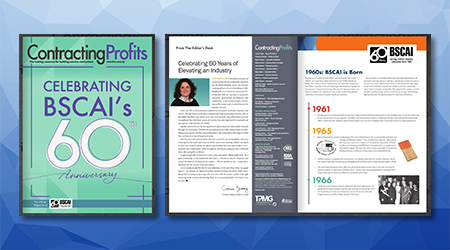
 Celebrating BSCAI's 60th Anniversary eBook
 Recognizing the 2026 Reader Choice Award Winners
 2026 Emerging Leader Award
 How Surfactant Use is Expanding in Commercial Cleaning
 Boost Cleaning Efficiency and Sustainability in Just 40 Minutes
 Case Studies & White Papers
Case studies & white papers for the cleaning professional
Management: Certification Keeps Contractor Focused On Consistency, Improvement
When John Austin, vice president and CFO of Vonachen Services, Inc., and his operations team first heard about the ISSA Cleaning Industry Management Standard (CIMS) case study certification program, the concept sounded familiar.
The Peoria-based janitorial service company had started the process of standardization internally three years earlier in order to remedy the same types of problems that CIMS targets.
“We started standardizing our processes and procedures three years ago because we found that we were having a difficult time providing consistent customer service,” Austin explains. “We were losing clients. The main reason was a lack of consistency. We’d do well for a while, and then slip.”
Austin explains that top management at Vonachen realized the company needed to improve consistency and better document policies and procedures to fix the problems it identified. “We looked at each job and asked ourselves: How should we be doing this? What are the best processes?” he says. “We needed to say ‘Here’s how to train cleaners’ to make sure everyone is on the same page.”
One way of ensuring consistency throughout the organization involved the development and implementation of a facility worksheet. For each job in a given facility, Austin’s team created a worksheet that outlines what should be done on each shift. The worksheet includes easy-to-follow illustrations, written materials and crucial training information.
“The worksheets serve as a maintenance log that shows exactly what has been done in a facility and when it has been done,” Austin says. “It’s a reminder or a checklist for employees, but it is also used by supervisors who can see exactly what their people should be doing.”
So, having just gone through an extensive internal review of the organization’s processes and procedures, CIMS came along at the perfect time. While the Vonachen team was pleased with their own internal scrutiny, they immediately identified CIMS as a key way to prove, via an outside, independent assessment, that they were raising the bar and doing the right things.
“We decided to use CIMS as a way to audit what we were doing,” says company owner Jay Vonachen. And the CIMS process certainly taught them that there was much to learn and additional improvements that needed to be made. In preparing for CIMS, Vonachen discovered that the facility worksheets were not as effective as they could be and some documentation was either incomplete, inaccurate or missing altogether. “We require a workloading plan for each job somewhere on the job site,”Vonachen says. “Through CIMS, we found cases where we didn’t have one, or they were outdated or the people didn’t know where they were.”
“We also found that our environmental policy needed documentation and updating,” says Austin. “We found that we didn’t have it solidly in place, so we spent time putting it together.”
Austin further believes the CIMS process has helped remedy problems the organization had in the past in terms of ensuring the delivery of consistent customer service. “Now when a customer calls and says, ‘Hey, my floors don’t look good,’ we can go back to the facility worksheet and see exactly when the floors were done. If the customer thinks the floors don’t look good despite us keeping to our plans, we can increase our floor cleaning schedule. Or we can see that the floors weren’t done when they should’ve been, and fix that problem. It’s a good way to keep us on track.”
Just because CIMS certification has been achieved, it is certainly not the end of the process, Vonachen notes. He intends to use CIMS to continuously improve his organization. “CIMS will help us conduct annual reviews of our organization,” he says. “Running through the CIMS checklist internally on a yearly basis will serve as a way to make sure the changes we’ve made will stick. CIMS will help us make sure we’re still doing what we’re supposed to be doing.”
Along with being the means by which Vonachen will audit its internal excellence, Austin adds that CIMS certification is also an important marketing tool.
“We are marketing this certification heavily to our customers,” he says. “CIMS is a big deal and it gets people’s attention.”
Given the internal auditing and external marketing value that it presents, Vonachen says his company will definitely renew its CIMS certification in two years. Vonachen also believes CIMS will be a boon for the industry as a whole.
“I think CIMS will become a pre-qualifier for sophisticated bidders in this industry,” he says.
Austin agrees. “CIMS will improve the industry overall. It will be a way to differentiate between companies, highlighting who is doing the right things the right way. From now on, you can’t just get a mop and a bucket and call yourself a cleaner. CIMS provides a higher bar.”